Foodtubes Foodtubes Foodtubes  Foodtubes  Foodtubes Foodtubes Foodtubes  Foodtubes Foodtubes Foodtubes Foodtubes

Global-Warming,   Global-Warming , Global-Warming,  Global-Warming. Global-Warming,   Global-Warming


FOODTUBES – SPONSORING ORGANISATIONS

A global project to reduce CO2 and global-warming.


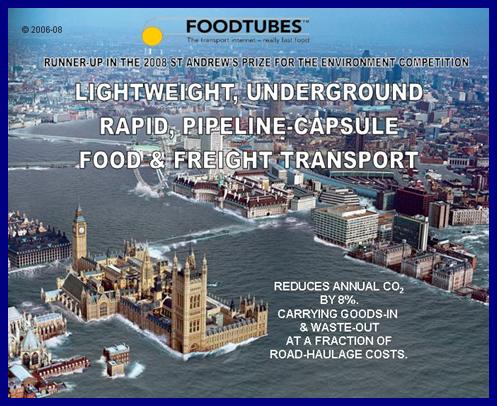
Runner-Up in the 2008 St Andrews Prize for the Environment competition.

Sponsored by CONOCOPhillips


Summary

4 Slides

St Andrews Prize

8 Slides

Croydon Urban & Rural            

41 Slides

March 08   Texas Conference 

EC R&D  proposal          JUN 07

State of the Art 

Proposal Summary


Project Team

What-If?  Interactive Financials

Statistics & Basic Calculations

Targets Calculation

Sponsors

St Andrews Prize Summary

Home Page


LIST OF PARTICIPANTS:


Participant no. *

Participant organisation name

Country

1 (Coordinator)

SW2000 Intelligent Transport (SW2000)

UK

2 Partner

ADVANTICA (British Gas) (ADVAN)

UK

3 Partner

STONER SOFTWARE (STON)

UK

4 Partner

Fundacion Universidad-Empresa de Madrid (FUE)

Spain

5 Partner

SES Construction Software Ltd (SWIFT)

UK

6 Partner

Fraunhofer-Gesellschaft, Institute for Industrial Engineering (IAO)

With  …the Universitiy of Stuttgart; Institute for Human Factors and Technology Management (IAT),
Partner-Institute of FhG-IAO

Germany

7 Partner

Industrial Research Institute for Automation and Measurements (PIAP)

Poland

EXPERT TEAM OF PIPELINE CAPSULE SCIENCE & ENGINEERING

8. Subcontractor

Professor FW Taylor M.A. D.Phil., F.R.A.S., F.R. Met.S., F.R.S.A. (TAYLOR)

UK

9. Subcontractor

Dr. Jonathan Carter, Imperial College, London. Director of Container World Project

UK

10. Subcontractor

J.T. Zaklad Budowy Gazociagow, which develops pipelines for EUROPOLGAS

Poland

11 Subcontractor

Prof. Turkowski, Head of Pipeline Systems studies; Warsaw University of Technology

Poland

12. Subcontractor

Professor Henry Liu, President, Freight Pipeline Company

USA

13. Subcontractor

P. Brink Weaver, President, Pneutrans Systems Limited

Canada

14. Subcontractor

Ms Sarah Hadland, LLB, Director of IPR, Intellectual Property Expert

UK

15

Subcontractor

Mr Alan Foster – CEO of FORCE ENGINEERING LTD. Linear Induction Motors specialist.

UK

16 Subcontractor

Mr Dave Wetzel FRSA FCILT, Transport, Public Finance, Local Government and Sustainable Land Policy Consultant

UK

17 Subcontractor

Mr Don Hughston, Business Development Consultant.

USA


THE TEAM


This is a collegiate Team of experts from major industry, universities, research institutes and SMEs (small & medium enterprises). Each member of the Team is an experienced multi-skilled expert with direct relevance to FOODTUBES. All persons will contribute to the main task – namely, of creating the best possible technical specifications for a world-first pipeline-cargo-capsule mass goods-transit system, which saves substantial energy and can be built and operated profitably. Some technical experts also have management / coordination duties. None of any of the participants’ allotted time is surplus to requirements.


PARTICIPATING INSTITUTIONS


1. ADVANTICA (ADVAN)


FOODTUBES looks to ADVANTICA and STONER to write and create the computer-simulation-model which will incorporate and demonstrate all the research conclusions and design from the FOODTUBES Team.


Advantica was originally formed in the early 1970’s, to operate British Gas’ (BG) extensive R&D and technical programmes, including the development of the bespoke software used by Transco in network management.   Through the purchase in 2001 of Stoner, a US-based technology company, Advantica’s consulting services and bespoke software applications were complemented by Stoner’s market-leading off-the-shelf software products for electricity, natural gas, water and petroleum industries.Advantica’s solutions improve clients’ knowledge of network performance and customer behaviour, providing the foundations for direct improvement of financial performance, operational efficiency, customer service and regulatory compliance.  Leading energy and water delivery companies are working with Advantica to implement integrated solutions, allowing them to rapidly determine, distribute and act on network performance knowledge.  Advantica supplies a wide range of consultancy services to support the planning, design and operation of oil and gas installations from up-stream through transmission, distribution and product utilisation.  This includes the application of advanced engineering expertise, hazard and risk management, integrity management, asset optimisation, legislative compliance, metering and due diligence. 


2. ADVANTICA - STONER SOFTWARE (STON)


Stoner Software are world leaders in pipeline computer simulation modelling. The organisation is a brand name and division of ADVANTICA, which is an international pipeline consulting company established by British Gas.


Stoner Software Products


SynerGEE Software LogoSYNERGEE Network Modelling and Analysis


Model and analyze gas, water and electric distribution systems. Perform steady state, pressure flow simulation of single-or multi-pressure level networks.

Stoner Pipeline SimulatorSTONER PIPELINE SIMULATOR


Simulate transient flow of gas and liquid transmission systems. Manage pipeline scenarios including control system analysis, equipment performance, pressure flow.


*******************


3. CONTAINER WORLD – FOODTUBES EXPERT SUBCONTRACTOR - DR. CARTER


A major factor in the proposed FOODTUBES system is the algorithms that are used to route cargo-capsules from place to place. FOODTUBES looks to Dr Carter to lead research on this aspect of the design.


CONTAINER WORLD


The Container World Project is a three year research project funded jointly by the UK Government and some of the major companies involved in containerised transport. The aim of the project is to improve strategic modelling of the container transport system both within the UK and internationally. We have developed two models: the International Trade Model, and the UK Distribution Model. Between then it is possible to simulate the flows of containers between their country of origin and a UK postcode, all within the international context of the container industry. Users can define their own "what-if" scenarios for the future of the container transport industry and simulate the response of the industry.


Imperial College London's Container World project is using computer modelling to simulate the UK Container Business. Government and commercial enterprises will be provided with a flexible tool that can easily be adapted to address their own strategic questions, whether concerned with planning, investment or legislation. No such holistic capability exists at present for the container business in the UK, or overseas.


*************


4. FRAUNHOFER-GESELLSCHAFT (IAO)


ISI


The Fraunhofer-Gesellschaft undertakes applied research of direct utility to private and public enterprise and of wide benefit to society.


Our Customers:

Industry

Service sector

Public administration

Facts and Figures at a Glance:

56 Fraunhofer Institutes in Germany

at 40 different locations

12 500 number of employees

1,2 Mrd € annual research budget totaling

Roughly 2/3 of this sum is generated through contract research on behalf of industry and publicly funded research projects

Research centers and representative offices:

Europe

USA

Asia


Fraunhofer-Gesellschaft is also active on an international level: Affiliated research centers and representative offices provide contact with the regions of greatest importance to present and future scientific progress and economic development.


The FRAUNHOFER - FOODTUBES pipeline research connection.


About 70 per cent of the costs of water consumption have to be spent on the financing and maintenance of pipelines. The researchers at the Fraunhofer Institute for Systems and Innovation Research, ISI, Karlsruhe, reckon with a total investment demand of between 5 and 8 billion € per year over the next ten years for building, modernising and renovating sewage treatment plants and sewers. Repair and maintenance expenses are continuously increasing; pipelines are ageing in many cities and especially in rural areas: "Water pipes have about the same lifespan as a person, and the older they get, the more preventive care and maintenance they need", says Prof. Karl-Ulrich Rudolph from the Institute for Environmental Technology and Management of the University of Witten/Herdecke


Pipelines / Freshwater and Sewage Pipes


Approximately 3 millions kilometers of oil and gas pipelines span the world. Due to the growing energy needs, this length increases annually by 25 000 km. Compared to tankers, the pipelines are the safest and most economical way of transporting large quantities of oil and/or natural gas, though the installation costs are fairly high (500,000 to 1 million Euro per km, depending on terrain, depth, etc.)


Today, the pipelines are mostly made of high-tensile ductile steel with yield strength 600 to 800 megapascal (MPa). Because of internal pressure, they can be operated with mechanical stress up to 80 percent of the specified minimal yield strength. It is expected that pipelines can carry these loads without any threat to their integrity. However, the pipelines are exposed to mechanical damaging of the coating, corrosion and corrosion-induced cracks which may lead to their failure.


***************


5. FREIGHT PIPELINE COMPANY – FOODTUBES SUBCONTRACTOR - PROF HENRY LIU


This company and its founder Professor Henry Liu can claim to be one of the world’s the most experienced practical researcher in the pipeline capsule field. FOODTUBES looks to them to provide many innovative solutions to the FOODTUBES designs.


Capsule Pipelines & Underground Freight Transportation


Capsule pipeline is a new pipeline technology that can transport freight such as coal and other minerals, solid waste including hazardous waste, grain and other agricultural products, mail and parcels, and many other products. By using large capsules running through large-diameter pipes, conduits or tunnels, cargoes on pallets or in boxes, crates and bags or even in standard size containers can be transported underground by this new technology.


Advantages of Capsule Pipelines


The pipeline is underground and environmentally friendly, safe, reliable, energy efficient and weatherproof. Use of such underground pipelines to transport freight not only reduces freight transportation cost but also reduces the number of trucks on highways and streets, and freight trains crisscrossing the nation. Consequently, there will be less traffic congestion on highways and streets, fewer accidents caused by trucks and freight trains, and less damage to highway and rail infrastructures and hence reduced infrastructure maintenance cost. As compared to truck, train, airplane and boats, underground capsule pipeline is also the most reliable and secure means of freight transport, very difficult to inflict serious damage by terrorists, and impossible to be used by terrorists as projectiles or bombs to destroy other targets as experienced by the World Trade Center tragedy. Finally, because pipelines are built by private companies, there will be no increase in tax to the average citizen for implementing capsule pipelines commercially. It is a new technology that will create new jobs and revolutionize freight transport in the 21st century.


There are three general types of capsule pipelines: pneumatic capsule pipeline (PCP), hydraulic capsule pipeline (HCP), and coal log pipeline (CLP).


Pneumatic capsule pipeline (PCP) uses wheeled capsules (vehicles) to carry cargoes through a pipeline filled with air. The air is used to push the capsules through the pipeline. For a PCP of 3-foot diameter, each capsule can carry about two tons of cargo, traveling at 25 mph approximately. Because the capsules travel at 25 mph non-stop, they move at approximately the same daily average speed of trucks in rural areas, and much faster than trucks in cities. High-value products, such as mail and parcel, can be transported by PCP. The system is best suited for underground freight transport in large city – see News in this website about the completion of the feasibility study on using PCP in New York City.


Hydraulic capsule pipeline (HCP) uses unwheeled capsules (water-tight cylindrical containers) to transport cargoes through a water-filled pipeline. The water is used to float and push the capsules through the pipeline. HCP travels at 6 to 10 feet per second in pipe which is much slower than PCP. However, HCP can transport several times more freight than can PCP of the same diameter. It also uses less energy than PCP, and is more economical. Consequently, HCP is more suitable for transporting bulk materials such as grain and other agricultural products, and minerals.


Hydraulic Capsule Pipeline tested at University of Missouri - Columbia in 2001.


Pneumatic capsule pipeline wheeled capsule utilized in Japan.


Coal log pipeline (CLP) is a special type of HCP in which the capsules are in the form of compacted coal that can be in direct contact with water and the pipe. Because no containers are needed for CLP, there is no need for a separate pipeline to return empty containers, as would be required for HCP and PCP. CLP is the most cost-effective type of capsule pipeline. However, its use is limited to coal and a few other minerals and solid waste materials which, like coal, can be compacted into water-resistant and wear-resistant logs

MU’s Contribution and Research in Capsule Pipelines


During the period 1991-200, Dr. Henry Liu, Director of Capsule Pipeline Research Center (CPRC),University of Missouri-Columbia (MU) and his colleagues invented the coal log pipeline (CLP) technology, and also invented special pumps and injection systems for HCP and PCP, such as an electromagnetic pump based on the principle of linear induction motor (LIM). For MU's contribution and accomplishment in capsule pipeline, in 1991 the National Science Foundation established a research center on capsule pipelines—the Capsule Pipeline Research Center (CPRC), which was Missouri's only NSF Center and the nation's only pipeline research center. Since 1991, CPRC received over six million dollars of funds from various government agencies and private companies. This has resulted in extensive research and development in capsule pipelines, bringing all three types of capsule pipeline close to commercial use. An HCP/CLP pilot plant was constructed and tested on MU's Holstein Farm t