The sentient universe. TOE Theory of
Everything, TOE, Dark Matter, Dark Energy, Instantons, QED, Quarks, Universal
Fractals, Universal Theory, Universe, an alternative to String Theory, Hubble
Expansion, Gravity, Fundamental Forces, Not String Theory, spinning straw into
gold, matter from energy, forming surfaces, double-slit experiment, prime
matter, prime numbers, QED, DNA transmission.
New Model of the Universe – V7 – copyright
–
<a
href="http://www.tinycounter.com" target="_blank" title="counter"><img
border="0" alt="counter"
src="http://mycounter.tinycounter.com/index.php?user=noelhodson"></a>
Short, pictorial, overview of these speculations
http://www.noelhodson.com/index_files/Life-Universe-Everything-8Mar2011.pdf
Updated
22
December 2015
PRESESENCE & ABSENCE
Higgs Bosons & Vacuums.
Look for the presence of
matter
AND for the absence of
energy.
TOE Theory of
Everything TOE
EIG Expansion is
Gravity
&
The
sentient universe
Email:
CLICK
for TOE Archives, articles and work notes
Home Page - http://www.noelhodson.com
CONTENTS
GRAVITY - A NEW THEORY - Monday, 9 March 2015
CASIMIR-GRAVITY. THE CASE FOR CASIMIR IS GROWING – 16 DEC
14
More on Gravity 4 – 26 Apr 14.
GRAVITY - IS IT AS SIMPLE AS CASIMIR?
Meet the
electric life forms that live on pure energy
Fusion, Gravity, Inertia, Lifeforce 21 Jan 2013.
FUSION, GRAVITY, INERTIA, LIFEFORCE.
BIG-BANGS,
AND GENTLE, SENTIENT FORCES – THE FIFTH FUNDAMENTAL FORCE:
HIGGS AND BABIES – 9 Sept 2013.
THE LIGHT FANTASTIC – 20 MAY 2013
Massless
particles contribute rest mass and invariant mass to systems [edit]
IN MY 70TH YEAR – SO FAR, HOW DO I THINK THE
UNIVERSE WORKS?
What this website discusses – an executive summary.
Expansion is Gravity - 2007 – the EIG model
RECORD
RECORDS - DNA PACKS IN DATA.
FUSION,
GRAVITY, INERTIA, LIFEFORCE.
BIG-BANGS,
AND GENTLE, SENTIENT FORCES – THE FIFTH FUNDAMENTAL FORCE:
MORE ON BIRTH, EXISTENCE, LIFE AND DEATH.
11th
July 2012 The Higgs Boson & Higgs Field – The Aether.
23 FEB
2012 To Melvyn Bragg BBC 4 discussion - Conductors & semiconductors.
4 January
2012 – Structure of the universe - Aether-Matrix & Pauli.
3 DEC
2011 – A short, horrified anthropological diversion.
3 AUGUST
2011 – Music of the spheres – structure of the universe.
26 JUNE
2011 – Photon Aether, solves spooky action at a distance.
9 May
2011 – Heretical physics.
4
February 2011 – From physics to metaphysics and metaphors.
RYDBERG’S CONSTANT – IDIOT’S GUIDE
22 Jan
2011 – Spinning on their axis?.
18 Jan
2011 – Immortality & the Power of Inertia
26
October 2010 – White Holes & Sinks
24 October
2010 – Alpha, Aether and Inertia.
10 Sept
2010 - How Many Photons make you? What is your sphere of influence? Click the link…
http://www.noelhodson.com/index_files/Creatures-of-Light-SEPT-2010-V1.xls
12 April
2010 – Quarks – Rest Mass – Protons – Neutrons – EIG still works, OK !
BROOKHAVEN - ECHO OF EIG’s VORTICES
22
February 2010 – Quark-Gluon plasma forms vortices.
NOT NEARLY THERE – QUESTIONS TO EXPLORE?
25
January 2010 – Bouncing photons and constant in-falling.
1 DEC 09
– The Electric Universe - A dilemma:
The Electric Universe by Wallace Thornhill &
David Talbot - 3 Nov 09.
Heavyweight empty space. 28 Sept 09.
Is the Casimir-Vacuum gravity? – 20 August 09.
Melvyn Bragg & Co - vacuums or not? – 30 Apr
09
“Ooops” Change to the expansion of the universe
constant – 11 March 09
“Spooky” action at a distance – 21 Feb. 09
“All the
world’s a hologram” – 17 Jan 09 & 19 Jan 09.
Three
illuminated thoughts - 2 November 08.
Wikipedia
- Massless particles
The LHC
and a contradiction - 12 September 08.
The
sentient universe and how humans alter it. 15 July 08
Is this the EUREKA moment? 28 March 2008.
Frank Close, The Void & that pesky Aether –
18 January 2008
Particles or Waves – 24 March 2007
(An unpublished) Letter to New Scientist –
“Inflation” 1 March 2007
Dark Energy – Cosmological Constant –
Quintessence – 15th February 07
Reconciliation – mathematical task – 25th
September 06
Aether or Ether or neither – 12th
September 06
Bubbles & Black Holes – 24th July
06
Making dark matter – 15th July 06
Water is the most likely laboratory to test EIG -
10th April 06
Descriptive Essay on EIG – how it might work
Gravitational Repulsion at Long Range – Stephen
Battersby NS 24th Sept 05
7 DEC 05
– A diversion into Intelligent Design & Is the LIFE FORCE the 5th
fundamental energy?
Instanton – reproduced from New Scientist 6
August 2005.
The holographic universe – thoughts on the
Aether.
Memo on March 05 Scientific American article,
Misconceptions about the Big Bang. - 17 March 05
Memo on the double-slit experiment – 15 March 05
Memo on Matter and Anti-Matter – 25th
November 04
Note on the Music of the Primes – 27 October 04
MAP, COBE
and Some Astronomical EIG Numbers
Six foot
man expands infinitely – says MAP and COBE
Sloan
Digital Sky Survey (SDSS)
Radio and
TV signals – permanent patterns in Space - inertia
Casimir
and EIG – gravity within dense matter.
Letters to science magazines (not published)
updated Tuesday 22nd DEC 2015 2015
GRAVITY - A NEW
THEORY
GRAVITY – HOW IT WORKS.
Noel
Hodson, Oxford. 8 Mar 15.

Gravity is the relative absence or reduction of the pressure of
the radiation that fills the universal ocean of radiation, which is from 13.7
to 43.7 billion-light-years deep. Contemplate "The ever tightening knot of
gravity, ultimately resulting in black-holes" and "Counter-intuitively,
the centre of the Sun is very dark" because the centre is most
"shaded" or protected from or excludes the universal radiation. The
external radiation is the PUSH and the internal partial absence of radiation is
the PULL of gravity. NCH March 2015
17 DEC 2015: This month, there is a surfeit of media
coverage about space travel - presumably its an anniversary of the first manned
space-station or moon-landing. It includes films of men doing space-walks,
extra-vehicular-activity, floating in black space not very far above the Earth.
Also, I watched THE HIDDEN UNIVERSE on IMAX at The Science Museum, London -
which wonderfully illustrates the inconceivable immensity of the observable
universe. There are thousands of billions of galaxies, each with thousands of
billions of stars, each star having planets - needing so many noughts that most
of us - who have difficulty assessing numbers over 7 of people standing at a
bus-stop - cannot conceive of the numbers. All these gravitational objects are
in turn made from trillions of trillions photons, which are whorls in all the
wavelengths that occupy the entire electromagnetic spectrum, which we refer to
as "light". It is the pressure of this light that causes
gravity.
Analogy - We all know that a sail on a yacht fills with wind (concave), tugs on
the mast and drags the boat across the water. What we think less about is that
on the convex side of the sail, the pressure of air has to be lower. If both
sides are the same pressure, the boat won't move - it will have flat sails. In
this theory of gravity, the convex side is in "shadow" from the push
of the wind. The shadow is the pull. This is equally valid for light.
We now know that sunlight, for example, has mass and can propel objects. In the
universe, far out in deep space, the light from all galaxies acts equally on
all objects or things. There is little or no "shadow" and the object
is defined as free-floating. This equal pressure of light eventually makes all
objects into globes. It is also a force that pushes all objects away from each
other (dark energy?). Other forces pull them back together.
If I were a brave space-walking astronaut, in say, geosynchronous Earth orbit,
about 33,000 km above the surface and orbiting at about 11,000 kph (staying above
the same spot on Earth), I would be free-floating and, with a slight shove, I
might fly off into deep-space, never to be seen again. The gravitational pull
between me and the Earth would be very small. I would have to get very much
closer to Earth before its gravity would "grab" me and condemn me to
re-entry and being burned to a cinder by air friction. What is actually
happening here?
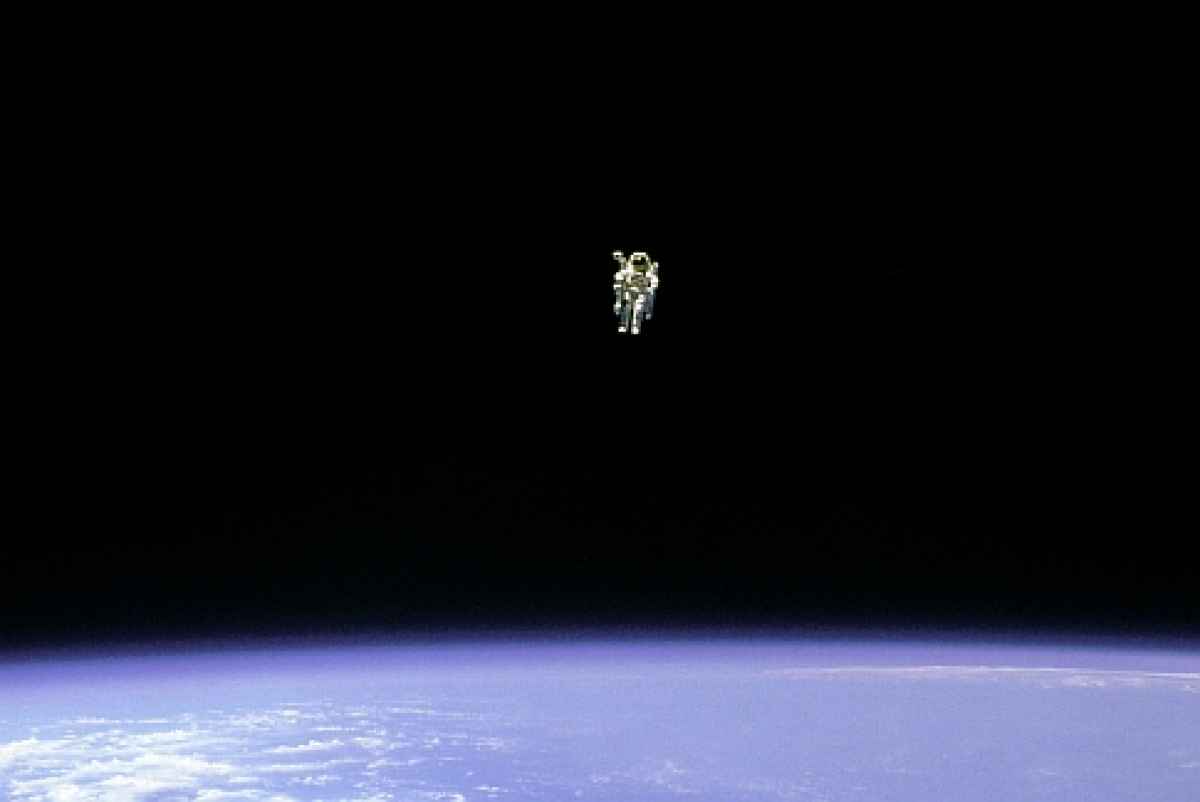
My theory is that out in deep-space,
I am surrounded equally by the pressure of the ocean of light, which is the
stuff of the universe. Nowhere, except perhaps in black-holes, is without these
waves and particles, which impinge on my surface and in which I
"float". I have very little electromagnetic shadow. Left
floating for a few million millennia, the equal pressure would make me
globular.
As I move closer to the Earth, the light, which travels in straight lines
(curved space and multitudinous complex reflections and refraction excepted) is
intercepted by the bulk of the planet (line-of-sight-transmission) and part of
the spectrum of wavelengths between me and Earth is diminished. On my
deep-space side (concave) I am subject to the universal-ocean-of-light-pressure
(43.7 billion light years deep) while on my Earth side (convex) there is
relative electromagnetic shadow following the vertical lines of force to the
centre of gravity. Some wavelengths are excluded (Casimir) and I start to
"fall" to Earth. The planet is a conglomerate of matter, say atoms or
molecules, which also have a light and dark side. The dark side is in shadow
which excludes some wavelengths, and the deeper we look into the Earth, the
darker the shadow of each particle becomes. The globe, formed by the equal
pressure from the 43.7 billion light years deep ocean, is tending to become a
black-hole; whose nearly infinite density mirrors the nearly infinite pressure
of the universal light. All things, all objects in the universe are potential
black-holes, or gravity sinks.
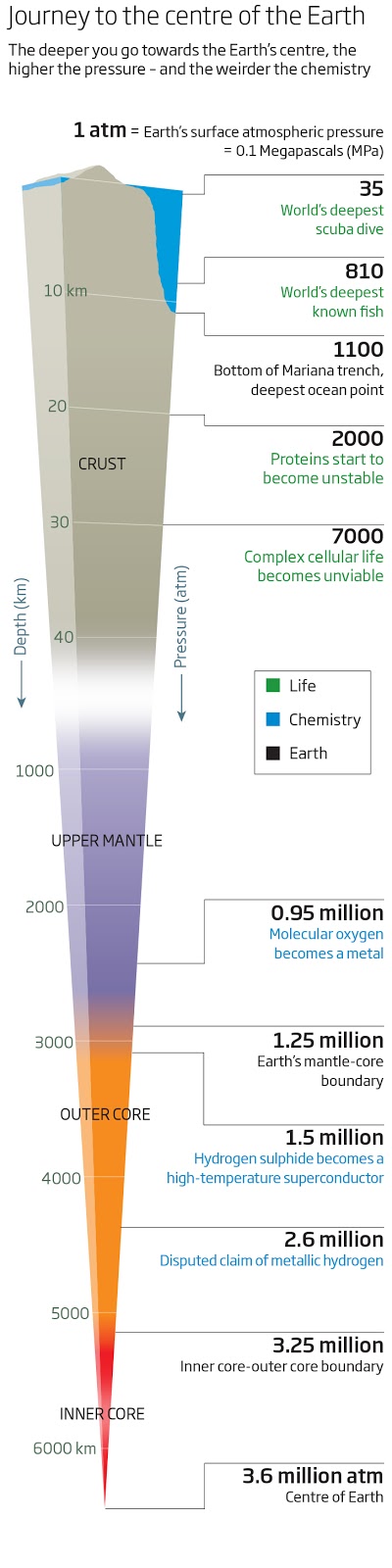
Centre of Earth to the surface (radius) is 6,371 kilometers (3,959 mi) :
A person weighing 62.5 kilograms on the surface, who moves 19,013 kilometres
from the surface (4 radii from the planet's centre) will weigh the equivalent
of 7
kilograms (science converts this weight into units of 39 Newtons (one Newton is the weight of a small
apple - Yes, really). His or her MASS doesn't change, but our Earth weight is
mass x distance from the center of Earth x change of speed. (or substitute
Moon, Mars, other planet etc). So, at only 7kg, a small push will send the
space-walker into deep space - probably never to be seen again. I guess that
although the space-walker is relatively near the huge Earth, he is now
surrounded by and separated from the planet by most of the universal
electromagnetic spectrum of waves (light); which now press in on him from all
directions.
http://www.astronomynotes.com/gravappl/s5.htm -
Finally, for this note, the lines of force towards the centre of the Earth from
deep-space come in straight lines. They are all "vertical" to the
centre of gravity of the planet. As I race at 11,000 km per hour at an angle
(orbit) through these invisible lines of force, I will experience G-Forces or
inertia. Let's remove the hot-air which would burn me up, and say do this on
the airless Moon at 17% of Earth gravity; because I am defying nature and
orbiting through the lines of force, I experience the universal inertia of the
ocean of light, which in-tends, in straight lines, to the centre of gravity of
the Moon. However, Newton's laws about the force changing by the square of
distance (very feeble even at short distances) allows me to live at the
required orbital speed - the inertia I feel is very slight. If I speed up a
million times, in the same orbit, my defiance of the vertical lines of force
will give me great discomfort, probably dismemberment - unless, which is most
likely, I spin away from the gravitational body and its lines of force (light)
making for its centre.
26 November 2015. INERTIA - Does it fit with this theory?
I was recently struck by reports of fighter pilots, astronauts and
Wall-of-Death riders experiencing G-forces, as they accelerate, decelerate and
take curves and bends. The G-force stress on humans caused by such manoeuvres
mostly occur within the Earth's atmosphere and gravitational field; both of
which are hardly detectable a few miles up from the surface. Leave the planet's
gravity and you all but escape the G-force. We primates, water based life-forms,
inside our thin skins, creatures formed by and in Earth's gravity, intuitively
understand G-force and its companion, the Center of Gravity. Simply swinging
ourselves at the end of a rope tied to a high branch, informs us that
countering the direct vertical downward pull of gravity, even slightly off 90
degrees, requires much energy. The most stable stance using least energy is to
stay on one spot on the surface and stand straight - that is to stand at 90
degrees to the planet's center of gravity. Or, to adopt our most natural stance
and shape as a sphere resting on the surface.
Giant Californian Redwoods do the vertical stance very well. Our
tall buildings also stand straight - one brick precisely and directly above the
other (Pisa excepted). When we playful humans defy the straight up and down
force; when we swing at an angle through the gravity field - we could be, and I
suspect we are, crossing the columns of light (waves, particles or wavicles, as
you like) that press down on every square centimeter of surface, the pressure
from the light of the observable universe, and are also pulled in equally
straight vertical lines, by the partial vacuum, caused by the dark side of
light, beneath our feet, down to the center of the Earth. This is "the relentless
ever tightening knot of gravity" that ultimately creates black holes.
These precisely vertical columns of dynamic light-force, above and below us
manifest in an organised field - like infinitely long straws - the energy and
inertia of which we and our machines challenge when we go for the G-force. Few,
if any machines rise exactly vertically from the surface, but even if they do,
they have to counter the ever in-falling light from above and the ever suicidal
urge of every particle, every thing, to follow its shadow and reach the dark
(less light pressure) center below. QED
17 September 2015: TESTING, TESTING, TESTING. IF there is any merit in this
idea of the mass of the universal ocean of light causing gravity - then it
should be possible, by applying the Laws of Gravity and working from known
gravitational masses - The Earth for example - to measure the depth of the
ocean and thus the size of the universe. For example: if Black Holes are
thought to have infinite gravity, then the pressure of the ocean of light which
causes the Black Holes is likely to also be infinite. At the other end of the
scale, a tiny atomic or sub-atomic particle will always be surrounded by and
subject to the ocean of light, pressing equally on its circumference, casting
little or no gravitational "shadow" and will thus have hardly any
discernible mass. I am daily increasingly inclined to believe that this idea
does have merit.
A SHORT SUMMARY OF HOW GRAVITY WORKS AND WHAT IT IS:
20 July 2015. - What you need to believe or know the science of
to grasp this novel theory.
Firstly, that the stuff of the universe is light (the electromagnetic spectrum)
which propagates at every possible wavelength throughout the entire universe at
a maximum rate of 300,000 km per second. These intersecting waves or particles
comprise the Aether-Matrix or deep ocean of cross-hatched light that is the
fundamental-material of the universe. The energetic broadcast of these waves
enable us to see or detect all the phenomena that we know of, from sub-atomic
particles, to people, to galaxies.
Secondly, that light is not weightless; it has a slight but perceptible mass.
This is a fairly recent scientific discovery; previously science believed that
light had no mass. Thus in the ocean of light that fills our immense
"observable" universe (as far as we can see or reliably calculate),
the mass of light creates pressure. Gravitational bodies (all things large
& small) are congregations of light. These congregations of waves
/particles (matter) are compressed by the pressure of the deep ocean of light
on the "outside" while the matter shields or casts a shadow on the
"inside" of the gravitational body. "Counter-intuitively
the centre of the Sun is very dark"
Thirdly, that the well observed Hubble Expansion is most probably real and is a
primary driver of cosmic events.
Fourthly, that the universally detected Cosmic Microwave Background (CMB) which
manifests at 3 degrees above absolute zero, is most probably real and
demonstrates that nowhere in the observable universe is there "empty
space". Light is some-thing not no-thing. There is no empty space.
Fifthly, that the geniuses Isaac Newton and Albert Einstein, and the hundreds
of brilliant mathematicians and engineers who have and do accurately apply
their formulas, are reliable and correct; that the Laws of Gravity and our
observations of how gravity behaves, are correct.
|
|
|
New Scientist Sep 2015. |
NB 1 - note
to self - Is time the dimension that holds the 80% of missing mass from
protons, neutrons etc; the past & future energetic activity as in DISSIPATIVE PHENOMENA (2)
NB 2 - Bubbles in liquids form by energetic events, and after a time they
implode as the universe presses in. Do bubbles form in "pure" energy?
How? Bubbles have an inside and outside dimension, which mirrors this theory of
gravity. Are they precursors of the so far unknown process of creating matter
from energy - spinning straw into gold? If so, then gravity could be the
fundamental, subtle and gentle force that makes matter. From ephemeral,
delicate bubbles to destroyers of galaxies - Black Holes. The inexorable
"ever tightening knot". Think on't.
NB 3 - If the first particles precipitated from "the searing hot
plasma of the Big Bang" as it spread out and cooled, would light waves
passing today through - CMB "empty" space at 3 degrees Kelvin - still
precipitate such particles? Nowhere in the universe is shielded from the light
from all universal phenomena; we can "see" the entire universe from
anywhere.
NB 4 - Wireless Flyte lightbulbs float on magnets. Does such a human
constructed magnetic field insert wavelengths otherwise excluded by this
rheory's Casimir type effect?
https://www.newscientist.com/article/mg22730371-200-is-the-universe-infinite-or-just-very-big/
Infinite Universe? New Scientist 12 Sep 2015
https://www.newscientist.com/article/mg22730380-500-modern-day-alchemy-is-putting-the-periodic-table-under-pressure/
NB 5 - Immense Pressure at Earth's Centre - The centre of
gravity - New Scientist 12 Sep 2015.
Why do ALL particles drill down to the centre of all gravitational objects -
even to their own destruction?
NB 6 - Neutrinos
- 2015 Nobel Prize awarded for
experiments that discovered the "flips" across the three types,
demonstrating neutrinos have mass. (?? are the 3 types related to the 3 quarks?
Are they quarks in free flight?). This adds weight to the idea of the pressure
of light.
9th March 2015 - What is Gravity?
The basic stuff of the universe is an energy field of electro-magnetic waves,
radio waves, or in brief, light. By, reverse-engineering Hubble
Expansion, the age of the universe is calculated to be 13.7 billion years.
However, from astronomy observations, the horizon of the sphere of the visible
or observable universe is calculated as 43.7 billion light years – which
implies that the horizon has expanded faster than the speed of light; otherwise
the horizon would be 13.7 billion light years away. If the calculations
are awry or incomplete, the universe might be infinite in size and in age.
The calculations are possible because
we can see to the edge of the "observable" universe by looking at the
light being broadcast by distant and near objects, such as galaxies and
planets. We can see objects in our immediate vicinity, and see each other,
because all objects broadcast their presence. We infer the existence of
non-visible objects such as the alleged black holes, from the behaviour of
nearby visible objects – such as atomic particles, gas clouds or whole galaxies
“falling into” black holes. All phenomena, on every scale, of every size and
time duration, broadcasts its presence – and thus we see them.
These light broadcasts are spherical
waves which propagate from the phenomena at the speed of light “C” which is
about 300,000 km per second(300,000 km /sec in a vacuum. Light is slowed in
denser media). We are able to see and understand the phenomena
because the expanding spherical light waves, or radio waves if you prefer,
carry coherent and stable data to us. Wherever we position ourselves in the
universe, we can see the entire universe as the multitude of light waves carry
data to us. If we move our location, we see the entire universe from a
different angle. The largest sphere is the visible universe, which contains the
longest possible wavelengths. I envision that where the almost infinite number
of electromagnetic (light) waves intersect, turbulence occurs which we see as
photons or other particles.
Such intersections occur at every point in the universal field; an energetic
event, such as a source of light, vibrates the intersection particles, as the
light waves propagate through the field, at the speed of light. We interpret
what we see as moving "bullet like" particles - but just as in
electric and telephone cables the in-cable-electrons do not travel but are
excited in-situ - hence power sockets do not "leak" electricity - so
the photons are not travelling; the waves are propagating. All broadcasts are
natural spheres of waves - even laser-light, once it escapes far enough from
the restricting confines of its crystalline source. Every thing, item, object,
phenomena we "see" or detect is broadcasting its presence, its
existence as a sphere of waves, either by internal or reflected energy.
Each viewing sphere we might occupy
is filled with the coherent data from the entire universe, excluding light
waves that are too large to fit into our viewing sphere. Every possible viewing
sphere in the universe contains all the information about the universe, except
wavelengths too large to fit the sphere. I call these spheres holograms.
The data in the holograms is real, is unique, is perceptible, and is stable.
The broadcast data changes moment by moment, mirroring all the events in
the universe from sub-atomic to galactic. But, on human time scales, the appearance
of the whole universe, of the visible universe, remains reassuringly stable. I
believe this overall stability in the light field where at a detailed level
everything is changing, is inertia.
The almost infinite in number,
spherical, coherent, data-rich broadcasts of waves intersect each other in the
light field, and yet retain their unique information and identities, creating a
matrix of interwoven, cross-hatched light waves. I believe this is The Aether,
proposed in Victorian times as the medium that carries light. Einstein did not
deny the existence of The Aether, he said that he didn't need it in his
calculations. I call it the Aether-Matrix.
It is the essence of the universe and
it is a field. There are now several discoveries about light that demonstrate
that light has some mass – in contradiction to long-held scientific dogma that
light is weightless /massless. Light does exert slight pressure on matter.
We know with a high degree of
probability that Hubble Expansion is real. The light-field is continuously
expanding, marked by the movements of galaxies. This expansion might be
attenuating the basic energy field, which in turn seeks homogeneity and balance
and so moves, at the speed of light, to balance the attenuated zones. Thus, at
every point in the universe there is movement and a pulse, driven by expansion.
Equally probable is that CMB, the
cosmic microwave background, is ubiquitous, it is everywhere, between the
galaxies, manifesting a bitterly cold temperature of just 3 degrees above absolute
zero; three degrees Kelvin which is -270 degrees Celsius or Centigrade.
This extreme cold, which is close to freezing even the movement of all
subatomic particles, nevertheless signals its existence to us, as the “snow” on
old TV screens. The nearly frozen CMB light-waves are still energetic enough to
jiggle the electrons in the cathode-ray tubes of old TV screens on Earth. Light
has some mass.
Light is not “no-thing” it is
“something”. Scientists are planning to use light’s momentum to power solar
sails through outer-space. Light has mass. The Aether-Matrix has mass.
Conceiving the Aether-Matrix as an
ocean of active, data-rich waves of light; a spherical ocean that is at least
43.7 billion light years deep, the total amount of light in the ocean is heavy
– light is some-thing not no-thing. If a person could be placed at the
“bottom” of this ocean, the almost infinite weight of the light would crush
them out of existence. Fortunately, oceans of light don’t behave towards humans
as a very deep ocean of water does to frail air breathing creatures. The
light, and therefore the pressure it exerts is everywhere. It surrounds us; it
is within us e.g. we can see through a human with X-Rays, a child can see
through its finger with a bright torch, we are not impervious to light; it
forms the most fundamental particles which form matter. The infinite pressure
of light is in balance in all universal phenomena. And thus it does not
crush objects out of existence, except perhaps the alleged black-holes.
When younger and more arithmetically adept, I applied the infamous E=MC2 and
other algorithms to explore why light is limited to 300,000 km per sec. Even a
gram of matter, approaching or at the speed of propagation of light becomes
"infinitely" heavy. And so is impenetrable to light waves or
particles. Waves of light hit a brick wall at light-speed. They cannot go
faster. This limit demonstrates the pressure of the ocean of light.
Casimir 1909
- 2000, a Dutch scientist, is famous for placing two entirely flat,
non-magnetic plates together side by side, separated by tiny wedges, where the
plates stuck together. He found that the light waves between the plates were less
energetic than the waves outside, because the tiny space inside and between the
plates was less than some wavelengths of light and so excluded those
waves.
The same Casimir effect occurs
between two tall sided ships close together at sea. The gap between the ships
imposes a size restriction on the waves in the gap, while the waves outside are
those of the whole ocean and are larger. The ships are pushed together. The
space between the ships or plates is shaded from some of the external waves;
the external waves “cast a shadow” in the gap.
Instead of plates, imagine atoms of
hydrogen, “floating” in a vast cloud in space. Each atom is equally surrounded
by the deep ocean of light waves, and the light pressure, measured from the
horizon of the universe, is the same on every point of an atom’s circumference.
Forces, such as the Hubble Expansion “stirring” (above), along with chemical
and atomic bonds, bring atoms into close proximity. Between the atoms, the
Casimir Effect operates and casts a shadow “inside”, as compared to “outside”.
There is less light pressure inside than outside as one or more wavelengths of
light are excluded from the gaps. Inside is sheltered, is in shadow; is a
subtle, partial vacuum. Outside is the full pressure of all the universal light
waves stacked up to a depth of 43.7 billion light-years. Just as with the
plates and the ships, the atoms are pressed together and pulled together. This
is gravity.
I arrived at this concept by puzzling
about "The ever tightening knot at
the centre of gravitational objects - which all particles and mass seem intent
to reach, even at the cost of their existence, in cases where they disappear
into Black Holes."
As atoms, or primary sub-atomic particles, clump, through the same processes as
in the previous paragraph, the shadow between them deepens as more longer light
waves are excluded. The largest waves cannot manifest or exist between the
atoms. Initially, the pressure differential is almost undetectable. Other
forces will break the delicate hold exercised between the masses of the
phenomena, and they will drift apart. But in time, masses do clump together and
are joined by other masses. The cloud of trillions of 3 degrees Kelvin freezing
cold hydrogen atoms starts to coalesce. The masses cast deeper shadows,
excluding more light waves from the “inside”, creating a relative low pressure
zone internally, compared to the inexorable, almost infinite external pressure.
A gravitational object is forming.
As it forms, the particles inside are
pulled closer by the partial inner vacuum and are pressed together by the full
force of all the light waves in the universal field. Each minute particle is
observed or calculated, by us, to be trying to make its way to the centre, to
the region of maximum shadow, minimum pressure and the centre of gravity.
If enough matter is continually
attracted to the gravitational object, it grows large enough for the ever
increasing pressure differential to create enough heat to ignite the previously
freezing hydrogen. It becomes a star. Counter-intuitively, it becomes a bright
star because in its centre some light waves are excluded, compared to the
universal pressure from all light waves. The centre of the Sun is very dark.
All gravitational objects, all masses
are dissipative. The mass and energy that is added to them, that continually
"falls" onto an object, is mostly dissipated in heat, light and
surface eruptions. But the processes of in-falling and outgoing energy are not
always equal; and objects do retain in-falling mass and do grow.
Unchecked growth makes ever larger objects, with an ever greater pressure
differential; until a black hole is formed. Does a black hole exert such
external pressure on gravitational matter that the matter implodes back to its
original electromagnetic non-material wave form. Think of the immense, powerful
jets of radiation observed escaping from some astronomical objects. (nb
spinning quasars etc).
Noel Hodson – Oxford – An original
concept created from 1992 to 2015.
As far as I know, from my reading of
science magazines and books since 1959, this is an original idea. Plagiarize
this work at your greatest peril.
(NB - 3 June 2015. Can this idea be tested? Take many thousands
of Casimir plates into gravity-free space - Lagrange points will do well enough
- and bring two together so they stick. Introduce a pressure gauge & a
wavelength reading sensor between the plates. These two plates might
demonstrate the principle that excluding light waves creates a wavelength
partial vacuum compared to the external pressure from the universal ocean of
light. If so, add plates to the stack. Logically they should also stick. Add
plates to the sides of the stack (square plates make this easier). If this
theory has any merit, as thousands of plates are added to this growing
structure - the internal pressure will increase; the internal
"shadow" will grow darker; more wavelengths will be excluded. A
gravitational object will have started to form.)
( NB - 29 May 2015. New Scientist Page 12. Spacecraft may fly on graphene
wings by Jacob Aron. This is another indication that light has mass; evidence
for the "weight" of the universal ocean of light (electromagnetic
radiation) stacked up to 43.7 billion light years - which I see as the the
force for the "ever tightening knot of gravity".
http://www.newscientist.com/article/mg22630235.400-spacecraft-built-from-graphene-could-run-on-nothing-but-sunlight.html#.VWiTONJVhHw )
(NB - 23 June 2015 - A lot of material but low gravity "18 NOV 14 - If we reverse-engineer a large gravitational
body, say The Earth, by imagining it has 10,000 shells that make its 8,000 mile
- 12,700 km diameter; each shell is 1.27 km deep. Ignoring all forces &
factors except gravity - if we carefully separated the shells by 50 km -
breaking them as necessary to retain a globe like shape, like widely scattered,
curved jig-saw pieces - the outer shell of widely separated pieces would
be 51.27 km x 10,000 shells = 512,700 km (radius)" This
scenario - from Casimir Gravity - could be applied to The
Oort Cloud of rocks, ice and pebbles orbiting at the outer perimeter of the
solar system. Logic tells us that each rock will have low gravity, each pebble
will have almost undetectable gravity, and yet the total mass is ...massive.
Each individual piece is separated far enough from others to not have a
significant Casimir Shadow. The universal light presses equally on all points
of their surfaces. Imagine the pebbles replaced by sub-atomic particles - its
is understandable that particle-physicists ignore gravity, which will have
almost zero effect at that scale. But, pack them together, Casimir Shadows form
- and the whole mass would make a sizeable planet; a solid, heavy gravitational
body. I think this idea /theory has wings.)
********
100 Years of General Relativity - New Scientist 10 October 2015.
https://www.newscientist.com/round-up/general-relativity-100/
19 Oct 2015 - Generally, relatively speaking, this is a good round up of
the major factors in astro- and particle- physics from 1915 to 2015 - in
accessible language. Well worth reading. I'll come back to this note again at a
later date; for now I want to comment on information in Matthew Chalmers' The
Missing Piece (page 40) in which he tracks Gravitational Waves. If my theory
here has merit, then Gravity Waves as described by Einstein and searched for in
the Cosmos don't exist. Science needs to search for the absence of something -
Casimir Shadows as above - rather than the presence of as yet undetected waves.
One clue to the existence of Gravity Waves cited by Chalmers is the observation
of the precisely predicted slowing of the spin of binary pulsars - a reduction
in speed of spin ascribed to gravity waves. This slowing is assumed to be due
to loss of energy as the binary pulsars broadcast gravitational waves - a
process that requires energy. If the observed slowing is real, if confirmed,
then it is surely only to be expected of all and any object with mass in the
universe. Our planet Earth is slowing. Our moon tugs on the oceans and slows
our rotation. Without invoking gravity waves, my Casimir Shadow and the weight
and depth of 43.7 billion light years of light, which causes Inertia and
Gravity, is an oceanic medium with measurable mass that will slow any speeding
object. To maintain a rate of spin, the object needs to receive a kick of
energy from time to time. It is likely that all universal phenomena spin or
speed through the ocean of light, which however ephemeral slows the object. New
propulsive forces such as imploding stars and galaxies (not exploding but
imploding as proposed here) will accelerate objects - Inertia, the ocean of
light, will slow them. We may be saying the same thing in two languages but we
do not need to invoke gravitational waves to explain the slowing of binary
pulsars; which might be slowed by the slightest of friction from the ocean of
light. General Relativity isn't so much explaining what gravity is - but
observes what gravity does. Yes - it attracts and bends light - but give light
some slight mass, which recent science allows - and light becomes another
object that gravity pulls down to earth. - Not my clearest thoughts
- at the end of a long day - so I'll return to it another time.
My earlier concept – A slide show –
EiG - Expansion is Gravity (Dark Matter, Dark Energy, Sentient Universe)
http://www.noelhodson.com/index_files/Life-Universe-Everything-8Mar2011.pdf
My previous blog notes on this theme,
building to this theory of gravity:
http://sci-fi-future-fact-fiction.blogspot.co.uk/2014/11/casimir-gravity.html
http://sci-fi-future-fact-fiction.blogspot.co.uk/2014/04/more-on-gravity-7-spin.html
http://sci-fi-future-fact-fiction.blogspot.co.uk/2013/01/fusion-gravity-and-inertia.html
GRAVITY WAVES - WHAT'S THE FUSS?
www.noelhodson.com/index_files/Life-Universe-Everything-8Mar2011.pdf
http://www.youtube.com/watch?v=7dmvCsQly2c
INDEX - LIFE, UNIVERSE, EVERYTHING - JAN13
FUSION, GRAVITY, INERTIA, LIFEFORCE.
INDEX - LIFE, UNIVERSE, EVERYTHING - JAN - DEC 201...
FUSION, GRAVITY, INERTIA, LIFEFORCE.
************
CASIMIR-GRAVITY.
THE CASE FOR CASIMIR IS GROWING – 16 DEC 14
Monday, 10 November 2014
CASIMIR-GRAVITY
16 DEC 2014 - A bit more. The whole universe of electromagnetic radiation
presses "down" on any and all matter - as if the matter were at the
bottom of the deepest ocean trench, under pressure from the water above and
surrounding it. We know that "light" exerts pressure (and must therefore
have some slight mass - it is some-thing, not no-thing); all matter has been
formed from the light around it (E=MC2) creating a partial momentary void in
the surrounding space; the basic stuff of the universe - pure energy -
"falls" into the partial void and is followed by all light as it
balances the pressures. In that sense all matter is "under" the
pressure of the immeasurable ocean of all the light in the universe. Casimir
effects shield the "shadow" in-side of congregating matter - and thus
create the "ever tightening knot", the relentless pressure of gravity
on the inside of layers of matter - until black-holes form. Then what?
9 DEC 14 - The Casimir-Gravity effect is a shadow. Light on the
"outside" and dark on the "inside". The ambient light is
the entire Aether-Matrix, at the very least being the CMB (Cosmic Microwave
Background) of 3 degrees Kelvin above absolute zero. I repeat that the
Aether-Matrix is a field of coherent radio or light waves, which carry to every
point in the universe, all the information there is in the universe (except
long wavelengths too large to fit into the observing sphere). This ubiquitous
field is constantly in-formed and re-formed by every event in the universe; yet
over time retains powerful inertia and perpetuates identity. (Time: all events
on every scale broadcast their presence; which propagate at 300,000 km/sec
across the universe. Every event is detectable at some place in the universe,
at any time).
Thus there is coherent, data-rich, ambient pressure in the Aether-Matrix; introduce
matter, say a film of soap, and it will experience an outside and inside from
turbulence in the Aether-Matrix, which in this case will form spherical
bubbles. Crookes Radiometer or Light Mill, with paddles driven by strong (sun)
light, illustrates the effect of pressure from light. The deeper the material
is inside a gravitational body, then the stronger the minute differential
between the ambient electromagnetic waves on the outside and the dark shadow
inside. I repeat; that counter-intuitively, deep inside the Sun is a profound
darkness, a lack of most ambient electromagnetic waves, which creates a
relative difference in pressure; where the outside waves are pressing in (down)
on material that has an outer light side, and a darker inside.
|
|
|
Crookes Radiometer. |

18 NOV 14 - If we reverse-engineer a large gravitational body, say The
Earth, by imagining it has 10,000 shells that make its 8,000 mile - 12,700 km
diameter; each shell is 1.27 km deep. Ignoring all forces & factors except
gravity - if we carefully separated the shells by 50 km - breaking them as
necessary to retain a globe like shape, like widely scattered, curved jig-saw
pieces - the outer shell of widely separated pieces would be 51.27 km x
10,000 shells = 512,700 km (radius) out from the center. The pieces would each
retain The Earth's 1,007 mph or 1,670 kph rotation. The mass would be the same
as our compact Earth, but the gravity of each piece would be very small. The center
of gravity would be the same as before. Presumably, the Expanded Earth pieces
en-masse (forgetting the Moon) would have the same gravitational relationship
with The Sun, as does the Compact Earth. So, the planetary system of gravity
would not be significantly different. I don't know how many hundreds of
millions of years it would take for the pieces to clump and eventually reform a
Compact Earth, but in the meantime each piece would not be visibly, quickly
drawn to the center. The ever tightening knot of large body gravity, where
every atom and sub-atomic particle is ever more compressed and appears to be
suicidally intent on reaching the center and disappearing up or down its own
Black Hole - is here strung out in an open lattice of peacefully co-existing,
circling asteroids. What would be very different would be the Casimir Effect.
This force would be barely detectable between the millions of spaced out
asteroids. The data-rich* electromagnetic waves, photons and electrons that fill the
universe would envelope each piece, almost equally, and exert approximately
equal forces on each piece - keeping them in place (inertia). The imperceptible
tug of Casimir shadows does have many of the characteristics of gravity.
* These waves & particles enable us
to identify every phenomenon in the universe. Each "thing" broadcasts
its presence and essence via electromagnetic or light signals or waves, which
we receive and interpret or read. The waves are data-rich and legible and are
coherent in every location in space-time.
**********
10 NOV 14 - Discovering
the causes, sources and mechanisms of gravity, after 50 years of casual science
reading, has been such a shock to my system that I've had a streaming cold and
cough since; which has inhibited my concentration and clarity of text. So I
have brought forward the paragraph and now, here, intend to summarize the
summary.
Here in 3 simple steps is how it works:
1) THE AETHER-MATRIX. The essence and basic stuff of the
universe is light - the electromagnetic field - "pure" energy,
initially with no bits in it. According to the alleged Big-Bang theory, the
bits, matter, mass come a few micro-seconds later. This light exists in
coherent patterns which persist for eons. Examine any sphere of any size in the
universe and within that sphere you will "see" the entire universe,
made visible by the cross hatching of waves of electromagnetic broadcasts: this
broadcasting by all phenomena, of every size and energy level, is how we
identify "things" and people. What is missing from your chosen
viewing-sphere, are wavelengths too large to fit into the sphere. Apart from
those, you can, with suitable instruments, examine the entire contents of the
whole universe, in the comfort of your own sphere (e.g. The Earth or way out in
the so called "void"). Every viewing sphere has a unique holographic
image of the universe; unique due to variations in size and location. Inertia
tells us that the patterns are robust and persistent, not ephemeral. You can
re-visit any sphere, a thousand years later, and you will see pretty much the
same universe. However, every energetic event, second by second, on every
scale, changes the information in the universal field because the broadcasts
in-form and re-form the energy field. We can analyse the newly in-formed and
re-formed aether-matrix in our chosen sphere - and find it changed; for example
by the coherent TV wireless signals from the latest episode of Coronation
Street. These myriad holographic spheres of coherent and inertia-locked waves
of the whole universe - are indisputable. Unless a reader can find somewhere in
space where the universe is invisible.
2) HUBBLE-EXPANSION. I need the Aether-Matrix as a tangible,
patterned, coherent field of electromagnetic energy - containing waves and
lines of magnetic and electric force - because the first step after
"pure" energy, I think may be caused by Hubble-Expansion (of the
observable universe). The "light" energy is real, it is tangible, it
carries information, it is some-thing not no-thing. It is this universal field
that Hubble-Expansion (6.819E-19 percent/sec/sec) expands. No sphere in the Light field can become a vacuum.
Compared to pre-existence (before the Big-Bang if you like) when there may have
been no-thing, in the universe all zones are some-thing, not no-thing. Even the
"vacuum of space" is everywhere cross hatched with the coherent,
energetic and information-rich light field. Expansion of this field by Hubble
Expansion, attenuates the field forces. The attenuation of any defined sphere
is immediately filled or balanced by the field. This "in-falling" of
electromagnetic energy - and by any bits of mass in the vicinity - is perhaps
the underlying, very weak, constant precursor of gravity. It may also be the
mechanism where quarks or the most fundamental particles are forged - whereby
energy converts to matter, where straw is spun into gold. I have recently read
that today not all cosmologists and physicists are convinced that Hubble
-Expansion is proven - but it has been analysed and accepted as scientific fact
for nearly a hundred years; so I'll leave it in here as a slight contribution
to gravity; as a force that cannot be shielded.
3) CASIMIR-GRAVITY. The Casimir effect is well tested and
confirmed. It seems an interesting but rather inconsequential fact of the
universe - that between two very close, perfectly machined flat plates, long
wavelengths (of electromagnetism) are excluded - while all the wavelengths act
"outside" the plates; creating greater pressure outside than inside -
and pushing (and/or pulling) the plates together. The analogy of two large
ships side by side at sea very well illustrates the effect; the ships are
pushed together (see below). It occurred to me that a large object, say The
Sun, would also cast a wavelength "shadow" of some shape (curved
space-time) in its vicinity; or at least would alter the pattern of the
universal energy field, and could cause a Casimir effect. At the smallest scale
of matter, I thought of tiny particles, initially drifting in the eddies of electromagnetic
currents in the Aether-Matrix, perhaps drawn to a momentarily attenuated
Hubble-Expansion sphere; meeting, and between them experiencing a Casimir
effect - alongside their magnetic and nuclear forces. It was not a convincing
image to explain why, in large masses, all the bits seem to want to reach the
centre - the centre of gravity. And thus why we must measure gravity
arithmetic, for, say, space flights, from the exact centres of planets and
suns. But, start adding millions of bits and within this initially loose
conglomeration, and the Casimir effect, the wavelength shadow or wave
exclusion, increases. Outside the pressure is constant (waves of the whole
universe) while inside the slowly forming loose mass, the pressure of waves is
ever reducing. Here, it seems to me, is the ever tightening knot of gravity -
ultimately creating a black-hole. The centre of gravity is constantly shifting
as mass and energy in-fall onto the central mass.
Both the forces, of Hubble Expansion (see my EIG TOE) and the
Casimir Effect, are very weak, barely detectable in small masses. Neither needs
a further energetic sources or trigger. Neither can be shielded. The Casimir
Effect grows with every addition to the mass - shielding the interior from long
wavelengths. Both forces of in-falling energy/mass are dissipative (see
previous notes). The three phenomena above - Light-Field, Hubble and Casimir
are well attested and accepted by science.
|
|
|
CASIMIR 1909 - 2000 |

The above paragraphs are more coherent (information-rich?) and
complete than my notes below. In writing them, I am becoming more convinced
that they contain the seed of an expandable and eventually testable theory. Is
the mystery of gravity about to be solved? Would it have cheered Casimir to
know that he may have inspired a new trend in physics - and made him smile?
PREVIOUSLY:
http://sci-fi-future-fact-fiction.blogspot.co.uk/2014/04/more-on-gravity-7-spin.html
http://sci-fi-future-fact-fiction.blogspot.co.uk/2013/01/fusion-gravity-and-inertia.html
GRAVITY WAVES - WHAT'S THE FUSS?
www.noelhodson.com/index_files/Life-Universe-Everything-8Mar2011.pdf
http://www.youtube.com/watch?v=7dmvCsQly2c
INDEX - LIFE, UNIVERSE, EVERYTHING - JAN13
FUSION, GRAVITY, INERTIA, LIFEFORCE.
INDEX - LIFE, UNIVERSE, EVERYTHING - JAN
- DEC 201...
FUSION, GRAVITY, INERTIA, LIFEFORCE.
*****************
First outline of Casimir-Gravity - notes:
7 NOV 14. CASIMIR-GRAVITY. I think the major part of
gravity is due to the Casimir effect. I wrote out the logic of this an hour
ago, on this blog, where I had several tabs open. I was asked to
"quit" a tab - with no option to cancel - and my new text
disappeared. Will the world ever see my conclusive theory on gravity?
...So - after a short rest; here it is again.
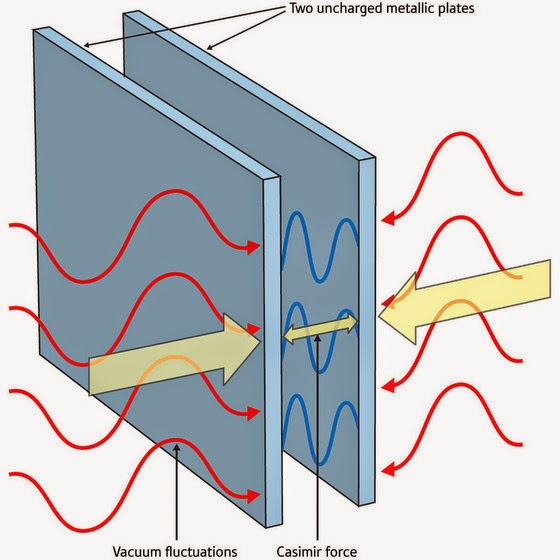
Casimir
1909-2000 noted that two totally flat plates brought together,
stuck together. He introduced tiny studs between the plates and they continued
to stick together. (The separation is very, very small - so don't try this at
home).

The Dutch scientist, Casimir
concluded that the glue was in fact the force of the universal electromagnetic
field waves outside the plates being stronger than the waves between the
plates. They were being pressed together by "light" waves because the
tiny space between them excludes larger waves, thus there is more pressure
outside, than inside.
In the above diagram, you can ignore the nonsense phrase "vacuum
fluctuations", which comes from stubborn old physicists who still insist
that the universe is mostly "empty" space. It isn't. Having realized
that there is no such thing as empty space they dreamt up miraculous
non-existent waves and particles that pop-in and pop-out of nothing. What they
are really referring to is the basic stuff of the universe - the pure energy
field of electromagnetism in which matter emerges. The waves are
electromagnetic waves (and particles) that exert force in so called
"empty" space. The waves are everywhere, at every scale, and
their field is the universal energy, which is continually in-formed and
re-formed by every energetic event in the universe - however large or small. It
is the persistently coherent (inertia) broadcasts of all events that enables us
to "see" phenomena - from sub-atomic particles, to each-other, to the
observable-universe. Every-thing broadcasts it's identifiable existence:
http://www.noelhodson.com/index_files/Life-Universe-Everything-8Mar2011.pdf
.jpg)
This same Casimir effect can be seen acting between two large ships alongside
each other at sea. The ocean waves outside the ships are far larger than the
waves in the calm area between the ships. The pressure outside pushes the ships
together, overcoming the weaker waves between the ships. Casimir Glue is in
fact a force that pushes rather than pulls; although both forces occur.
If we take two pieces of matter, say hydrogen or carbon molecules, drifting in
space, the pressure of electromagnetic light waves acts on them equally. But
when they drift close to each other, the Casimir effect acts to exclude long
/large wavelengths between them, reducing the separating forces. They are
pushed together by the universal "outside" waves.
Now add many millions more molecules or pieces; as they come together they
exclude more light, creating interior darkness - smaller internal waves and
less internal pressure. The pressure outside remains at full force. As new
pieces of matter "fall" onto the conglomeration, the surface grows while
the interior blocks more wavelengths - and darkness reigns internally. The
deeper inside the material - the more waves are excluded - the more insistent
the outside pressure seems.
If we anthropomorphise the process, it seems that all particles are willful
creatures intent on getting to the centre (of gravity). The centre is
constantly changing as the masses move and more matter "falls" on the
surface. At a certain size of mass, matter and energy join the incessant
"in falling"; the centre gets ever darker - and we enter the
mathematics of Black Holes. Counter-intuitively, large masses, such as the Sun,
which blaze into radiating light and heat, are in their centres very dark;
excluding most wavelengths.
Around such large shining stars, both particles and energy waves are pressed
and pulled to the surface by the Casimir forces and we observe light
"bending" close to the objects. This is Einstein's curved
space-time.
My realisation that gravity could or might be, mostly, Casimir forces, does not
preclude the logic that the matter and energy that "falls" onto a
planet, star, or galaxy is either matched by growth of the object or by an
equal outflow. All material objects are dissipative phenomena.
Between large, well separated objects such as planets, the electromagnetic
waves manifest equal pressure - and the objects stay separate for eons. But,
for example the Sun, a massive object compared to its planets, does shield the
planets' orbital areas from universal waves - and exercises a push-pull Casimir
force. The other 3 fundamental forces almost certainly are woven into the
congregrations of matter, and add to the cohesion - but those 3 can be
shielded, whereas gravity cannot be shielded.
What this implies is that there are no gravitons and no gravity waves, other
than the familiar electromagnetic /light waves - which is the basic stuff or
pure energy of the universe.
My previous essay, lost in Google space, was more elegant - but this will have
to do for now. I think it is shaping up to be THE answer to many of gravity's
mysteries. But - I would say that, wouldn't I.
DOES CASIMIR-GRAVITY MEET THE CRITERIA?
1) Newton's laws - including force diminishes by the square of the distance.
There is no reason why these rules would not apply. Casimir-Gravity may show
how this happens. 1a) Force acts from centre to centre of planets etc -
This is what triggered my attention to Casimir - why do all the particles seem
intent on getting to the centre? The cloaking effect inside as pieces of matter
aggregate, and the constant external, universal pressure outside, will act like
an ever self-tightening knot. The centre will become ever denser. It has always
baffled me why all the bits make for the centre instead of loosely holding
hands in a lattice - Casimir cloaking provides a mechanism - I think.
2) Curved Space-Time - I touch on curved light above. I think this theory can
explain Einstein's construct - in due course. More on this.
3) The smaller the particles of matter, the more homogenous and equal will
be the the "sea" of electromagnetic waves around and between
the particles - reducing the attraction between them.
4) This Casimir-Gravity force cannot be shielded. It is the shielding of
electromagnetic waves that manifests the force.
(I am (still) sneezing & coughing badly this morning - my usual November
reaction to the onset of winter. So will take a break and return to this in a
day or so. More to follow).
More on
Gravity 4 – 26 Apr 14.
Saturday, 26 April 2014
Saturday, 26 April 2014
GRAVITY - IS IT
AS SIMPLE AS CASIMIR?
7 NOV 14 - I think the major part of gravity is due to the
Casimir effect. I wrote out the logic of this an hour ago, on this blog, where
I had several tabs open. I was asked to "quit" a tab - with no option
to cancel - and my new text disappeared. Will the world ever see my conclusive
theory on gravity?
...So - after a short rest; here it is again.
Casimir noted that two totally flat plates brought together, stuck together. He
introduced tiny studs between the plates and they continued to stick together.
(The separation is very, very small - so don't try this at home). Casimir
concluded that the glue was in fact the force of the universal electromagnetic
field waves outside the plates being stronger than the waves between the
plates. They were being pressed together by "light" waves because the
tiny space between them excludes larger waves, thus there is more pressure
outside, than inside.
This same effect can be seen acting between two large ships alongside each
other at sea. The ocean waves outside the ships are far larger than the waves
in the calm area between the ships. The pressure outside pushes the ships
together, overcoming the weaker waves between the ships. Casimir Glue is in
fact a force that pushes rather than pulls; although both forces occur.
If we take two pieces of matter, say hydrogen or carbon molecules, drifting in
space, the pressure of electromagnetic light waves acts on them equally. But
when they drift close to each other, the Casimir effect acts to exclude long
/large wavelengths between them, reducing the separating forces. They are
pushed together by the universal "outside" waves.
Now add many millions more molecules or pieces; as they come together they
exclude more light, creating interior darkness - and less internal pressure.
The pressure outside remains at full force. As new pieces of matter
"fall" onto the conglomeration, the surface grows while the interior
blocks more wavelengths - and darkness reigns internally. The deeper inside the
material - the more waves are excluded - the more insistent the outside
pressure seems.
If we anthropomorphise the process, it seems that all particles are willful
creatures intent on getting to the centre (of gravity). The centre is
constantly changing as the masses move and more matter "falls" on the
surface. At a certain size of mass, matter and energy join the incessant
"in falling"; the centre gets ever darker - and we enter the
mathematics of Black Holes. Counter-intuitively, large masses, such as the Sun,
which blaze into radiating light and heat, are in their centres very dark;
excluding most wavelengths.
Around such large shining stars, both particles and energy waves are pressed
and pulled to the surface by the Casimir forces and we observe light
"bending" close to the objects. This is Einstein's curved
space-time.
My realisation that gravity could or might be, mostly, Casimir forces, does not
preclude the logic that the matter and energy that "falls" onto a
planet, star, or galaxy is either matched by growth of the object or by an
equal outflow. All material objects are dissipative phenomena.
Between large, well separated objects such as planets, the electromagnetic waves
manifest equal pressure - and the objects stay separate for eons. But, for
example the Sun, a massive object compared to its planets, does shield the
planets' orbital areas from universal waves - and exercises a push-pull Casimir
force.
What this implies is that there are no gravitons and no gravity waves, other
than the familiar electromagnetic /light waves - which is the basic stuff or
pure energy of the universe.
My previous essay, lost in Google space, was more elegant - but this will have
to do for now. I think it is shaping up to be THE answer to many of gravity's
mysteries. But - I would say that, wouldn't I.
*********
4 NOV 14 - ELECTRON SPIN - My EIG TOE presumes that light rushes "in"
to partially evacuated spheres which are being expanded by Hubble Expansion,
which is attenuating the basic stuff of the universe, requiring energy (light)
to move in (at the speed of light) to balance the momentary partial void
created by Hubble Expansion. I speculate that the light moves in from all directions;
that some in-falling light waves sometimes collide in the attenuated sphere;
that the collisions sometimes are at such wavelengths and angles to create a
spinning vortex; that the vortex is a primary particle - perhaps a quark; that
there is no-thing to inhibit the spin of the vortex; and that two colliding
light waves meeting in a frictionless medium multiply their momentums to spin
at C2 (the speed of light squared) 300,000 x 300,000 km per second = 90 billion
km per second; that this immense, forbidden speed creates a surface and a
particle with mass within the surface; E=MC2. Thus are primary particles or
fractals with mass formed from pure massless energy. They do spin straw into
gold.
HOWEVER - investigating the Spin of electrons and other sub-atomic particles,
the obscure 1, 1/2, 1/3 or 2/3 "spin" which rarely specify any units,
I read that it is not a "real" spin and is not intended to convey any
real properties of real particles. BUT, digging down into less obscurantist,
less reverent and more radical websites,
e.g. http://www.relativitydomains.com/Physics/MechSpin/QuantSpin.htm
I see that to account for its electro-magnetic charge the electron must have a
real spin, like a spinning top, of 1.117967846C or 1.1 times the speed of
light.
This is then taken as a standard - ascribed as 1/2 spin, implying that 1 spin
is 2.2 times the speed of light. BUT, all physicists know that nothing exceeds
the speed of light - so the measured spinning electron is said to be measured
incorrectly and cannot be spinning at 2.2 times light speed. This must be one
of the rare instances when oft repeated observational data
is deemed to be less reliable than man-made mathematical rules. If a dot
painted on the equator of an electron passes by at 1.1C - then the rule that
nothing moves faster than light is, in these particular, peculiar spinning
circumstances, not applicable.
It is fundamentally important because if primary particles /quarks are spinning
vortices of the basic stuff or energy of the universe, like whirlwinds
and typhoons, then such spinning entities can be UP or DOWN and can attract or
repel each other depending on orientation. They are too small and fundamental
for any other particle to disturb their spin - except disturbance by another of
their kind. The real spin creates the familiar electro-magnetic properties; the
necessary constant winding in of "free, pure" energy creates an
endless in-falling akin to gravity (the in-falling energy being balanced
dissipatively by the outgoing magnetic field); and these vortices can
combine to manifest the other sub-atomic forces - and to form stable long
lived protons. It is written (by Paul Davies) that quarks are never found alone,
outside of protons and neutrons, Maybe, if they are not in combinations of say,
2 UP and 1 DOWN or vice-versa, these vortices of pure energy unwind and
disappear from our sight.
NB - Space or space-time is never empty, it is never no-thing; it is always
some-thing. No-thing may have existed before the alleged Big-Bang. Bring back
the Aether!
*************
NB - 31 JULY 14 - Is gravity the ability to compress energy (& gain &
retain identity)? Continuing the dissipative phenomena idea - does the continuous
inflow, the falling in, of mass/ energy equate to the faint tug of gravity?
Matter somehow emerges from "pure" energy (light) and makes particles
- which fall onto or into each other (gravity) and form objects. These objects,
every-thing in the universe, by definition are identifiable, they have identity
- and thus we can name and study them. To have identity they presumably form
following rules, patterns, templates. To maintain an identifiable shape and
size (even if size changes) the inflow must be balanced by an equivalent
measurable storage and/or outflow - as in humans - or stars - or trees. Given
the extraordinary example below of a bacteria "eating" electrons, is
that eating/ absorbing process the basis of gravity? If so - there is nothing
"dead" in our universe of identifiable things; all are busy eating or
being eaten - at a rate which defines their gravity? Maybe?
UPDATE 30 JULY 2014
|
|
|
ELECTRON BACTERIA |

This article below,
copied (my apologies) from the excellent New Scientist magazine, of 16 July
2014, interests me. It seems very important to my musings about Life, The
Universe & Everything in general, and to puzzling over Gravity in
particular. The link to gravity is via my thought that all phenomena are
dissipative entities. We humans and everything that manifests in the universe,
absorb energy and excrete it, over our very short (humans) or very long
(protons) lifetimes. In the process everything retains identity, though changes
occur throughout their lives. It seems that matter that manifests gravity may
have energy and mass "falling" into it continuously. If so, to
maintain identity, the mass that falls in must be expelled equivalently.
I am also fascinated by the idea of templates, which order the energy into the
shape and identity of the phenomena. Human templates have been tracked back to
DNA, but non-living (as defined by us) objects also form into predictable
shapes - and sizes; while the dissipative processes continue. The Sun is such
an object - which inarguably has gravity and which is probably continually
dissipative. Is gravity the same force as absorption? These electron
"eating" bacteria absorb energy which we can measure in electrons -
are they mini-Suns? Could we measure their gravitational attraction? Would it
match the mass of the consumed electrons?
More information on these immaterial bacteria and more pondering required.
http://www.newscientist.com/article/dn25894-meet-the-electric-life-forms-that-live-on-pure-energy.html#.U8kpupRdXh4
Meet the
electric life forms that live on pure energy
·
17:08 16 July 2014 by Catherine Brahic
·
Magazine issue 2978. Subscribe and save
·
For similar stories, visit the Micro-organisms Topic Guide
Unlike
any other life on Earth, these extraordinary bacteria use energy in its purest
form – they eat and breathe electrons – and they are everywhere
STICK an
electrode in the ground, pump electrons down it, and they will come: living
cells that eat electricity. We have known bacteria to survive on a variety of
energy sources, but none as weird as this. Think of Frankenstein's monster,
brought to life by galvanic energy, except these "electric bacteria"
are very real and are popping up all over the place.
Unlike any
other living thing on Earth, electric bacteria use energy in its purest form –
naked electricity in the shape of electrons harvested from rocks and metals. We
already knew about two types, Shewanella and Geobacter.
Now, biologists are showing that they can entice many more out of rocks and
marine mud by tempting them with a bit of electrical juice. Experiments growing
bacteria on battery electrodes demonstrate that these novel, mind-boggling
forms of life are essentially eating and excreting electricity.
That should
not come as a complete surprise, says Kenneth Nealson at the University of
Southern California, Los Angeles. We know that life, when you boil it right
down, is a flow of electrons: "You eat sugars that have excess electrons,
and you breathe in oxygen that willingly takes them." Our cells break down
the sugars, and the electrons flow through them in a complex set of chemical
reactions until they are passed on to electron-hungry oxygen.
In the
process, cells make ATP, a molecule that acts as an energy storage unit for
almost all living things. Moving electrons around is a key part of making ATP.
"Life's very clever," says Nealson. "It figures out how to suck
electrons out of everything we eat and keep them under control." In most
living things, the body packages the electrons up into molecules that can
safely carry them through the cells until they are dumped on to oxygen.
"That's
the way we make all our energy and it's the same for every organism on this
planet," says Nealson. "Electrons must flow in order for energy to be
gained. This is why when someone suffocates another person they are dead within
minutes. You have stopped the supply of oxygen, so the electrons can no longer
flow."
The
discovery of electric bacteria shows that some very basic forms of life can do
away with sugary middlemen and handle the energy in its purest form –
electrons, harvested from the surface of minerals. "It is truly foreign,
you know," says Nealson. "In a sense, alien."
Nealson's
team is one of a handful that is now growing these bacteria directly on
electrodes, keeping them alive with electricity and nothing else – neither
sugars nor any other kind of nutrient. The highly dangerous equivalent in
humans, he says, would be for us to power up by shoving our fingers in a DC
electrical socket.
To grow
these bacteria, the team collects sediment from the seabed, brings it back to
the lab, and inserts electrodes into it.
First they
measure the natural voltage across the sediment, before applying a slightly
different one. A slightly higher voltage offers an excess of electrons; a
slightly lower voltage means the electrode will readily accept electrons from
anything willing to pass them off. Bugs in the sediments can either
"eat" electrons from the higher voltage, or "breathe"
electrons on to the lower-voltage electrode, generating a current. That current
is picked up by the researchers as a signal of the type of life they have captured.
"Basically,
the idea is to take sediment, stick electrodes inside and then ask 'OK, who
likes this?'," says Nealson.
At the
Goldschmidt geoscience conference in Sacramento, California, last month, Shiue-lin Li of Nealson's lab presented results of
experiments growing electricity breathers in sediment collected from Santa
Catalina harbour in California. Yamini Jangir, also from the University of
Southern California, presented separate experiments which grew electricity
breathers collected from a well in Death Valley in the Mojave Desert in
California.
Over at the
University of Minnesota in St Paul, Daniel Bond and his colleagues have
published experiments showing that they could grow a type of bacteria that
harvested electrons from an iron electrode (mBio, doi.org/tqg). That research, says Jangir's
supervisor Moh El-Naggar, may be the most convincing
example we have so far of electricity eaters grown on a supply of electrons
with no added food.
But Nealson
says there is much more to come. His PhD student Annette Rowe has identified up
to eight different kinds of bacteria that consume electricity. Those results
are being submitted for publication.
Nealson is
particularly excited that Rowe has found so many types of electric bacteria,
all very different to one another, and none of them anything likeShewanella or Geobacter.
"This is huge. What it means is that there's a whole part of the microbial
world that we don't know about."
Discovering
this hidden biosphere is precisely why Jangir and El-Naggar want to cultivate
electric bacteria. "We're using electrodes to mimic their
interactions," says El-Naggar. "Culturing the 'unculturables', if you
will." The researchers plan to install a battery inside a gold mine in
South Dakota to see what they can find living down there.
Continue reading
page |1|2
NASA is
also interested in things that live deep underground because
such organisms often survive on very little energy and they may suggest modes
of life in other parts of the solar system.
Electric
bacteria could have practical uses here on Earth, however, such as creating
biomachines that do useful things like clean up sewage or contaminated
groundwater while drawing their own power from their surroundings. Nealson
calls them self-powered useful devices, or SPUDs.
Practicality
aside, another exciting prospect is to use electric bacteria to probe
fundamental questions about life, such as what is the bare minimum of energy
needed to maintain life.
For that we
need the next stage of experiments, says Yuri Gorby,
a microbiologist at the Rensselaer Polytechnic Institute in Troy, New York:
bacteria should be grown not on a single electrode but between two. These
bacteria would effectively eat electrons from one electrode, use them as a
source of energy, and discard them on to the other electrode.
Gorby
believes bacterial cells that both eat and breathe electrons will soon be
discovered. "An electric bacterium grown between two electrodes could
maintain itself virtually forever," says Gorby. "If nothing is going
to eat it or destroy it then, theoretically, we should be able to maintain that
organism indefinitely."
It may also
be possible to vary the voltage applied to the electrodes, putting the
energetic squeeze on cells to the point at which they are just doing the
absolute minimum to stay alive. In this state, the cells may not be able to
reproduce or grow, but they would still be able to run repairs on cell
machinery. "For them, the work that energy does would be maintaining life
– maintaining viability," says Gorby.
How much
juice do you need to keep a living electric bacterium going? Answer that
question, and you've answered one of the most fundamental existential questions
there is.
This
article appeared in print under the headline "The electricity eaters"
Leader: "Spark of life revisited thanks to electric bacteria"
Wire in the mud
Electric
bacteria come in all shapes and sizes. A few years ago, biologists discovered
that some produce hair-like filaments that act as wires, ferrying electrons back and forth between the cells and
their wider environment. They dubbed them microbial nanowires.
Lars
Peter Nielsen and his colleagues at Aarhus University in Denmark have found
that tens of thousands of electric bacteria can join together to form daisy
chains that carry electrons over several centimetres – a huge distance for a
bacterium only 3 or 4 micrometres long. It means that bacteria living in, say,
seabed mud where no oxygen penetrates, can access oxygen dissolved in the
seawater simply by holding hands with their friends.
Such
bacteria are showing up everywhere we look, says Nielsen. One way to find out
if you're in the presence of these electron munchers is to put clumps of dirt
in a shallow dish full of water, and gently swirl it. The dirt should fall
apart. If it doesn't, it's likely that cables made of bacteria are holding it
together.
Nielsen
can spot the glimmer of the cables when he pulls soil apart and holds it up to
sunlight (see video).
It's more
than just a bit of fun. Early work shows that such cables conduct electricity
about as well as the wires that connect your toaster to the mains. That could open
up interesting research avenues involving flexible, lab-grown biocables.
--
UPDATE 8 JULY 2014.
My holiday reading: Both these books claim to have found a new Standard Model
and the fundamental building blocks of the universe:
In THE SPEED OF MASS - A new look at relativity - Philip J Morgan claims
to create a new Standard Model and says among his other ideas that (7) Gravity
is the same as the electromagnetic force that holds an electron around the
nucleus of an atom; it is not caused by the bending of space time. (8) Black
holes far from being the mass eating monsters of current theory are the mothers
of galaxies. Galaxies are formed from vacuum fluctuations in pairs of matter
and anti-matter galaxies (9) I paraphrase - Hubble expansion is actually
galaxies shrinking as they lose mass, thus increasing the distance between
them. I had great difficulty following the author's logic and in dealing with
the lack of punctuation.
In EVERYTHING IS PHYSICS - Book 3 - Particle physics and the quarks revealed -
the author Dr Andrew Worsley, Fellow of the Royal Astronomical Society, is
lyrical about the beauty, elegance, obviousness and natural symmetry of the
mathematics underlying the aesthetic universe and particle physics. He lifts
"the shrouds of mystery" which surrounds his subjects, by taking us
back to "first principles" and by positing a fundamental unit
/particle that is 100 billion billion times smaller than Planck's smallest
unit. Dr Worsley then multiplies this tiniest of units by a "harmonic quintessence"
of the speed of light - and with clear mathematical logic, printed throughout
the book, he shows that all phenomena are built with these tiniest of units,
dubbed "Quintessential
Mass Quantum". Sadly, my maths is not up to the standard required to
assess his workings, but I soldiered on through the book which I found quite
readable and it has some neat histories of physics - including of quarks - with
interesting quotations and anecdotes. He links his harmonics and quintessence
to musical scales and hence to String Theory (which he sees as failing). All is
focused on the electron as the central and primary particle - from which all
other matter is made or derived (I think). All is harmonics and wavelengths.
Although unable to follow his arguments I quite liked the idea of his tiny
Quintessential Mass Quantum, which at times seem to be behaving like the
fundamental particles that I speculate about in my EIG concept, where colliding
light waves spin into vortexes to form matter - perhaps quarks. He devotes
chapter 8, Vortex Harmonics, to this topic. It would help, as it is the
foundation of the book, if I knew what a "harmonic quintessence of the
speed of light" means.
I was not able to comprehend either of these two radical books sufficiently to
amend my own theory. I might re-visit some paragraphs in Dr Worlsey's well
informed, wide ranging work.
***********
UPDATE - 29 May 2014. - "THE HIGGS FIELD DOES NOT CREATE GRAVITY"
Picking the bones out of the Royal Society, Pall Mall, UK - Lecture 20th May
2014 - Professors Ben Allanach, John Ellis, Tara Shears, Terry Watts - Chairman
Alok Jha.
Reply 21 May - Dear Noel
Thanks a lot, and we're
really glad you enjoyed the event last night. I've tried to answer your
questions briefly below.
Q1 - I assume that Higgs Bosons do not exist today and only existed briefly
just after The Big Bang?
Yes
Q2 - So there were no Higgs Bosons (snowflakes) with us in the hall last
night?
Basically no, only
insofar as they are popping in and out of the "seething vacuum"
Q3 - But the Higgs Field (snowfield) did and does suffuse the hall and the
entire universe - somewhat like the CMB?
Yes.
About F4 below:
Strictly, it's going up
from 8 thousand billion electronvolts to 14 thousand billion... so not quite a
doubling (but roughly)
All the best,
Ben
What I thought I heard last night that was new to me was:
F1). The colliding protons impact at about 280,00 kps
F2). Vacuum quantum fluctuations might add mass to the CERN-made Higgs Bosons
(and other particles).
F3). The LHC has collected only 1% of the available (now or in the near future)
data.
F4). You are doubling the power of CERN.
F5). Proposed - Super
symmetric particles probably decay into dark matter.
F6). The Higgs Field does not create
gravity.
F7). Dark Matter and Dark Energy most probably do exist.
F8). The Higgs field adds mass only to the force carrier particles. Human mass
includes a "fingernail-full" of Higgs-enhanced particles.
F9). An uneasy cooperative symbiotic truce exists between airy theorists and
solid engineers.
You most probably know of the Imperial College 2014 plan to collide high power
lasers to create matter - electrons and positrons; originally postulated in
1934? For me this could resurrect that great free radical, Professor Fred Hoyle
and his Steady State Theory.
·
In the early 90's I met (now Sir) Tim Berners Lee on the Oxford-Heathrow
bus and he told me of his hyper-links project at CERN.
Finally - do you take turns to pedal the CERN dynamos to power the LHC?
Thank you again for a most illuminating, stimulating and enjoyable lecture.
Regards
Noel Hodson
MORE ON GRAVITY
- 4
UPDATE - 19 May 2014. WOW! - HOW ON EARTH DID I MISS THIS VITAL EIG MATTER? - in 1934
Gregory Breit and John Wheeler worked out that photons could collide with
sufficient energy to make electron-positron pairs, which have mass and are
therefore matter. In 1997 the idea was tested using powerful lasers at the Stanford
Linear Accelerator, albeit including a massive beam of electrons from
"outside" the creation zone that collided with "green laser
light" and changed its nature. And this year it is being re-tested at
If photons can be spun into electrons-positrons, it begs the question "are
electrons material? do they have mass?" It seems that science is unanimous
in agreeing that electrons have mass and are particles and emit waves of energy
- electrons are wavicles. This modest,anonymous scientific
commentator, argues that quarks are not merely constructed from
electrons-positrons but indeed are electron-positrons - and make protons. He
speculates that his construct explains the missing mass-energy from protons and
neutrons. Protons are the solid building blocks of atoms that have a lifetime
far longer than we think and calculate (by winding back Hubble Expansion) that
the universe has existed. In human terms we can regard protons as (almost)
immortal spheres-waves of matter. It would seem, as I have long puzzled over
and suspected - that electrons are photons within matter. Release electrons
from the grip of matter and they fly off as photons (or propagate at the
"speed" of light).
And what about the disgraced, despised, silenced, gagged theories of the Electric
Universe? Coming round full circle to gravity, at the macro level -
in our search for the theory of gravity; it is calculated from astronomical
observations and measurements that galaxies are missing 80% to 90% of the mass
/gravity required to hold them together. And we do not of course know what
causes gravity or how it is transmitted. Is it indeed, an unshielded
aspect of the electrical forces that we know so well - and which the bound, gagged
and expelled scientists who dare raise the possibility that weak and feeble
gravity is a minor factor in creating galaxies etc. compared to electromagnetic
forces.
And wherefore The Impenetrable Higgs Boson? Isn't it dubbed the God Particle
that "confers mass" onto particles? More explanation please Professor
Higgs.
And what does this imply for Hoyle's Steady State Theory? For his idea that
particles are constantly created in the vast empty vacuums of space? Can we
revive Fred Hoyle from his premature sleep and ask him to comment? Did the Big
Bang really bang?
Any road up - you can imagine how pleased I am as a non-scientist observer of
science to find that one of my central speculations - how to spin straw
into gold - to compress energy into matter has since 1935 been on the
respectable scientific agenda and been demonstrated by applying one of our new
fangled inventions - lasers (once called a technology looking for an
application). Having been ignorant of these 80 year old developments, in
spite of looking diligently for such information, my suggestion to
scientists is do more for "intelligent cooperation".
**************
UPDATE - 17 May 2014. BOOM! - New Scientist 17 May 2014 "There at the birth" ...of the Big Bang Theory - Jim
Peebles recounts witnessing the formation of the Big Bang Theory from 1964. It
eventually replaced Fred Hoyle's Steady State Theory - demonstrating a single
point of matter creation (a single White Hole) and energy dispersal instead of
Hoyle's idea that particles of matter are created in the voids in all locations
at all times - in a Hubble expanding universe. The Big Bang Theory -
supplemented by the necessary theory of "Inflation" was largely
driven by the discovery of the ubiquitous Cosmic Microwave Background (CMB) at
2 degrees Kelvin (2 degrees above absolute zero - minus 232 degrees Celsius
- TV screen snow).
Although not crucial either way - Big Bang or Steady State Continual Creation -
to my EIG theory, my suspicious, doubting and cynical nature which was
triggered aged 6 by resisting illogical but infallible Catholic indoctrination,
still leaves room for Hoyle and questions The Big Bang (with Inflation).
Perhaps when science finds a sense of direction pointing to The Universal
Center, whence the Big Bang emerged, I will be more believing of the
impenetrable, reverse engineered Big Bang mathematics and be able to join the
One True Faith. Until then - we should keep open minds.
If, as in my EIG, the universal essence suffusing all space-time is the
Aether-Matrix - holographic spheres at every point, scale and location that
mirror the entire universe (intersecting light-waves reflecting the whole
universe wherever we place an eye or an observing instrument), then the
Aether-Matrix would also glow with a background temperature. Philosophers of
science, like 1950's Jesuits, "must work harder" to prove they are
infallible.
*******
More thoughts in the endless search for the causes of gravity. I've been
reading GRAVITY by Brian Clegg, 2012 (links below), a book for non-scientists
which I can almost completely follow - with an unaccustomed stretch of my
concentration.
(Previous article in
this series GRAVITY WAVES - WHAT'S THE FUSS? )

In GRAVITY, an excellent
book, Brian Clegg mentions in Chapter 2, only to dismiss, Mark McCutcheon, The Final Theory: Re-Thinking Our
Scientific Legacy, (see Notes) in which Mark apparently bases gravity on
the expansion of matter. Not having access to that book, I assume from Clegg's
brief comments that Mark's idea is that surfaces of matter, such as the Earth's
surface, accelerate "upwards" due to expansion, which silly Earth
creatures such as ourselves feel as gravity - and that the same is true for all
matter, however large or small. A few calculations, even at my low level of
teenage school arithmetic, show the theory to be impractical and such
effect wholly detectable, if Earth were expanding and accelerating at 32 feet
(say 10 meters) per second - per second.
I stress that my EIG - Expansion is Gravity, is quite a
different concept to what I suppose is Mark's theory. EIG proposes that Hubble
expansion expands space-time or "pure energy" the basic fabric of the
observable universe, at
6.819E-19 percent(0.000,000,000,000,000,000,068,19%),
of any specified sphere,
per second per second: which is a minuscule rate of change, more fitting for
the observed subtle power of gravity. This is the rate at which the Hubble
Universe expands. My EIG idea dates from 1992 and has been disseminated via the
internet since 1998. It is this tiny, persistent, universal attenuation of
space-time that I imagine "attracts" energy - light - to balance the
energy field; everywhere, perpetually, on every scale, which causes gravity and
creates fundamental particles of matter (maybe quarks).
Brian Clegg also
comments (Page 95) on a question I put to a senior physicist a couple of years
ago "If I dug a
vacuumed tunnel from North Pole to South Pole on the Moon and jumped down it;
what would occur? When would I turn to go up instead of down?" and Clegg gives the same professorial
answer, but applied to the Earth; a sort of bungee rope see-saw
oscillation would happen, until minor frictions brought me to a halt. On
reflection, Clegg's answer triggers other questions. As I fall down towards the
center of the planet, the mass of the planet would relatively move around me;
at the center - the bottom, there would be far more mass "above" me
than immediately below. In falling, would not the gravity of the mass around me
pull me back up - be a brake on my plummeting to the center?
Is THE CENTER, from and
to which all Newtonian gravity is calculated, actually the center of gravity?
Surely not - the center of gravity, any center of gravity, must eternally
oscillate; the moment it is located, it will attract matter or energy which
will move towards it, which movement will re-locate the center of gravity -
ad-infinitum. Its easier to envisage the effect in the molten center of the
Earth. In our turbulent, cycling Solar System, all centers of gravity of all
things must perpetually oscillate - creating additional energy /mass and tidal
forces, on all scales, at all points.
This unavoidable oscillation of centers of gravity at the heart of every mass, of any
size, mirrors, perhaps, the unstoppable sub-atomic quivering at Absolute Zero
(-273 Centigrade) which otherwise freezes atoms and all matter, in its tracks.
On page 150, Brian Clegg
kindly explains to me (at last - and about time too) why non-scientists find
"simple and beautiful" maths formulas impossible. Quite simply the
authors never cite the units of anything - and behind, say (x-y = x+abc) lie
vast sheets of hidden calculations that underlie the 'x' and the 'y' etc. The
academic purpose, I assume, is pure bloody-minded obscurantism. I once wrote to
Oxford's top maths professor, Marcus du Sautoy, suggesting a common global
maths alphabet and dictionary to make formulas accessible to say, 5 billion
people, instead of today's handful of, often mad, specialists; would get all
unresolved maths problems solved in a week - or so.
Clegg clearly explains
and illuminates Special Relativity with new metaphors and similes - and
introduces, to me, gravitomagnetism (What's that? Read the book) and
explains Frame Dragging. He also corrects my understanding of the weak nuclear
force, which I imagined I knew holds the electrons/cloud in orbit; it
transpires that the weak nuclear force acts on sub-atomic particles to keep
them a fraction of the diameter of a proton apart - and - is the trigger that
flips quarks inside protons to convert protons to neutrons. Clegg also
reminds me throughout that it is NOT Space that is distorted by mass to 'make'
gravity - but Space-Time. Movements in any of these 4 space-time dimensions can
trigger mass moving towards mass - and all things are moving through Time.
In all - GRAVITY is an
accessible book which brings for me several new factors - in the hunt for
gravity. Well worth the risibly low price for such a useful and scholarly work.
It does not yet cause me to reach for my EIG Theory and amend it.
****************
THE UNIVERSE IS ONLY
SPACETIME by John Archibald Wheeler.
The next paper I read is
of a different order. The Universe is Only Space Time - by John Archibald
Wheeler (2012) races along the extreme outer edge of my ability to follow the
logic. Wheeler sprinkles his dense, taut text with mathematics, which helpfully
do state the units of measure and which he explains in English words - and
which therefore with great effort I can just about grasp, at least sufficiently
to not lose track of his arguments.
This challenging paper
might give me cause to revise and update EIG. Excitingly - if I interpret it
accurately - Wheeler produces arguments in favor of what I call the Aether-Matrix; harking back two
centuries to when science decided that space must be a medium that carries
light. The Aether was abandoned finally when it was misreported that
Einstein said it didn't exist. What he actually said was that he didn't need
the Aether for his calculations. We now summon it back from the past for
another incarnation.
My EIG supposes that the
Aether-Matrix is formed by the intersecting of all the light signals
(electromagnetic waves) from all phenomena from the whole observable universe,
which are visible to observers on every scale at all points in the universe and
which are dynamically informed and reformed by every event in the universe. It
is these undeniably present energy waves and fields that collide in Hubble
attenuated spaces /spheres to form fundamental primary particles (Spin straw
into gold / Higgs Boson ). We humans, ephemeral creatures of light, existing
for a meagre three score years and ten, broadcast our every movement and
thought into the Aether-Matrix and thus constantly re-form it. The data thus
created, a record of everything, and holographically reproduced across the
entire universe on every scale, may hold the data-dense templates that inform
delicate complex structures such as DNA.
Wheeler calculates the
"stiffness" of such a medium and compares the energy content of
space-time (energy density of a vacuum) when calculated from the Quantum
Electrodynamics theories (particle physics) or from General Relativity
(astrophysics). He finds that answers from the two systems differ by 10E+122 (1
followed by 122 zeros) joules per cubic meter - an unimaginably enormous
number. (Read the Book)
This, I think, and the
first time I have heard the detail of it, is the heart of the irreconcilable
disparity between the brilliant and wholly tested and proven Standard Model (of
atoms etc) and the equally brilliant, wholly observed theories of cosmology
/astrophysics. It is hoped that coming to understand gravity and its equally
mysterious partner, inertia (centers of gravity?), will bridge the two sets of
theories and enable science to figure out a TOE - a Theory of Everything.
I will re-read both
these texts and think on it. More, later. In the meantime - we have here sketched
out Oscillating-Centers-of-Gravity, which might prove to be important. I must
also read Stuart Clarke in New Scientist 26 April 14 - Page 32, "The end of the
beginning"...
...Done that. Stuart Clark further explains what the BICEP2 Polar instruments
data might mean for "Gravity Waves" and he raises more doubts about
the basis assumptions. Did the Big Bang happen? If so - when? Do gravity waves
exist?
My EIG ascribes gravity to attenuation of the stuff of the universe due to
constant Hubble expansion, which in turn allows or enables or attracts light to
fill the attenuated spheres. As such, science should be searching for the absence
of something, not for ghostly waves and "carrier" particles labelled
"gravitons". Though such partially evacuated spheres would perhaps
draw universal energy inwards, in waves. EIG also sketches explanations for
Dark Matter and Dark Energy. Three for the price of one. Buy now to avoid
disappointment.
I will revisit this blog after re-reading the books below.
**************
LINKS
www.noelhodson.com/index_files/Life-Universe-Everything-8Mar2011.pdf
http://www.youtube.com/watch?v=7dmvCsQly2c
INDEX - LIFE, UNIVERSE, EVERYTHING - JAN13
FUSION, GRAVITY, INERTIA, LIFEFORCE.
DISSIPATIVE PHENOMENA (2)
INDEX - HIGGS BOSON
INDEX - LIFE, UNIVERSE, EVERYTHING - JAN
- DEC 201...
BRIAN COX AND TALES OF DOOM
FUSION, GRAVITY, INERTIA, LIFEFORCE.
GRAVITY AND IMMORTALITY
GRAVITY - by Brian Clegg http://www.brianclegg.net/gravity.html
Everything
we know is governed by four physical forces, but there is only one of them that
is immediately obvious - gravity. Although ludicrously weak compared to the
other forces (a tiny magnet can hold up a piece of metal against the
gravitational attraction of the whole Earth), gravity permeates our everyday
life and being. We begin with humanity's earliest ideas of how we remain stuck
to the ground - a significant consideration when you realize that despite the
myths, educated people have known the Earth was a sphere since the time of the
Ancient Greeks.
Along the way we'll see how the Arabic scholars explained the force of gravity,
why Galileo didn't need to drop balls off the tower of Pisa, exactly how Newton
came to his conclusions and why he refused to 'frame hypotheses' about gravity.
We will explore the concept of action at a distance, and see how Einstein
transformed our understanding of gravitation with general relativity and
consider whether the graviton will ever be discovered. We will see how birds,
bees and rockets seem to defy gravity, and whether the concept of anti-gravity
can move from pure science fiction to possible fact.
Gravity never fails to fascinate...
*******************************
john@onlyspacetime.com
John Archibald Wheeler 2012.
http://onlyspacetime.com/Chapter_4.pdf
"If spacetime can propagate waves such as gravitational waves or dipole waves, it implies that
spacetime must have elasticity. This elasticity requires the ability to store and return energy as
the wave propagates. The medium itself must have energy density. The quantum mechanical
model of space is
filled with a sea of energetic
fluctuations dipole waves. If these are
visualized as energetic waves in spacetime, then a new wave can be visualized as compressing
and expanding these pre-existing
waves. If this new wave causes
the pre-existing waves to
slightly change their
frequency and dimensions as
they are being compressed and expanded,
then this picture provides the necessary elasticity and energy storage to spacetime. "
"This book proposes
a quantum mechanical model of spacetime
where the energy density of
dipole waves in spacetime is 10
to the power of
113 J/m3 and the implied pressure is 10 to
the power of 113 N/m2. Therefore the picture
that emerges is that the quantum
mechanical model of spacetime not only
has a tremendous energy density, but
it also is capable of exerting any
pressure up to
Planck pressure of about 10 to the power of
113 N/m3. If
the pressure is unequal on opposite sides of an object,
then this unequal pressure would be
considered a force. Furthermore, this
force could be considered either an
attractive or repulsive force depending on
the direction of the object “causing”
the mysterious force. Later in this
chapter it will be shown that
the maximum pressure that spacetime can exert for a particular size object is the limiting factor
for the size radius of a black hole. Also, all fundamental particles will be shown to possess energy density
and pressure that is
stabilized by an interaction with
the energy density and pressure of the
dipole waves in spacetime. "
john@onlyspacetime.com
John Archibald Wheeler 2012.

Fusion,
Gravity, Inertia, Lifeforce 21 Jan 2013.
Monday, 21 January 2013
FUSION,
GRAVITY, INERTIA, LIFEFORCE.
|
|
|
ISAAC NEWTON AND HIS APPLE. |

Listening last week to a brilliant young physicist, who is
working to bring us unlimited clean energy from atomic nuclear fusion at Culham
Laboratories, UK, struggling on an annual budget of just a few hundred million
dollars; I learned that his team uses electricity to heat a fissionable, or
fusion-able, element to 10 million degrees, which forms a plasma hotter than
the centre of the Sun, which they capture in a magnetic “bottle”. The powerful
magnetic fields of the bottle retain the very slippery few grams of hot plasma
for a few minutes before it “leaks” away, while 50% of the energy used to make
the plasma is now, triumphantly, recovered in useful form – to heat water – to
drive turbines – to make electricity – to energise our society. One day in the
future, fusion power will be contained, controlled and channelled; and all our
energy problems will be solved.
ALSO READ - GRAVITY MASS HIGGS AND BABIES
How? I asked …does the Sun, a
fusion star, make and maintain its scaldingly hot plasma? – The Sun, I was
told, is rather good at holding in the energy. I assumed it does so by applying
Gravity. Which brings me back to asking myself – What the devil is Gravity?
PS - 16 May 2013 - This horizontal gravity has implications for my earlier
question, "why does all matter crowd to the centre of any object, planet
or star?" And, "what happens to me if I jump into a hole dug through,
say the inert Moon, from north to south poles?" Horizontal mass such as
the polar ice will affect such a fall /climb. Answers on a postcard please. http://www.newscientist.com/article/dn17134-flood-risk-from-antarctic-ice-overestimated.html
New science upsets calculations on sea level rise, climate change ...
1. www.theregister.co.uk/2012/.../sea_levels_new_science_climate_change/
Nov 28, 2012 – New science upsets calculations on sea level rise, climate change ... from the data produced by the Gravity Recovery And Climate Experiment (GRACE) spacecraft, ... Meanwhile the Antarctic ice cap is actually getting bigger, ...
The urge of sub-atomic particles,
atoms, molecules, gases and lumps of metal and us to “fall” to the centre of any
body (mass) they happen to meet, is a mystery. Why make for the centre? It is
this determination for all things to go to the center of mass that creates the
pressure, that creates the heat, that creates the plasma, that creates,
expels and propels Light, that warms and enables life on Earth - and
probably elsewhere.
If we empty the entire Universe for a moment’s thought, and revert it to pure
massless energy, Light, which is currently deemed to have no mass at all, and
thus no Gravity (but as some-thing rather than no-thing it must have a
very slight mass) – and in this empty space we allow the creation of a
single particle, using the Light collision method in my TOE -
LIFE THE UNIVERSE AND EVERYTHING 2011: http://www.youtube.com/watch?v=7dmvCsQly2c OR AT
www.noelhodson.com/index_files/Life-Universe-Everything-8Mar2011.pdf
…then the mass of the spinning particle, collects pure energy from a large sphere around it (E=MC2), continues to spin (like a tornado – not a virtual mathematician's spin) and continues to exist in a dynamic, not static Universe, as the product of three forces: Attraction (as the sphere of pure energy “falls” onto and into the mass), Repulsion (as the spinning surface repel each other) and Expansion (as Hubble expansion operates continually – NB. Hubble Expansion is not theoretical; it is known from decades of scientific observation, backed up with impeccable maths). However, when particles meet in empty, free space to form atoms and planets etc. we can realistically imagine them congregating in a lattice – as equal partners – not in a compressed mass, such as the Sun. It is the unexpected (self) compression of mass jostling to reach the centre that heats the material that forms the plasma in the process of nuclear fusion. (If we dismiss theories of The Electric Universe).
So, what is so damn attractive about the centre? What is Gravity? Einstein's is a circular explanation to say that mass sits at the bottom of a space-time bowl into which other mass falls.Newton offers no explanation, he simply accepts Gravity. I now see Gravity as a continuation and product of the tornado spin that, I imagine without evidence, forms the primary particles from colliding light beams.
INERTIA AND CENTRES OF GRAVITY.
Imagine two such primary
particles meeting. They are both dynamic entities, not static, and both are
emptying large spheres of energy, which makes the mass and accords with
We humans naturally understand and utilise centres of gravity. When we clothe ourselves in a leopard skin leotard and swing on liana vines through the trees with a loud whooping sound, we control and balance the ever changing centre of gravity between our bronzed muscular bodies and planet Earth. When we miscalculate just where the centre of gravity is or will be in the next second, we overbalance and probably plunge unwillingly to the new centre of gravity, face down on the planetary surface. Our two primary particles are in a similar relationship – and together they are whirling round in their own private world.
|
|
|
LAGRANGE POINTS - A contour plot of the effective potential due to gravity and the centrifugal force of a two-body system in a rotating
frame of reference. The arrows indicate the gradients of the potential around
the five Lagrange points — downhill toward them (red) or away from them (blue).
Counterintuitively, the L4 and
L5points are the high points of the potential. At the points themselves
these forces are balanced. |

Now let us add a multitude of
primary particles, all spinning, all dynamic, all growing second by second. As
they interact, they make large congregations, each of which has a dynamically
changing centre of gravity – their own centre. They are oriented by these
centres to THE centre of gravity which forms and can be found between all the
congregations. All the spinning entities of groups of primary particles are in
dynamic relationship with all other particles, through the mechanism of winding
pure energy or light into matter or mass. These centres of gravity
relationships constitute the Inertia of the Universe. All matter or masses are
in relationship to and are fixed in place, subject to their dynamic spins, by
Inertia. Inertia provides the capacity of orientation. (LAGRANGE POINTS are the
counter balances to centres of gravity. They are locations between planets and
the Sun where gravity from all the masses is balanced and so has no
gravitational pull in a particular direction. We are parking observation
satellites in such non-gravity locations. Lagrange points move if other masses
enter the region.
http://en.wikipedia.org/wiki/Lagrangian_point
A very large congregation, such as the Sun, in which the primary particles have been forged into Hydrogen, Helium and trace metals, comprises googolplexes of primary particles in such relationships, all spinning, all continually attracting energy to themselves and all expanding in size, courtesy of Hubble. They jointly and severally clear a large space around the mass (the Sun) which space, in turn, is being constantly refilled by in-falling pure energy from The Field. This never-cleared space surrounding masses is Einstein’s bowl, his bending of space time. The Sun has a centre of gravity, which shifts dynamically with every addition and subtraction of mass to and from the Sun. Every primary particle also has its own centre of gravity and all groups have centres of gravity. All entities are spinning and all are Hubble-expanding. As primary particles are crowded by others, they are limited in drawing in only pure massless energy and their surface vacuums and emptying spheres are refilled, not by pure energy, but by neighbouring particles. The particles are continuously falling into each others’ Hubble expanding spheres – irrespective of size or scale. This in-falling is centralised by the many centres of gravity throughout the mass – and ultimately by the single centre of gravity at or near the heart of the Sun – which is also expanding.
But, as we experience in our
daily lives, this jostling and crowding of primary particles squeezes out
particles, with mass, at very high speeds – and thus with very high energies;
which we experience as heat and solar radiation – the solar wind. Thus, the Sun
and all masses, large or small, dynamically grow, compress and expel energy and
matter. Thus, large masses attract matter and energy (which are
interchangeable) that falls onto or into the mass, and then
the compression forces matter and energy to be expelled as dust and
radiation. In this way, the Sun and all large masses have a pulse - like living
organisms, they are dissipative entities - dynamic, never static.
All masses are held in place or orbits by Inertia, the combined centres of
gravity of the entire Universe, until immensely energetic changes occur in
matter or in the pure energy field that are powerful enough to shift Inertia
and enable new forms.
This is not a circular argument – its basic given assumptions (axioms) are just two – First that the Universe exists as a field (infinite and perpetual if you like) of pure energy (from God or by accident as you like) and Second that pure energy or Light, is the building material of particles which compress the Light.
How these particles are made and behave is my unproven speculation, my concept, my imagination fuelled by decades of reading popular science. This blog might trigger ideas that will illuminate the Standard Model and will assist in capturing applicable fusion power. A key point is that gravity requires a continuous and regular in-falling of matter, however diffuse, onto the centre of the gravitating phenomena. I guess the mechanism that causes the in-falling is Hubble expansion - which is constant throughout the Universe. Centres of gravity and Lagrange points may appear to vary gravitational forces.
Perhaps a mini-black-hole at the heart of every fusion-plasma holding “bottle” will replicate the effects of Hubble expansion in a laboratory and will create controllable in-falling gravity to maintain 10 million degrees of heat, with minimal electricity input.
BIG-BANGS,
AND GENTLE, SENTIENT FORCES – THE FIFTH FUNDAMENTAL FORCE:
We humans are of a size that is approximately halfway between the smallest and the largest phenomena that we know of. Perhaps our size dictates the upper and lower scales we can explore. Our Universe has massive, walloping, crashing, searing energies of terrifying inter-galactic power – but it also grows tadpoles, daises, blades of grass and babies. These latter water based life-forms are both subtle and vulnerable, and they are sentient – they can feel their environment – and they need gentle environments safe from all the shouting, burning and banging. All phenomena emerge and are organised, somehow, from the universal field of pure energy (Light). It is logical to search for the subtle energies that enable short lived bags of sea water to acquire brains, occasionally act intelligently, reproduce and to wonder at the Universe. This organising, sentient energy, is, I believe, the Life-Force; a fundamental force ranked alongside Gravity, Electro-Magnetic, Strong and Weak Nuclear forces. The organising, sentient Lifeforce is the fifth fundamental force of our Universe.
My calculation of Hubble Expansion is that the Universe (Space-Time-Continuum) expands at6.819E-19 percent per second. My maths is not great, so check it out – the circumference of the observable universe, disappearing at light speed. I have not read any reasonable arguments that say that some parts of Space are shielded from this expansion.
This minuscule, gentle rate is almost undetectable on a human or even on a Solar System scale, but is observed by astronomers between galaxies. IF, Hubble Expansion does drive gravity, then several of the mysterious universal forces, such as Dark Matter and Dark Energy can be investigated in the light of this new factor. Gravity would be seen as Hubble Expansion acting on every sphere from the smallest (Planck Minimum) to the largest (the entire Universe). Inertia would be the balance and dynamic tension, on every scale, between centres of gravity (foremost at the centres of large objects) of groups of orbiting and spinning masses – and Lagrange points. At the sub-atomic scale, human-scale investigations of particles will unavoidably and continually alter the centres of gravity under observation.
************
For a Theory of Everything, many fundamental matters remain to be understood and slotted into the jigsaw. The Standard Model of atoms and sub-atomic particles appears to be bogged down. Several top scientists say a new model or breakthrough is needed.
ENERGY CONVERTED INTO MATTER - The Higgs Boson and Higgs Field is a dubious discovery; first credited with “conferring mass” on other sub-atomic particles, its role and existence is now uncertain and debateable. No scientist has claimed that it was or is the mechanism that converts “pure energy” (Light) into “real” things (fundamental particles).
EQUIVALENCE – Einstein is credited with explaining Gravity. Part of what he proposed was to assume that Gravity and Inertia, the mysterious force that keeps everything in its place, are equivalent – and therefore perhaps equal and opposite sides of the same coin. This fundamental assumption is now being re-examined. Neither Gravity or Inertia are understood.
GRAVITY – Einstein pictured Gravity by comparing it to the force under the feet of a person being whisked up in an accelerating elevator or lift, far from any gravitational mass such as Earth, but experiencing the same downward pressure, as if standing on the Earth, due to the acceleration of the rising floor. The passenger would actually be experiencing the Inertia or fixed masses of the entire universe – relative to the floor’s acceleration compared to the relatively static universe. He also pictured Gravity as an infinitely large deep bowl at the bottom of which is the attractive object, such as Earth; any-thing with mass, including massless light, that enters the Earth’s bowl, no matter how distant, will eventually slide down it, to the Earth. If the falling thing is dense enough, far denser than our planet, it will continue going down until its centre (of gravity) gets to the Earth’s centre of gravity – in the centre of our planet. Einstein saw this falling object asappearing to accelerate as it falls through spheres within spheres of what I will call The Aether-Matrix surrounding the planet, each sphere equidistant from all others but those nearest the planet being shrunk (by gravity) so that the object takes less time to pass. You either need to read more about this – or need to get out more.
3 comments:
1.

Edward Ott21 January 2013 07:52
I was at a dinner party not to long ago where most of the people
there were physicts PHd studends and professors and saw a yelling match break
out on what is gravity. highly entertaining. great article abd great blog.
2.

Noel Hodson22 January 2013 04:22
Edward - Thanks for your compliments and interest. At 70 I have
decided to publish my lifetime conclusions - to "speak now or forever hold
thy peace". Unlike professional scientists, I have nothing to lose and so
can speculate. - Noel
3.

Super article, Noel, and beautifully written as always! Love
your science blogs!
HIGGS AND
BABIES – 9 Sept 2013.
Letter to New Scientist - 7th September 2013.
Jon
Butterworth’s Instant Expert,The Higgs Boson, New Scientist, 7 Sept 2013, is the
clearest article I have read on The Higgs; and gives a good short summary of
The Standard Model. He asks “What makes matter”?
My view is that there is no unbridgeable
divide between energy and matter, micro and macro, there is a single universe
and an organising principle which manifests in life forms and all phenomena -
The Lifeforce.
|
|
|
34 WEEKS, 2 TRILLION CELLS AN ENERGY DISSIPATIVE ORGANISM DO WE IGNORE "THE LIFEFORCE"? |

Our daughter had a 34 weeks premature baby
11 days ago, which reminded me that a single fertilized ovum or cell, the size
of a typed full-stop, drew energy from the mother to create and organize 2
trillion more cells and make a (very beautiful) new 4 lbs 10 oz life-form. He
will grow into a 100 trillion celled, hairy 6ft 2in rugby prop forward and then
an old man, like me; in the process of, say, 80 years, consuming 70 tons of
food (energy) and several tons of air (energy) and an allegedly weightless
amount of sunlight (which logically is not weightless). But, he will remain
identifiable, as his template concentrates and dissipates these tons of energy.
It seems to me that all phenomena of every
size, from Quarks to galaxies, are similarly dissipative organisations,
governed by ever evolving universal templates. Where are these templates? I now
think they exist and persist as data-dense (far more data-dense
than DNA), legible radio (electromagnetic /light) waves in what
pre-Einstein science called the Aether and which I now refer to as the
Aether-Matrix.
The sentient baby “confers mass” on the
energy it collects and integrates (all food is compressed sunlight) and
dissipates, retaining enough energy to maintain its identity and integrity for
80 years – while every event in its body and brain, from quantum events, to
thoughts, to punching the referee, are broadcast into the Aether-Matrix. These
broadcasts are as legible and coherent as cell-phone signals, as TV and radio
signals, as supernova signals. As they expand as globes from the site of any
energetic event, these waves intersect with each other and with existing
(older) waves in the universal energy field. These waves enable us to “see” the
underlying event, the phenomena that caused the waves – from blazing Suns,
quarks or so called single photons – we do not “see” the object, we detect/
receive its signal.
There is nowhere in space-time, in the
entire universe, however apparently empty it may be, where we cannot see the
entire universe, to the limits of our instruments. In any space sphere, from
Planck’s minimum to the Observable Universe, each sphere is filled with a
unique, “holographic”, radio-wave, data-dense “picture” of the whole, limited
only by the size of sphere compared to the wavelengths observed. These
holographs of cross hatched electromagnetic waves, constitute the
Aether-Matrix, and, I think, hold the templates that govern and in-form
phenomena. Where the waves intersect, sub-atomic particles are formed; the type
of particle we find at any such node depends on the characteristics of the waves.
By following the creation by propagation of such particles, we trace a path and
"see" a speeding particle - which is in fact a wave front. It is the
gaps between waves and thus between nodes, that we define as the black-body
quantum leap.
As the baby broadcasts its presence, its
signals in-form and re-form the dynamic, ever evolving Aether-Matrix. These
radio forms reach to the limits of the universe and in human terms are eternal
and remain legible “until the end of days”.
To complicate our view of the holographic
Aether-Matrix and phenomenal universe, the whole is subject to Hubble-Expansion
at every scale. If The Standard Model is, more realistically, re-imagined as
consisting of broadcast electromagnetic spheres intersecting, instead of as particles,
then Einstein’s spooky action at a distance, entangled particles, and our
inability to observe without altering the particles, is perhaps explicable as
the data-dense waves propagate at light speed and illuminate the intersections
(make particles) which we currently interpret as particle paths. Observe
(interfere with) any part of the wave-sphere, perhaps just “one-photon” strong,
and the entangled particles will instantly change on each side (at any point)
of the propagating sphere as we alter the wave form.
If all phenomena are collections of
ephemeral nodes of intersecting energy waves, how is a screwdriver constructed
and made to retain its hard fixed form, identity and integrity for, say, 10,000
years? Tangible, macro "real" objects, such as ourselves, have
inertia (and gravity). They and their constituents resist change, despite
inevitably slowly changing moment by moment - inertia resists rapid change. The
observable universe resists change; despite constant change the night sky is
reliably pretty much the same night after night, millennium after millennium.
How pure energy (light) converts to, say, uranium, is THE central mystery for
the Standard Model; how is straw spun into gold? Experiment tells us that
uranium is made of light - we see it when we blow up the element in atomic
bombs. We can disintegrate elements - elements as small as protons, in the LHC,
but we are not able to integrate them. My
view is that at the base of all sub-atomic particles, maybe quarks or even
smaller, are the primary particles "fractals" which are revolving,
tornado-like vortices; throughout all space. A primary vortex is formed by
Hubble expansion, drawing light into a partially evacuated sphere. The light
waves collide, spin and create matter - a vortex of matter is formed by
in-falling light maintaining a partial vacuum (gravity) whose spin creates a
revolving surface that repels other fractals; between these two forces inertia
is created. Thus
straw is spun into gold. The
fractals spin, align, pull, push, integrate and disintegrate to form, maybe
quarks (currently thought to make protons etc). Science proves that protons
persist for tens of billions of years - and from them we make screwdrivers;
which on human time-scales appear to be solid, unchanging and permanent. But,
the (data-dense) energy waves, that make the fractals, are moment by moment
re-formed and in-formed by all events in the universe. We sentient beings
are all also re-formed and in-formed moment by moment by these forces. Inertia
is subject to evolution and it is in the underlying dynamic energy field (Higgs
field?) that we can seek the templates that hold the data to make stuff - such
as DNA - that makes the blueprints for babies.
It seems to me that like my grandson, all
phenomena are dissipative systems, absorbing and emitting energy, organized and
governed by universal data-dense templates (maybe Higgs Field) which confer
mass and persistent identity. These templates are intersecting electromagnetic
broadcasting spheres which science can detect. We humans are built from or by
these forces, as are sub-atomic and all phenomena. Because we are made from
“the stuff of the universe” and are sentient – we have the capacity to
eventually understand it.
I think that The Standard Model needs to
be considered in the context of Hubble-expansion, the Lifeforce, the wave
formed Aether-Matrix, and babies (who do choose to be born), whose brains, as
far as we know, are the most complex entities in the universe.
www.noelhodson.com/index_files/Life-Universe-Everything-8Mar2011.pdf
INDEX - LIFE, UNIVERSE, EVERYTHING - JAN13
RECORD
RECORDS - DNA PACKS IN DATA.
I
NEVER ASKED TO BE BORN - THE FIFTH FORCE
THE LIGHT
FANTASTIC – 20 MAY 2013
I badly need light
beams /light waves /photons to have rest-mass. Which all of respected and
accepted science denies.
Maybe the conundrum is
in the way we express ourselves. Since rejecting The Aether around 1900,
science has determinedly talked of “empty-space” /the void /the space-time
vacuum and made fabulously correct calculations on that assumption. But space
is not empty. There is nowhere, no location large or small, in this or any
other imagined universe that is not criss-crossed, cross-hatched with ever
changing, legible electro-magnetic light radio waves. Every possible sphere,
large or small, seethes with data-carrying, energetic, stable, permanent,
visible and legible signals, broadcast by every phenomenon, large or small,
from single electrons to brain-waves to colliding galaxies. It is these signals
that enable us via our instruments to see the universe. I think these waves and
photons have energy /mass and create the dynamic structures that create dynamic
inertia. I think the Victorians were not wrong; I now call it The
Aether-Matrix.
If
"weightless" photons are the primary particles - they are not massless
– they must have rest-mass. Many articles state that gravity has no
effect on photons /Wavicles – but the famous observation of a solar eclipse, to
prove Einstein’s theories, was of light from distant stars being curved by the
gravity of the sun. Was that solar gravity tugging light beams or were they
merely massless photons travelling through “curved space-time”?
But, the “weight” of
sunlight has been demonstrated: (e.g. The difference between Lebedev's
contraption, called a Nichols Radiometer, and the failed Crookes' set up was
Lebedev's panels twisted on their string even in a complete vacuum. When the other
contraption was totally evacuated of air, the paddles stopped. In the absence
of any other force on the paddles (including heat), Lebedev finally proved that
it was light pushing the paddles around.)
Four years ago while attending physics classes, I thought I read on the
internet (and made notes of it) that Mathematician Mitchell
Figenbaum ascribed a rest
mass to the photon of 10E-49 grams. I cannot now find the article I read –
nor any mention of 10E-49 grams. Contrariwise, internet searches now tell me, a
thousand times over, that photons have no rest mass. I might even start to
believe it.
The solar wind does
however have weight, often referred to as the pressure of sunlight. This “wind”
that streams the tails of meteors and comets away from the sun does contain
particles other than “massless” photons, such as neutrinos – and presumably
hydrogen and helium atoms expelled from the sun. But it is mostly photons. NASA
has announced the “2014
Sunjammer mission which will deploy a sail that measures approximately 38
metres along one side with a total surface area of around 1,200 square metres,
or a third of an acre. That's seven times larger than any solar sail tested in
space to date.”
Citing, yet
again, E=MC2 each gram of photons must compress or empty or attract
energy from the ever Hubble expanding, basic, all pervasive electromagnetic
field; in today's values (2013) clearing a volume of a sphere in “empty” space
with a diameter of 500,000 meters or 500 kilometres (575,805,138.9118680 meters) and compacting the light to make
a rest mass of 1 gram.
1 gram of photons at my
imaginary rest mass represents ten-thousand-billion-billion-billion-billion
photons. So a single photon needs to collect the energy from a sphere of 6E-41
metres diameter; at current 2013 values (as my universe is dynamic not static
and changes with time) of the energy that "empty" space contains.
That is a surprisingly small sphere – so I wonder if my arithmetic is awry?
The essential search
here is for the mechanism that turns pure energy into matter – and confers a
reliable life span on the matter and the things it builds – say
three-score-years-and-ten on a not totally repellent, complex walking sack of
saline solution, such as me, for example. We are searching for the magic that
converts ephemeral, insubstantial straw into solid, long lasting gold. Every
subatomic action in every passing micro-second in every one of my 100 trillion
cells – and all of the cells’ interchanges and co-operations – and the
signature signals from the whole (person) broadcasts into the field of the
Aether-Matrix and thus informs and reforms the energy field.
If a photon is the
product of intersecting light/ radio waves at a place or focus that compacts
energy from the surrounding field, such entities subsist everywhere. Each photon draws and holds the energy of a
measurable sphere which logically must for a time contain less free-energy –
the existence of a photon attenuates the space around it – it exists in a
partial vacuum. I envisage the particle as a spinning vortex, a whirlwind,
winding in the light field, creating a surface, with compression within and
relative vacuum without. The relative
vacuums “attract” and the spinning surfaces “repel” – creating dynamic inertia.
The orientations of
such transitional phenomena, as they combine, may account for magnetic dipoles
and monopoles.
Light does not
“travel”. Light does not “speed”. Light propagates. The energetic event we
observe as light is an event that passes energy from light wave to light wave –
at 300,000 KPS which is (so far) a basic quantum of our universe. This is the
medium that propagates light, in wave formations that we do intuitively
understand (because we are made from this stuff) and see in water, gases and
all materials – even in rock. As the energy travels or spherically broadcasts
it stimulates in-situ photons that we can then see – whatever the carrier
wavelength. Thus the photons, in spheres surrounding an energetic event, might
appear to be travelling faster than C 300,000 kilometres per second.
As the spinning
entities we name as photons combine, they make other particles, a myriad of
particles to which we ascribe a myriad of new names and properties. And the
photons disappear into the transformation.
That’s it for now; I
have written down part of what was in my head – until I realise how wrong this
article is and revisit to correct it.
Massless particles [edit]
Massless
particles have zero rest mass. Their relativistic mass is simply their
relativistic energy, divided by c2,
or m(relativistic) = E/c2.[25][26] The
energy for photons is E = hfwhere h is Planck's constant and f is the photon frequency. This
frequency and thus the relativistic energy are frame-dependent.
If an
observer runs away from a photon in the direction it travels from a source,
having it catch up with the observer, then when the photon catches up it will
be seen as having less energy than it had at the source. The faster the
observer is traveling with regard to the source when the photon catches up, the
less energy the photon will have. As an observer approaches the speed of light
with regard to the source, the photon looks redder and redder, by relativistic
Doppler effect (the
Doppler shift is the relativistic formula), and the energy of a very long-wavelength photon approaches zero. This
is why a photon is massless;
this means that the rest mass of a photon is zero.
Massless particles contribute rest mass
and invariant mass to systems [edit]
Two
photons moving in different directions cannot both be made to have arbitrarily
small total energy by changing frames, or by moving toward or away from them.
The reason is that in a two-photon system, the energy of one photon is
decreased by chasing after it, but the energy of the other will increase with
the same shift in observer motion. Two photons not moving in the same direction
will exhibit an inertial frame where the combined energy is smallest,
but not zero. This is called the center of mass frame or the center of momentumframe;
these terms are almost synonyms (the center of mass frame is the special case
of a center of momentum frame where the center of mass is put at the origin).
The most that chasing a pair of photons can accomplish to decrease their energy
is to put the observer in frame where the photons have equal energy and are
moving directly away from each other. In this frame, the observer is now moving
in the same direction and speed as the center of mass of the two photons. The
total momentum of the photons is now zero, since their momentums are equal and
opposite. In this frame the two photons, as a system, have a mass equal to
their total energy divided by c2.
This mass is called the invariant massof the pair of photons together.
It is the smallest mass and energy the system may be seen to have, by any
observer. It is only the invariant mass of a two-photon system that can be used
to make a single particle with the same rest mass.
Since sunlight
has energy, it also has a mass associated with it as indicated by Einstein's
famous equation E = mc^2 or m = E/(c^2).
An elementary textbook says the sun converts 4.2
x 10^9 kg of mass to energy every second. Using this number, we can estimate
the amount of energy (mass) from the sun hitting the earth by calculating the
fraction of the entire solid angle the earth intercepts as seen by the sun.
Since the diameter of the earth is about 1.3 x 10^7 m and it is 1.5 x 10^11 m
from the sun, it subtends an angle of about 8.7 x 10^-5 radians. If we square
this angle and divide by 4 pi = 12.6, we get the solid angle fraction subtended
by the earth, which I calculate to be about 6 x 10^-10 of the entire solid
angle. Multiplying this by the 4.2 x 10^9 kg burned by the sun every second and
we obtain 2.5 kg/s as the mass of the photons (light) from the sun striking the
earth every second.
There is another way to guesstimate this number
using the rough estimate of 1 kW/m^2 as the energy of the sunlight striking the
earth. Multiplying this by the area of a disk with the area of the cross
section of the earth (pi x R^2 = 1.3 x 10^14 m^2) gives 1.3 x 10^17 J/s.
Dividing this by the velocity of light squared (c^2 = 9 x 10^16) gives 1.4
kg/s. I consider this to be in excellent agreement with the figure of 2.5 kg/s
obtained above.
Please let me know if you find this less than
clear or would like more information or explanation.
Best, Dick Plano, Professor of Physics emeritus,
IN MY 70TH
YEAR – SO FAR, HOW DO I THINK THE UNIVERSE WORKS?
1. It is logically valid to review what I
know about science and speculate in the context of the human body – or, more
specifically, by reference to my own person.
We humans are products of and are embedded
in The Universe. As far as we know we are the most complex phenomena in the
universe. I write this for me and other humans in a language evolved by humans
for our communications. I think about the universe with a human brain, in human
terms and apply human garnered knowledge. I comprise and organise about 100
trillion human cells that are similar to the cells of almost all life forms. I
utilise 10 billion brain cells and 1,000 billion synapses to consider life, the
universe and everything. My DNA “programme” has evolved over the 4.5 billion
years The Earth has existed – and may have earlier influences from other solar
systems or galaxies. Each cell has a DNA strand of 8 metres long, encoded by 4
chemicals; a gram of DNA can carry 455 billion gigabytes of data (
There are 7 billion humans on Earth, each
with unique experience and intelligence. Our pooled or networked sentience,
intelligence and reason is truly immense. We continually communicate by
shedding and acquiring DNA, cells, viruses and bacteria, via brain waves,
through reproduction, families, tribes and nations, and through books and art
and our work-products, electronically, verbally and via broadcasts. Willy-nilly,
we all continually exchange bits of our bodies, genes, memes, ideas and
knowledge.
On a universal size scale, we humans are
approximately halfway between the smallest things (Planck length) and the
largest (Observable Universe circumference). We are thus representative of
universal phenomena and – as far as we know – we are the complex pinnacle of
creation and evolution.
“KNOW THYSELF” - To consider the Big
Questions in science while ignoring life and humans – is blinkered and
perverse. If we could understand ourselves, intellectually or intuitively - or
better still in both ways – we would be far closer to finding more answers. So,
with the inescapable fact of our shared existence as human beings in mind –
here are my ideas to date.
2. LIFEFORCE – Wherever we look there is
organisation. The universe is not a random soup of jumbled particles. Dust
clouds become stars and planets, stars make galaxies, galaxies cluster and
black-holes grow at their centres (we calculate). Humans and their trillions of
parasites, viruses and bacteria demonstrate that the universe creates
organisms. There are billions of trillions of organised organisms.
Organisation, self-organisation is characteristic of our universe. I conjecture
that it is a fundamental force of nature, ranking with Gravity,
Electro-Magnetism and the Strong and Weak Nuclear forces. The LIFEFORCE is the 5th fundamental force.
3. THE BIG BANG – We calculate backwards
from Hubble Expansion red-shift that the universe exploded 13.2 billion years
ago from the opposite of a Black Hole, namely a White Hole. The location or
direction of this central expansion point has not been found or calculated.
There could have been multiple White Holes – which would solve several puzzles
– but a single source will just about do. What is clear is that the essence,
the basic stuff of the universe is “pure energy”. This energy is widely
accepted as being Light or the electro-magnetic spectrum. It was and is,
therefore, a field or set of fields, of energy exhibiting diverse wavelengths;
from infra-red to ultra-violet, from X-Rays to Micro Waves to Gamma Rays to all
radio waves. There were and are waves of every frequency, wavelength and energy
level. Science now understands that such energy waves can and do carry
information or data – allegedly at the Speed of Light. I refer to this
ubiquitous energy field as The Aether
Matrix.
4. LIGHT “SPEED” – To date, science
demonstrates that Light in all its manifestations travels at 300,000 Kilometres
per Second (KPS). We recognise Light
Waves and Light Particles or photons, at wavelengths or energies across the
wide spectrum indicated above. I imagine
that
What this website discusses – an executive summary.
1)
That gravity is due to Hubble Expansion of the universe – a stretching
or attenuation of the universal energy fields at 6.819E-19 % per second that creates diverse vacuums which attract matter and
energy on every scale, everywhere.
2) That the Aether exists – being a
structure made by the criss-crossing of fields and waves and particles,
everywhere. The Aether connects
everything to everything. Any change
requires “permission” or accommodation from everything else that exists. (NB –
I want to marry this to Inertia, which keeps the universe as it is).
3) Dark Matter is the combined pull from
the momentary vacuums.
4) Dark Energy is the depletion, reduction
of field power, mutual letting go which occurs in the electromagnetic field
when matter is formed and precipitates out of the field at E=MC2.
5) That the momentary vacuums, of diverse
strengths, attract field energies (light) which collide in the vacuums and
sometimes make a fundamental particle, quark or basic fractal which are spinning
tornado like entities binding the energy. These are too small to be disrupted
by most of the other phenomena in the universe; and they bind together through
mutual vacuum and Casimir type forces – maintained by Hubble Expansion. This
contributes to Inertia.
6) That the universe, the Aether, is
holographic and these holograms, being complete globular models of the whole
etched by light, at every scale from the size of the whole universe down to the
minimum Planck scale, contribute to Inertia.
7) That all sub-atomic particles act in a
similar way to electrons in a telephone wire, converting from electric current
to magnetic wave and back again, infinitely. This implies that every particle
coalesces onto a centre at a density of E=MC2, and expands back to
field-energy, to at least fill the space occupied by that amount of energy and
probably to the edges of the universe – and then reforms. This is the pulse of the universe, organised
by we know not what; acting on all matter including us humans. We, and all phenomena, re-posit ourselves
continuously.
8) That consideration ought to be given to
a new force in physics alongside the nuclear, gravitational and electrical
forces – the Life-Force - which organises complex systems and energies (Chaos
Theory) up to and including intelligence and sentience, wherever we look in the
universe.
Expansion is Gravity - 2007 – the
EIG model
(NB - This concept is NOT following the
Einstein thought-experiment that if the surface of, for example, the Earth is
expanding, that the upward or outward movement of the surface under our feet
would be indistinguishable from gravity; however valid that thought may be. Nor
is it String-Theory or Multiverse or
Curled-up-Hidden-Dimensions theory).
As the universe expands, as found by Hubble,
the omni-present electro-magnetic spectrum or light, the observable boundary of
the universe, and every imaginable sphere therein, attenuates at 2.304E-18% 6.819E-19 % per second, and creates a total
(supra) or partial (super) vacuum. Light moves in to the vacuum – at the speed
of light – and in some zones or spheres the light waves collide or merge at
angles and at wave frequencies that reinforce the “speed” and cause colliding
waves to spin in a vortex, at perhaps 90 Billion Kilometres per Second (KPS).
This immense “speed”, C2, creates a surface between the vortex and
its surroundings, and a fractal of primary matter (perhaps a Quark) is created
or spun from the energy; following Einstein’s formula Energy=Matter X
Light-Speed Squared (E=MC2).
All zones or spheres of every size, attenuating with the “quantum-pulse”
of expansion-and-pause, create the subtle and minuscule force of gravity –
everywhere.
The Hubble universe constantly expands (all
zones or spheres, some of which might be as small as the Planck length, do not
necessarily contract after expansion) and inrushing energy feeds the spinning
fractal. As in the vortex of a tornado, the spin draws in surrounding energy
leaving a depleted zone around the vortex-sphere. This third vacuum, a
surface-vacuum, attracts other fractals, while the constantly expanding (Hubble
expansion) spinning surface repels them. The dynamic thus created between
repulsive and attractive forces is the dynamic tension that underlies all
matter. At this pre-particle, fractal level no thing exists that can interfere
with the expanding and spinning vortex. Stability and permanence and inertia
are created by Hubble expansion. Dark
matter, and its theoretic “extra” gravity, may not be matter – but the temporary
attenuation of the every part of the field.
This event is the moment when energy from the
energy field (light) becomes matter. As it requires a great deal of energy to
make a small amount of matter, the immediate impact on the energy field is to
deplete or partially reduce the energy of the field. This reduction of and
locking-up of power in matter weakens the inter-attraction of the
electro-magnetic field, which then further expands. The more matter that is
created the more the field expands locally. Thus Dark Energy – the mysterious
repulsive force - is in fact the releasing of the brake as the field, which is
or which contains the universe, is depleted and its mutual attraction is
weakened.
The rapidly spinning fractals thus created,
throughout the universe, may initially be spinning on any axis of orientation,
until their surface vacuums draw them together and from many collisions they
harmonise their spins. Solo fractals may
spontaneously unwind and revert to energy.
Fractals in stable and mutually reinforcing relationships may persist
for long periods. I would like to explore the neat thought that clumps of
fractals (say Quarks) which are made of prime numbers of fractals, persist.
A single fractal made or held in, say, a
single Planck sized sphere is in contingent relationship with all adjoining
(empty) spheres which are expanding-pausing with the quantum pulse. The solo
fractal may unwind – or be drawn in any direction at the speed of light into
any adjoining sphere, as it expands. Thus, to fit the Heisenberg Uncertainty
Principle, fractals of matter may appear and disappear, or may move in any
direction at any time – but, one can imagine a preferred direction being
created from sphere to sphere by the original orientation of the field – which
the fractal is likely to follow.
To complicate the calculation
“quantum-expansion-pause” arithmetic further, each (imaginary) Planck sphere is
not only surrounded by interpenetrating spheres of the same size, but each
sphere is also at the centre of an infinite
(imaginary) set of ever larger nested spheres, like Russian Dolls, expanding
out to the extremity of the universe. The calculations of the vacuum powers of
these ever expanding zones, of every size, are truly bewildering.
Friday, 1 February 2013
WHAT IS GRAVITY?
WHAT
GRAVITY IS AND HOW IT WORKS – A NEW IDEA.
DYNAMIC EVOLVING Universe
Please
read this essay with empty space, outer space, in mind. It ought to be a dark
sphere of space, extremely cold – just a few degrees above absolute zero (-237
Kelvin) of any size, far from Earth, and as empty of matter as space can be;
which is approximately five hydrogen molecules per cubic metre. Now, travel to the
centre of that lonely, cold, lifeless, empty space – open your eyes and look
around the sphere – and you will see the whole astonishing, magnificent,
shining Universe. Your empty space is filled with Light, broadcast by all the
galaxies, stars and phenomena that exist. You can see them because they
broadcast, they send out, sphere’s of light waves; some in your visible
spectrum, others as X-rays, infra-red, ultra-violet, radio, long-waves,
short-waves and every type of waves imaginable. Your empty space is
criss-crossed, cross-hatched with trillions of energetic light or
electro-magnetic waves. The whole universe presents itself to you in that
sphere. The only waves you cannot detect are those too large to fit into your
sphere or into your viewing equipment. Casimir found that when a gap between
two flat plates excludes large wavelengths, it causes a pressure deficit and
the outer complete wavelengths press the plates together; the Casimir effect
may stabilise the large and small spheres of the holographic Aether Matrix; and
add to gravity within matter. The majority of the images you detect
are accurate, reliable and repeatable. The signals retain their unique
identities, their special information, across billions of light-years and
trillions of trillions of kilometres. You are occupying a holographic image of
the universe made from waves of pure energy that illuminate you and any other
objects in that “empty” sphere.
Now,
quit that zone. Zip through hyperspace for a few million light years to another
empty space; stop and look at the Universe. It’s the same Universe you
are seeing, but from a different angle. The holographic images of the same
objects are different. Each viewing zone differs; each is unique. You have
discovered that empty space is not empty. You are experiencing the universal
Aether-Matrix, made of Light. Now read on:
WHAT’S
NEW? THE HOW AND WHY OF GRAVITY
As
explored in my previous speculative essays, why and how all matter and energy
attempts to “fall” to the centre of mass – be it The Sun, the Earth, the
Galaxy, or yourself, is not understood, but is the fundamental proven, observed
fact of gravity. This constant in-falling, compelled by the weakest force
(gravity is a billion, billion, billion, billion times weaker than magnetism) is
an unsolved scientific mystery; until today.
Although
very weak, gravity is persistent, cannot be shielded and reaches to infinity.
Magnetism is very strong, can be shielded, with lead for example, and has a
short reach. We all experience these two forces, are created by them and we use
them at every moment of every day. Nuclear binding forces are very, very
powerful, can be shielded, and act at very, very short distances across atoms.
I
think that perhaps: Light waves are forged into the primary fundamental
particles “Fractals” that revolve as vortices in the light field, the
Aether-Matrix. Fractals concentrate a large sphere of pure energy dictated by
E=MC2 (energy = mass x light-speed x light-speed) Einstein’s famous
equation to demonstrate that matter and energy are opposite sides of the same
coin and that light cannot go faster than 300,000 km/s. We do not know how
Light is concentrated into particles but we have often converted particles back
into Light – in atom and hydrogen bombs – with truly spectacularly bright
results that show in reverse just how much Light was locked up in the uranium
or other fissionable material. Matter is compressed Light (electro-magnetic
waves). These tiny Fractals combine to make particles, atoms, stars and planets
– that have gravity.
Fractals
have a surface revolving at 90 billion k/s, have cleared a huge area of the
energy field around them, which is re-filled by in-falling energy, and are
expanding due to Hubble expansion at the minuscule rate of 6.819E-19 % per second
(0.000,000,000,000,000,000,681,9 %) The spinning surfaces repel each other, the in-falling energy
attracts each other – which create the underlying dynamic Inertia of the
material Universe – where things, phenomena, are robust and persist.
Two
revolving Fractals meeting in the partial, Hubble-expanding void, caused by
their creation from energy, revolve around each other. They have a common
centre of revolution and their orientation or Inertia, aligns. A third Fractal
joins and the focal point of revolution shifts; then a fourth and fifth join -
and so on. To exist, the Fractals need to draw in energy, which is freely
available in our almost infinite Universe. As Fractals congregate, they block
each other’s access to the energy – but their Space continues to expand,
creating voids which are filled by other in-falling Fractals. We have Gravity.
Expansion IS Gravity.
For a
body such as a Star, a Planet or a simple rock to continue to have gravity,
where all particles seek to fall to the centre (of gravity), Hubble Expansion
must be continuous, which it is; and for the cycle to persist the in-falling
mass (material and energy) must have an outlet. The gravitating body must be a
dissipative system – otherwise gravity stops; it seizes up. My new idea is that
all gravitating bodies do expel mass. We detect this reverse flow as energy
waves and dust – from the Sun, from all stellar bodies and from ourselves; we
broadcast legible unique identifiable radio waves and emit heat, as long as we
are alive.
My
guess is that the in-falling energy is balanced by the out-flowing energy – and
that the differential in the rate of in-flow and out-flow and the time
differences between integration and disintegration of mass enables the
existence, for a time, of the body or phenomena (phenomena or “things” include
pebbles, trees and thoughts – thoughts are tangible packets of energy). This
reverse flow manifests as energetic events, which broadcast their presence as
waves in expanding spheres; Light waves, that fill the Aether-Matrix with
holograms of the entire Universe, even in the so-called “empty” space of
outer-space.
Thus
the cycle of gravitation is continuous. The Aether-Matrix of Light, which is
the fundamental stuff of the Universe, evolves continuously as the reverse flow
of energy from integrated phenomena in-forms and re-forms the Aether-Matrix.
Like that most unlikely minuscule recording material, DNA, the blueprint for
weak and feeble creatures such as we humans, which can retain legible data for
millions of years, science knows that the broadcast radio signals from all
things – from atoms to worms to black-holes (Hawking radiation) – are
indestructible and fill the entire universe. This dynamic energetic feedback
creates new templates, which create new forms, which evolve constantly.
INDEX
- LIFE, UNIVERSE, EVERYTHING - JAN13
LIFE THE UNIVERSE AND EVERYTHING 2011: http://www.youtube.com/watch?v=7dmvCsQly2c
www.noelhodson.com/index_files/Life-Universe-Everything-8Mar2011.pdf
QED –
for now.
Tuesday, 29 January 2013
RECORD RECORDS - DNA PACKS IN DATA.
|
|
|
You'd be going in, if
only you hadn't stolen the |

Ian Sample writes in The Guardian 24 Jan 13, about the
remarkable feat in Cambridge UK, of compiling Shakespeare’s poems, Martin
Luther King’s speech and Watson & Crick’s paper on DNA, in the code G,T,C,A
the four bases that form all DNA strands, and reducing the texts to a tiny
speck of DNA. The article is short on
dates, but finishes with “A similar feat was achieved by …George Church,
Harvard Geneticist …last year”. So it seems George Church did it first.
I wrote a detailed account in August 2012 21 Aug 12.
DNA STORES YOUR LIFE
As DNA makes the code for all life forms and reproduces
the code in precise copies over about 3.5 billion years before significant
“errors” are made – and as functioning DNA in old bones and teeth has been
found intact after several million years – scientists claim it is a very long
lived, reliable digital recording material; either stored in an inert form or
perhaps, in the future, stored as part of an active, reproducing live DNA chain
in life-forms.
Perhaps a full analysis of your DNA with its 80% “unknown
function”, previously dismissed as “junk DNA” would reveal the full
text of War and Peace, Titbits, The Beano and all the publications in the
British Library. Perhaps all these texts could be recorded and inserted into
your DNA, making you an information genius. Should we re-think reincarnation
theories of child prodigies?
Such reliable, permanent and accurate minuscule DNA
recordings, in chemical life forms that have measurable mass, are surpassed by
the almost massless radio (light) signals broadcast from all things.
Astronomers focus scanners on stars and galaxies 13.75 billion light years
distant, and can read their broadcast information; or they focus on a star a
mere 4.2 light years away and its signals reveal not only what it is made of
and where it is going but what the intervening interstellar dust is made
of. As far as science now knows, your
vital mobile phone signals informing your Mum you are on the bus and nearly
home, broadcast infinitely across the universe in legible form – for eternity.
All these signals can be re-read; they occupy no measurable space; they
criss-cross each other; they propagate in waves at 300,000 km per second; your
favourite TV soap, with all its adverts, races out to the horizon of the
observable universe and probably amuses very distant little green persons. Our
brains also broadcast radio signals – all the time. We are on universal
perpetual record, with every other thing and event in the universe.
This relieves Saint Peter of the onerous eternal task of
writing our deeds and misdeeds in a great book – he just presses “replay” as we
apply for our entry visas. “Thank God...” he says as he dispatches wailing
souls down to The Burning Fires of Hell forever “...for the electronic
revolution.”
INDEX
- LIFE, UNIVERSE, EVERYTHING - JAN13
LIFE,
THE UNIVERSE, AND EVERYTHING – BLOG ARCHIVE
Monday, 28 January 2013
BRIAN COX AND TALES OF DOOM

Last night I looked forward to watching
I was disappointed.
He did indeed, with his usual élan and clarity, present DNA and the
roots of living cells from which all life on Earth springs – and boldly said
that today’s physics and chemistry can explain it all. But he then laboured the
point, with heat photographs of animals and humans, that Life absorbs well
ordered “high level” energy (light) and dissipates it as “low level” less
orderly energy (heat); which he regretfully, sadly, morosely concluded yet
again proves The Second Law of Thermo-Dynamics or Entropy (increasing
disorder), which in turn proves that the entire universe will inevitably,
irrevocably and irreversibly experience (a sentient universe that grows brains as big as Prof. Cox’s can
logically have experiences) Heat Death – which actually means
cold-death, as the universe drifts down to Absolute Zero temperature.
Everything is falling apart and going cold – and nothing
can stop it - Really?
I think the Heat Death conclusion is flawed. Human beings
are creatures that integrate trillions of molecules in efficient warm
cooperative conglomerations that build brains, sentience and intelligence.
Blades of grass are almost as amazing. Stars condense bitterly cold gas clouds
and set them on fire. Solar systems hold orbiting planets that support Life and
attract and capture passing asteroids. Galaxies attract and hold solar systems
in orbit – and grow by collecting inter-galactic dust. Galaxies collide and
merge – and make new solar systems and Black Holes – which shoot out streams of
energy. Things explode spectacularly and all the materials are recycled. Most
scientists now believe that Life exists in millions or billions of locations
across the universe. The universe is alleged to have formed from a limitless
expanding field of “pure energy” that somehow (via Higgs?) condensed energy
into matter. There is ample scientific evidence of natural forces in our
universe that combine and integrate energy and organise (give rise to sentient
organisms) matter and energy into vital and identifiable phenomena with
scientifically predictable life cycles, lifetimes and half-lives. All these
events laugh in the face of today’s scientific conclusions of doom,
extrapolated from The Second Law of Thermodynamics. Again, science applies
double-speak: “thermodynamics” implies a dynamic universe that responds, evolves
and changes with events. But, what the
Doom, Doom, Doom mongers believe is that our universe is static – Open, Closed,
Saddle-Shaped or Megaphone shaped – they believe it is set on a fatal static
course that will not change.
Today’s science largely relies on The Standard Model –
built with logic, experiments, interpretations and brilliance over the past
hundred years. Science advises us that the standard model is incomplete – hence
the hunt for The Higgs and a hundred other sub-atomic bits and pieces – and
advises that 80% to 90% of mass is “missing” both from Galaxies and from the
nucleus of atoms. Science does not know what Gravity is – or its anti-force,
Inertia. All these mysteries are being pursued by science. What is not being
addressed by science is; where does the integrating, organising,
sentience-creating power come from.
I am sorry to contradict your current view, Professor Cox,
but in reality and observably Life and the Universe are evolving and are
dynamic – not predestined. We and they are not doomed to evolve to Heat Death.
Every action and event in the universe, even thought, feeds back as coherent
radio waves, into and is accurately recorded by the universal energy, which
thus re-formed and in-formed creates the matrices for the next time-second of
eternity. Science should now focus on
complex integrated systems - more than
on disintegration.
LIFE THE UNIVERSE AND EVERYTHING 2011: http://www.youtube.com/watch?v=7dmvCsQly2c
OR AT
www.noelhodson.com/index_files/Life-Universe-Everything-8Mar2011.pdf
Monday, 21 January 2013
FUSION, GRAVITY, INERTIA, LIFEFORCE.
|
|
|
ISAAC
NEWTON AND HIS APPLE. |
Listening last week to a
brilliant young physicist, who is working to bring us unlimited clean energy
from atomic nuclear fusion at Culham Laboratories, UK, struggling on an annual
budget of just a few hundred million dollars; I learned that his team uses
electricity to heat a fissionable, or fusion-able, element to 10 million
degrees, which forms a plasma hotter than the centre of the Sun, which they
capture in a magnetic “bottle”. The powerful magnetic fields of the bottle
retain the very slippery few grams of hot plasma for a few minutes before it
“leaks” away, while 50% of the energy used to make the plasma is now,
triumphantly, recovered in useful form – to heat water – to drive turbines – to
make electricity – to energise our society. One day in the future, fusion power
will be contained, controlled and channelled; and all our energy problems will
be solved.
How? I
asked …does the Sun, a fusion star, make and maintain its scaldingly hot
plasma? – The Sun, I was told, is rather good at holding in the energy. I
assumed it does so by applying Gravity. Which brings me back to asking myself –
What the devil is Gravity?
The urge
of sub-atomic particles, atoms, molecules, gases and lumps of metal and us to
“fall” to the centre of any body (mass) they happen to meet, is a mystery. Why
make for the centre? It is this determination for all things to go to the
center of mass that creates the pressure, that creates the heat, that creates
the plasma, that creates, expels and propels Light, that warms and enables
life on Earth - and probably elsewhere.
If we empty the entire Universe for a moment’s thought, and revert it to pure
massless energy, Light, which is currently deemed to have no mass at all, and
thus no Gravity (but as some-thing rather than no-thing it must have a
very slight mass) – and in this empty space we allow the creation of a single
particle, using the Light collision method in my TOE -
LIFE THE UNIVERSE AND EVERYTHING 2011: http://www.youtube.com/watch?v=7dmvCsQly2c
OR AT
www.noelhodson.com/index_files/Life-Universe-Everything-8Mar2011.pdf
…then
the mass of the spinning particle, collects pure energy from a large sphere
around it (E=MC2), continues to spin (like a tornado – not a virtual
mathematician's spin) and continues to exist in a dynamic, not static Universe,
as the product of three forces: Attraction
(as the sphere of pure energy “falls” onto and into the mass), Repulsion (as the
spinning surface repel each other) and Expansion
(as Hubble expansion operates continually – NB. Hubble Expansion is not
theoretical; it is known from decades of scientific observation, backed up
with impeccable maths). However, when particles meet in empty, free space to
form atoms and planets etc. we can realistically imagine them congregating in a
lattice – as equal partners – not in a compressed mass, such as the Sun. It is
the unexpected (self) compression of mass jostling to reach the centre that
heats the material that forms the plasma in the process of nuclear fusion. (If
we dismiss theories of The Electric Universe).
So, what
is so damn attractive about the centre? What is Gravity? Einstein's is a
circular explanation to say that mass sits at the bottom of a space-time bowl
into which other mass falls.
INERTIA
AND CENTRES OF GRAVITY.
Imagine
two such primary particles meeting. They are both dynamic entities, not static,
and both are emptying large spheres of energy, which makes the mass and accords
with
We
humans naturally understand and utilise centres of gravity. When we clothe
ourselves in a leopard skin leotard and swing on liana vines through the trees
with a loud whooping sound, we control and balance the ever changing centre of
gravity between our bronzed muscular bodies and planet Earth. When we
miscalculate just where the centre of gravity is or will be in the next second,
we overbalance and probably plunge unwillingly to the new centre of gravity,
face down on the planetary surface. Our two primary particles are in a similar
relationship – and together they are whirling round in their own private world.
|
|
|
LAGRANGE
POINTS - A contour plot of the effective potential due to gravity and the centrifugal force of a two-body system in a
rotating frame of reference. The arrows indicate the gradients of the
potential around the five Lagrange points — downhill toward them (red) or
away from them (blue). Counterintuitively, the L4 and L5
points are the high points of the potential. At the points
themselves these forces are balanced. |
Now let
us add a multitude of primary particles, all spinning, all dynamic, all growing
second by second. As they interact, they make large congregations, each of
which has a dynamically changing centre of gravity – their own centre. They are
oriented by these centres to THE centre of gravity which forms and can be found
between all the congregations. All the spinning entities of groups of primary
particles are in dynamic relationship with all other particles, through the
mechanism of winding pure energy or light into matter or mass. These centres of
gravity relationships constitute the Inertia of the Universe. All matter or
masses are in relationship to and are fixed in place, subject to their dynamic
spins, by Inertia. Inertia provides the capacity of orientation. (LAGRANGE
POINTS are the counter balances to centres of gravity. They are locations
between planets and the Sun where gravity from all the masses is balanced and
so has no gravitational pull in a particular direction. We are parking
observation satellites in such non-gravity locations. Lagrange points move if
other masses enter the region.
http://en.wikipedia.org/wiki/Lagrangian_point
A very
large congregation, such as the Sun, in which the primary particles have been
forged into Hydrogen, Helium and trace metals, comprises googolplexes of
primary particles in such relationships, all spinning, all continually
attracting energy to themselves and all expanding in size, courtesy of Hubble.
They jointly and severally clear a large space around the mass (the Sun) which
space, in turn, is being constantly refilled by in-falling pure energy from The
Field. This never-cleared space surrounding masses is Einstein’s bowl, his
bending of space time. The Sun has a centre of gravity, which shifts
dynamically with every addition and subtraction of mass to and from the Sun.
Every primary particle also has its own centre of gravity and all groups have
centres of gravity. All entities are spinning and all are Hubble-expanding. As
primary particles are crowded by others, they are limited in drawing in only
pure massless energy and their surface vacuums and emptying spheres are
refilled, not by pure energy, but by neighbouring particles. The particles are
continuously falling into each others’ Hubble expanding spheres – irrespective of
size or scale. This in-falling is centralised by the many centres of gravity
throughout the mass – and ultimately by the single centre of gravity at or near
the heart of the Sun – which is also expanding.
But, as
we experience in our daily lives, this jostling and crowding of primary
particles squeezes out particles, with mass, at very high speeds – and thus
with very high energies; which we experience as heat and solar radiation – the
solar wind. Thus, the Sun and all masses, large or small, dynamically grow,
compress and expel energy and matter. Thus, large masses attract matter and
energy (which are interchangeable) that falls onto or into the mass, and then
the compression forces matter and energy to be expelled as dust and
radiation. In this way, the Sun and all large masses have a pulse - like living
organisms, they are dissipative entities - dynamic, never static.
All masses are held in place or orbits by Inertia, the combined centres of
gravity of the entire Universe, until immensely energetic changes occur in
matter or in the pure energy field that are powerful enough to shift Inertia
and enable new forms.
This is
not a circular argument – its basic given assumptions (axioms) are just two –
First that the Universe exists as a field (infinite and perpetual if you like)
of pure energy (from God or by accident as you like) and Second that pure
energy or Light, is the building material of particles which compress the
Light.
How
these particles are made and behave is my unproven speculation, my concept, my
imagination fuelled by decades of reading popular science. This
blog might trigger ideas that will illuminate the Standard Model and will
assist in capturing applicable fusion power. A key point is that gravity
requires a continuous and regular in-falling of matter, however diffuse, onto
the centre of the gravitating phenomena. I guess the mechanism that causes the
in-falling is Hubble expansion - which is constant throughout the Universe.
Centres of gravity and Lagrange points may appear to vary gravitational forces.
Perhaps
a mini-black-hole at the heart of every fusion-plasma holding “bottle” will
replicate the effects of Hubble expansion in a laboratory and will create
controllable in-falling gravity to maintain 10 million degrees of heat, with
minimal electricity input.
BIG-BANGS, AND GENTLE,
SENTIENT FORCES – THE FIFTH FUNDAMENTAL FORCE:
We humans are of a size that is
approximately halfway between the smallest and the largest phenomena that we
know of. Perhaps our size dictates the upper and lower scales we can explore.
Our Universe has massive, walloping, crashing, searing energies of terrifying
inter-galactic power – but it also grows tadpoles, daises, blades of grass and
babies. These latter water based life-forms are both subtle and vulnerable, and
they are sentient – they can feel their environment – and they need gentle
environments safe from all the shouting, burning and banging. All phenomena
emerge and are organised, somehow, from the universal field of pure energy
(Light). It is logical to search for the subtle energies that enable short
lived bags of sea water to acquire brains, occasionally act intelligently,
reproduce and to wonder at the Universe. This organising, sentient energy, is,
I believe, the Life-Force; a fundamental force ranked alongside Gravity,
Electro-Magnetic, Strong and Weak Nuclear forces. The organising, sentient
Lifeforce is the fifth fundamental force of our Universe.
My
calculation of Hubble Expansion is that the Universe (Space-Time-Continuum)
expands at 6.819E-19 percent per second.
My maths is not great, so check it out –
the circumference of the observable universe, disappearing at light speed.
I have not read any reasonable arguments that say that some parts of Space are
shielded from this expansion.
This minuscule, gentle rate is almost
undetectable on a human or even on a Solar System scale, but is observed by
astronomers between galaxies. IF, Hubble Expansion does drive gravity, then
several of the mysterious universal forces, such as Dark Matter and Dark Energy
can be investigated in the light of this new factor. Gravity would be seen as Hubble Expansion
acting on every sphere from the smallest (Planck Minimum) to the largest (the
entire Universe). Inertia would be the balance and dynamic tension, on every
scale, between centres of gravity (foremost at the centres of large objects) of
groups of orbiting and spinning masses – and Lagrange points. At the sub-atomic
scale, human-scale investigations of particles will unavoidably and continually
alter the centres of gravity under observation.
************
For a Theory of Everything,
many fundamental matters remain to be understood and slotted into the jigsaw.
The Standard Model of atoms and sub-atomic particles appears to be bogged down.
Several top scientists say a new model or breakthrough is needed.
ENERGY CONVERTED INTO
MATTER - The Higgs Boson and Higgs Field is a dubious discovery; first credited
with “conferring mass” on other sub-atomic particles, its role and existence is
now uncertain and debateable. No scientist has claimed that it was or is the
mechanism that converts “pure energy” (Light) into “real” things (fundamental
particles).
EQUIVALENCE – Einstein is
credited with explaining Gravity. Part of what he proposed was to assume that
Gravity and Inertia, the mysterious force that keeps everything in its place,
are equivalent – and therefore perhaps equal and opposite sides of the same
coin. This fundamental assumption is now being re-examined. Neither Gravity or
Inertia are understood.
GRAVITY – Einstein pictured
Gravity by comparing it to the force under the feet of a person being whisked
up in an accelerating elevator or lift, far from any gravitational mass such as
Earth, but experiencing the same downward pressure, as if standing on the
Earth, due to the acceleration of the rising floor. The passenger would
actually be experiencing the Inertia or fixed masses of the entire universe –
relative to the floor’s acceleration compared to the relatively static
universe. He also pictured Gravity as an infinitely large deep bowl at the
bottom of which is the attractive object, such as Earth; any-thing with mass,
including massless light, that enters the Earth’s bowl, no matter how distant,
will eventually slide down it, to the Earth. If the falling thing is dense
enough, far denser than our planet, it will continue going down until its
centre (of gravity) gets to the Earth’s centre of gravity – in the centre of
our planet. Einstein saw this falling object as appearing to accelerate
as it falls through spheres within spheres of what I will call The
Aether-Matrix surrounding the planet, each sphere equidistant from all others
but those nearest the planet being shrunk (by gravity) so that the object takes
less time to pass. You either need to read more about this – or need to get out
more.
CHASE THE LIGHT
 MORE ON BIRTH, EXISTENCE, LIFE AND DEATH.

Response to an email discussing the previous Blog – I NEVER
ASKED TO BE BORN.
My ideas are based on science. It is scientifically true that:
(1) A 90 kilo man or woman is made of:
889,041,045,200,000,000,000,000,000,000,000,000,000,000,000,000,000,000
photons
889 thousand, billion, billion, billion, billion, billion
photons.
(2) If the 90 kilo man collected the photons from “empty” space,
he would have to gather them from a sphere or ball with a diameter of 25
million kilometres. BUT, he collects the photons on the Earth, which is already
very compact, so in the process of growing from a seed, he gathers them from a
sphere or ball in the Earth’s atmosphere of only 12 metres diameter. A human
egg or ovum is about the size of a full-stop or period on this page.
(3) Every particle of matter, and every sub-atomic particle,
does broadcast its presence and activity as radio waves. Radio waves (Light
waves) do go out in spheres for billions of years and maybe for eternity,
scientifically, to the edge of the Universe. It is from these “broadcasts” that
CERN etc can detect the particles (particle physics) and the Hubble Telescope
can detect (see) very distant galaxies (astrophysics).
(4) The human brain and all organised forms (organisms) do also
broadcast identifiable, legible radio (light) signals, all the time, from their
thoughts. E.g. “I am hungry, I must eat” – “I am angry, I will kill” etc. We do
operate on a 10 to 75 watt electrical circuit, depending how physically
active we are. We create the electricity from our food. These radio broadcasts
are probably received by all sentient life (Jung’s collective unconscious). An
average person funnels or channels and processes 25 tonnes of nourishment –
plus several tonnes of air – in their lifetime. We are
indeed “dissipative” creatures.
(5) IF, the 90 kilo man exploded in a nuclear blast (nuclear =
centre of the atoms), it would be similar to several
Not yet fully scientifically accepted but demonstrably true:
(6) “Empty Space” is not empty. Most scientists now accept it is
not empty. My analysis is that because we can “see” the whole universe, from
anywhere in the universe, that the light waves we see make light images of the
whole universe (holograms) on every scale, everywhere. This is logically true
and will be accepted one day. These light waves include ALL our broadcasts from
every second – that do scientifically last “for-ever”. This universal
sub-structure made from organised light from all phenomena is what I call The
Aether-Matrix. Einstein did not say the Aether doesn't exist - he said he
didn't need it for his calculations.
(7) The LIFEFORCE is real, as a fundamental, natural, organising
force. Science currently turns itself inside-out and through painful
quasi-logic contortions to try (and so far to fail) to explain how the
scientifically inexplicable “four fundamental natural forces” Gravity,
Electro-Magnetism, Weak Nuclear and Strong Nuclear forces become accidentally
organised to make Galaxies, Stars, Planets, etc AND very delicate,
subtle Sentient and Intelligent life-forms. While science reluctantly
accepts from undeniable experimental observations and measurements that the
Four-Fundamental Forces (and the Fifty Universal Constants) exist; science is
stubbornly blind to blades of grass, trees and walking, talking humans as
scientific fundamental factual demonstrations of the natural combination
and organisation of energies. I predict that someday the Lifeforce will be
ranked with the Four Fundamental Forces, as The Fifth Fundamental Force.
(8) If and When the Lifeforce is accepted as The Fifth Force –
it will be seen as the balance of and counter to the gloomy laws of
Thermodynamics including Entropy that imagines all energy is expanding
(cooling) and will eventually (in a few trillion years) turn the entire
universe into a cold, dark, inert, featureless soup. We humans, all 7 billion
of us - and our spectacular universe - are living testaments to an organising
principle of nature that continues to combine energy in interesting and novel
ways. The universe is dynamic; not simply and irrevocably flat, expanding or
contracting.
(9) The human seed, within a seed, within a seed does make us
(we who are alive in 2012) scientifically “disappear” when traced back down the
ancestral line to about 1760 when the enfolded seed (you and me) was too small
to exist. It logically was smaller than “The Planck Length” which is the
smallest thing permitted by science.
Completely and entirely unscientific:
(10) It is pure speculation that our personal broadcasts are
imprinted on the Aether-Matrix and are somehow retained or recorded for all
time, and that they then create the templates for new life. But it is a neat
theory and accords nicely with many religious insights and philosophies.
(11) It is not scientifically investigated or proved that “we”
choose to be born, live and die”. Free will and self-determination is at the
very fuzzy edge of the study and science of consciousness. It is part of my
“faith” from esoteric reading and works that I believe we unconsciously
understand the universe – because we are made of the same stuff as the universe
– and that we have free-will.
Do continue to chase the light – and we will find that elusive
spirit.
************
I NEVER ASKED TO BE BORN
LIFE THE
UNIVERSE AND EVERYTHING 2011:
http://www.youtube.com/watch?v=7dmvCsQly2c
www.noelhodson.com/index_files/Life-Universe-Everything-8Mar2011.pdf
AFTER-LIFE HEAVEN – NEAR DEATH EXPERIENCES
11th July 2012 The Higgs Boson & Higgs Field – The Aether.
|
|
|
An actual decay of a
suspected Higgs boson into |
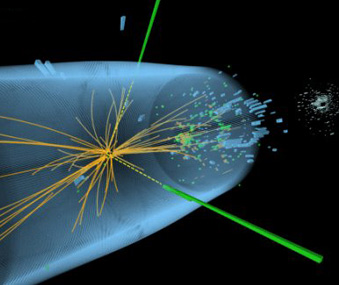
HIGGS & CUSTARD. Physics tackles the very small, Quantum /Sub-Atomic Physics –
and the very large, Cosmology. Among the many mysteries is the moment when
energy was (or is) turned into matter. With E=MC2 Einstein proved
that mass is compressed light. Since then particles are measured as electrical
energy or light. (See earlier articles). The Higgs might logically link the
micro and macro worlds. Popular journalism paints a picture of fat Higgs Bosons
wading through thick custard that “sticks” to the particles giving them mass;
while other particles such as photons and electrons zip through the custard
without hindrance (or mass). Fermilab uses the analogy of fast fish swimming
through water compared to a fat physicist wading through water; in a popular
video. It seems to me that both universal custard fields and ocean fields are
metaphors for The Aether.
Science believes that
matter was created from Pure-Energy or Light a micro-second after the beginning
of the universe – in the alleged Big Bang. How did it do it?
THE STANDARD MODEL, dissecting the workings of the atom, dates from about 1920 and
has been added to and applied in the real world so often by so many scientists
that it is accepted as utterly reliable. However, it does not bridge the gap
from sub-atomic to astronomic, nor explain gravity, nor why 80% of the energy
of the nucleus (protons and neutrons made of Quarks) of atoms is “missing”, nor
why cosmologists need to assume that, not yet detected, Dark Matter and Dark
Energy make up the 90% “missing” mass of galaxies like the Milky Way. Defining
The Higgs might answer “How was Matter Made? How was Straw spun into Gold? How
did Pure Energy get its Mass?
THE CUSTARD IS THE HIGGS FIELD: Einstein dismissed the Aether as
unnecessary. Earlier scientists had conjectured that a matrix that conducted
light filled the universe. I have long thought that the Aether does indeed
exist. My Aether-Matrix, made of the intersecting light from all phenomena from
galaxies to brain-waves, detectable everywhere by eye (visible light) or
instruments (radio waves) and reproducing “holographic” images of the universe
at all scales, is scientifically undeniable, if little known. It does indeed
conduct Light.
www.noelhodson.com/index_files/Life-Universe-Everything-8Mar2011.pdf
THE HIGGS
BOSON
is deemed to be the unit of energy in an approximately atom sized sphere of 70 pm - 70 trillionths of a meter). The boson weighs about 115MeV/C2 to 125MeV/C2.
In English, these are 115 million electron volts to 125 million electron volts
each divided by 90 thousand trillion - and in ordinary arithmetical units the
Higgs Bosons weigh:
from 0.000000000000000000000205010000 grams
up to 0.000000000000000000000222830000 grams
Bosons are about 134 times as large as protons (which are at the heart /nucleus
of atoms alongside neutrons). All the
“Higgs Bosons” in the entire universe link with each other to make “The Higgs
Field”. By definition a field has no parts so each Higgs Boson (a boson is in
the photon /electron family) permeates the whole universe. {For me, this logically implies that the Higgs Field, or Aether, or
my Aether-Matrix has the capacity for instantaneous communication, across a
sentient medium; logical because sentience and intelligence (our brains for
example) emerge from this field.}
PUTTING ON WEIGHT: Atoms are often depicted as shells within shells as in this
uranium 238 atom (92 Protons + 146 Neutrons).
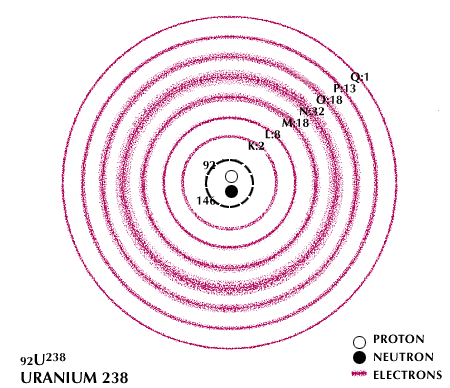
Science cannot “see”
these shells but experiment shows how they act and we can apply that knowledge
in practical machines. This is The Standard Model in daily use. The different
particles are never static but in constant flux, as if pulsating. Even at
Absolute Zero temperature, when everything freezes, they still slightly
pulsate.
Pre-Higgs, where and how
the particles acquire their weights /mass is not clear. If we imagine this atom
swimming in the Higgs Field, the ubiquitous journalists’ “Custard”, the
particles are getting their mass – their energy (mass and energy are
interchangeable) from the Higgs Bosons that “carry” or “confer” or “transmit”
the mass/energy to the particles (which are not particles but Wavicles). So,
The Higgs field of Higgs Bosons might be thought of as an all permeating shell
around each atomic particle.
In my EIG Theory, the
different masses expected of diverse Higgs Bosons accords with the differing
vacuums spheres created in the field by the unceasing expansion of the
universe. It is in those spheres that I speculate matter is created from light.
23
FEB 2012 To Melvyn Bragg BBC 4 discussion - Conductors & semiconductors.
Electrons do not flow down wires. A current from a power
station creates a carrier wave, guided by the wire, which jiggles /energises IN
SITU electrons. No electrons flow from dynamos to your home socket. Ditto for
telephone signals - a carrier wave, within and without the wire, jiggles IN
SITU electrons. The planetary model has been a very brilliant & useful
image; but electrons do not hop from atom to atom. Conductive materials have
electrons/orbits that will take in more energy and pass it on - non-conductives
do not; their orbits/waves are stable (full).
I think the mechanism will come to be more understood with Casimir
principles, where some wavelengths are excluded and some included in narrow confines.
What moves is the mysterious basic "stuff" of the universe - we
detect its intersections as particles. I
think. –
4
January 2012 – Structure of the universe - Aether-Matrix & Pauli.
The Aether-Matrix (that I propose as a fundamental scientific fact of the universe) formed by the electromagnetic signals or waves of all phenomena of all sizes, creates zones or spheres on all scales; each sphere is unique in that it “sees” the entire universe from a different angle and on a different scale than all other spheres. One of the forces that holds these spheres in place and contributes to the inertia of the universe is the Casimir effect. (See slide summary http://www.noelhodson.com/index_files/Life-Universe-Everything-8Mar2011.pdf
or read the paragraphs below).
Given the existence of the Aether-Matrix; it has a large-scale
structure that necessarily changes slowly, over eons of time as galaxies etc
change position, while the sub-atomic detail, the information, within the
structure changes instantaneously and constantly as the Aether-Matrix is
informed and reformed by signals from all phenomena; such as the human brain
(see the slides). On a human scale, the
Aether-Matrix is a permanent, rigid, inert scaffolding that supports phenomena
such as our bodies. So, how do we form
and move through or in it?
As stationary objects, we occupy a number of Aether-Matrix unique
spheres. Their unique identity confers uniqueness on us (and all phenomena).
When we move, say at walking pace, we may not alter the location of any spheres
as each is a holographic representation of the entire universe, but we re-posit
or reposition ourselves by applying energy to occupying new spheres and forming
ourselves anew in a new location. We colonise and appropriate the new spheres
with intention (and perhaps sometimes with consciousness). So, the universe, the Aether-Matrix remains
still (though constantly changing its information at a sub-atomic level) and we
dissolve and reform step by step, breath by breath, thought by thought.
Two humans or any defined phenomena cannot occupy the same spheres.
This is in accord with the Pauli exclusion-principle at a sub-atomic scale and
is self-evident at a macro-scale. If,
for example, a laboratory reared Oxbridge physicist attempted to occupy the
precisely same spheres currently colonised by Genghis Khan, a merger would be
resisted and the most probable outcome can be calculated by reference to their
relative energies. Similarly, if Genghis
Khan insisted that his sword, scimitar or dagger should occupy some of the
spheres colonised by the physicist, then the latter is likely to move rapidly
to new spheres or, and this is important, the phenomenal pattern intended and
maintained by the physicist will be substantially disrupted, perhaps to the
point where the energetic intention is overwhelmed and the entire pattern
disintegrates. Similarly, should a swarm
of cholera bugs invade the spheres occupied by Genghis Khan, they might well
prove to be more integrated and energetic than him, and thus persuade him to
re-locate in the Aether-Matrix.
What the above parable illustrates is that the entire Aether-Matrix
supports and accommodates all and any phenomena of whatever scale. The energy required for phenomena to change
location in the macro Aether-Matrix is relative to size or mass and the rate of
change or speed – and, of course, to what might already be occupying some or
all of the desired spheres.
3
DEC 2011 – A short, horrified anthropological diversion.
The
Guardian 3 DEC 2011, reports the terrible and shocking news that in the
Such
astonishing bullying and killing of helpless victims seems so alien and deeply evil
that the subject warrants some analysis.
(1) Sexual Highs – Cases such as Rosemary and Fred West who tortured and
killed women – and other infamous cases of sexual sadism - attest to the rare
addiction of attacking others for sexual “highs”. Such motives underlie the
medieval Witch Trials and today’s punishments in 3rd world regions of stoning,
flogging and imprisoning young women for “sins”. (2) Repressed Incest – Fathers,
uncles and other adult males might resent the girls bestowing favours on their
(non-tribal) suitors. Such resentment becomes perverted into a need to punish
the sexually attractive girl for the “sinful” feelings in the aroused male
relatives. Attacks and rapes are then justified. (3) Sexual competition – Most communities
have historically created wars to justify the old sending the young men to
their deaths; leaving the young women for the tribal leaders. Some ancient communities
did not need wars; the elders simply had the power to own exclusive harems.
Such behaviour is common in animals – for example bull seals, stags, etc. (5) Bullying and Oppression – all communities
contain a proportion of cruel bullies, male and female; who emerge whenever
politics and customs allow. These
“honour” families are examples of how the basest of behaviour can be normalised
in secretive, closed primitive groups. (6) Anthropological Roots – Troupes of
primates, including our nearest relatives, chimpanzees, similarly attack their
own children over mating habits. It seems that this evil also exists in nature,
even among the unconscious and “innocent” primates.
Perhaps
the only cure for the madness is evolution, accelerated by education. In the
meantime, advanced civilisations must actively protect the vulnerable by
applying existing laws.
http://pin.primate.wisc.edu/factsheets/entry/chimpanzee/behav
Restrictive
mating, where the dominant male restricts other males from mating with estrous
females in the community, consortship mating, where an adult pair leave the
community for several days to weeks, and extra-group mating, where females
leave their communities and mate furtively with males from nearby communities
(Goodall 1986; Gagneux et al. 1999). Chimpanzee social and mating groups do not
always overlap, given the variety of reproductive situations. This may have
evolved because females have limited choice in mates after committing to a
community, and the dominance hierarchy of males often dictates which males an
estrous female will mate with. By having multiple strategies, females can expand
the pool of males from which they choose while not losing the important support
of the males in their communities (Gagneux et al. 1999). Having multiple
strategies also maximizes the chances of males' reproductive success; they are
able to vary, throughout their lives, their mating strategies with depending on
their position in the dominance hierarchy.
************
3
AUGUST 2011 – Music of the spheres – structure of the universe.
Waves in water, air, rock, magma,
electromagnetic fields, and I suspect in molecules, atoms and atomic particles
share a common pattern in that they all strive to be expanding spheres.
Planets, moons, stars and perhaps galaxies also tend to be spherical. Why many
galaxies are plate and saucer-shaped needs might perhaps be accounted for by
their environment. Most life forms are spherical albeit with wilful protrusions
into their environment; cells, curled up DNA, seeds, embryos, etc. Light,
sound, material vibrations, planets, solar systems and energy, all propagate as
spheres. If uninterrupted, they would be perfect spheres – so perhaps the
ancient Greeks were right. But they, all
phenomena, and we the people, are not alone and unimpeded. All phenomena in the
universe have to accommodate all other phenomena. We, and everything, are in
contingent relationships in an existing field; which we may as well call The
Aether. Every energetic event, whether
massively obviously explosive or minutely covertly static, whether persisting
for eons or milliseconds, is in fact a dynamic system in motion, propagating as
a sphere. Much of what we observe in science is the intersection of these
(would-be) expanding spheres with the in-situ universe or Aether. Thus, we look
at any part of the sphere, expanding in waves from a central event, and find a
particle, which, we then observe, propagates along a line dictated by the
expansion. Reminding ourselves that everything we observe is of, on or in an
expanding sphere, albeit often not able to expand, or remain spherical and
therefore quivering in-situ, shifts our perception and thus the basic models of
the universe. This structural law, the music of the spheres, could account for
so many westerners becoming as near spherical as possible – with their limbs
protruding just and only sufficiently to allow locomotion to the next full-fat
meal.
26
JUNE 2011 – Photon Aether, solves spooky action at a distance.
Anil Ananthaswamy writes in New Scientist 25 June 2011, page 13, of spooky action at a distance and quantum entanglement; citing recent experiments where “a single photon exists in three locations”. I am reminded that light, or a single photon, does not actually travel as might a bullet from a gun. Light propagates. It is stimulated from/by an energetic event and it illuminates the surrounding space as a sphere. Just as electrons in a telephone cable do not travel along the wire but excite electrons in-situ via a carrier wave, and just as a shout or call does not propel a stream of air from mouth to ear across a ravine, and just as electricity does not push electrons from a dynamo through wires to the socket in your home, but excites in-situ electrons; light moves outwards in spheres and propagates by contingent relationships with in-situ photons. The energy wave energises in-situ photons and moves on at 300,000 KPS. This spherical radiation of light is ubiquitous, obvious and self-evident. Most current thinking has difficulty with the concept of in-situ photons, everywhere, which implies the Aether. However, current thinking is probably wrong (See my holographic notes below). The implications of spheres of light include the light being detectable, after one second, from any compass point or observers’ locations, simultaneously, even if the locations are each 300,000 km from the centre of the energetic event – thus being 600,000 km apart. If the energetic event, the stimulus, is just one-photon-power and can be classified as a single photon, it nevertheless could be detected at all points on the sphere, which expands at 300,000 KPS. The photons pre-exist everywhere.
9
May 2011 – Heretical physics.
I have been reading science magazines and popular books for 52
years. There seem to be more questions unanswered than answered, which is a
sign of a healthy collective scientific psyche. But some Big questions have
lingered for so long that they threaten to outlive me – which is untenable. So
I have set out the Big answers – while attempting to respect all the
information I have been exposed to – by filling in the gaps that have nagged
away at my sense of logic and perspective for many decades. It is not science as you (or I) know it – but
the ideas may jog or jolt some enquiries into new directions. It is also posted on You Tube – search for “Eternal
Life, The Universe and Everything”. One
of the largest scientific gaps or omissions is the lack of understanding of or
even acknowledgment of the Life Force as a primary organising force that we see
all around us and that should rank with the basic forces of physics.
Summaries of
some of the gaps - from 58 years of reading:
http://www.noelhodson.com/index_files/Life-Universe-Everything-8Mar2011.pdf
http://www.noelhodson.com/index_files/Seed-within-a-seed-APR-2011.pdf
4
February 2011 – From physics to metaphysics and metaphors.
Many scientists purport to be
focused and objective with no interest in “non-scientific” distractions, such
as The Meaning of Life, God, Life-Force, Soul and Spirit. I suspect that some
of these scientists are not being entirely objective about their inner
motivations. I suspect that many are in fact deeply curious about the big
questions that religions attempt to answer: Why we are born; Where do we come
from; Why do we die; Where (the hell) are we going?
Here is my current, plastic,
debateable view on how we, and our souls, might exist in and relate to the
universe.
I read in Electric Universe – How
Electricity Switched on the Modern World, by David Bodanis ISBN 0-316-72972-8
Page 74:
“…Lift your finger and this
slightly stronger field spreads outwards, like the light from the Statue of
This basic information is
fundamental, first year stuff to all physicists – and it is how a low powered,
comprehensible telephone conversation travels thousands of miles along undersea
cables – electricity > magnetic field > electricity > magnetic field
and so on. These energies are perpetual, unending, infinite, immortal and as eternal
as the universe itself. We, we humans, generate such fields from every movement
we make and with every thought in our electrically powered brains. Perhaps a
similar set of forces and fields generated by electrons in motion also operate
and oscillate between all other subatomic particles and their fields.
Putting these facts together
with my stubborn insistence on reviving a structured universal energy field,
such as the Aether and with Inertia and in a Holographic (see my description of
a holographic universe below) energetic universe, I propose that every action
and thought we generate, from birth to death, and perhaps from pre-birth to after-death,
is broadcast out as electric -> magnetic -> electric fields etc, as
clearly and coherently as telephone signals, to blend into, subtly change and
add to the sum total of information in the universe. The subtle changes do, in
scientific fact, alter the energy patterns of the universe, which in turn
affects all phenomena. As fields have no parts, such changes to the energy
field might be instantaneously known or recognised by the whole field – and
feed back to the whole universe, including to us, ourselves, the conscious,
intelligent generators of these particular subtle field forces.
Thus, the universe evolves with
every action and thought (which are actions) made by all existent phenomena in
the universe. And, thus, we are born into a world pre-stressed, pre-formed, pre-pared
and pre-packaged and pre-ordained by all that has occurred since the beginning
of time. And thus our arrival has an impact on the world. And thus our subtle
data, information and electrical signals, our essence, our soul – does live on,
in a coherent form – forever.
And if such signals can be
generated by humans – maybe the obverse is true – that we humans take our
physical form, we are informed, from such persistent signals, such energies,
modified by our immediate environment – such as parental DNA, geography, diet,
events, weather etc.
Heaven Forfend! We might even receive information from an
earlier life history – not necessarily in our own genetic family line.
QED
RYDBERG’S CONSTANT – IDIOT’S GUIDE
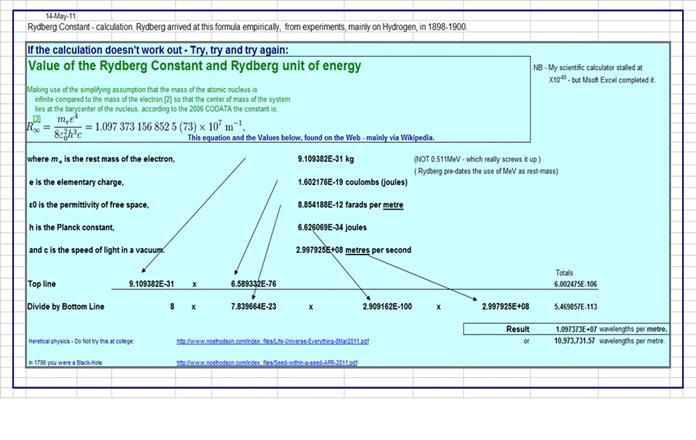
22
Jan 2011 – Spinning on their axis?
New Scientist 22 January 2011 page 16 briefly reports that the
Planck spacecraft and an “instrument” in the Canary Isles have detected
microwaves from interstellar dust clouds which are interpreted as coming from
charged dust grains, small enough to be set spinning on their axis by
collisions with photons, turning at “tens of billions of times per
second”. (arxiv.org/abs/1101.2031).
No researchers’ names or organisations are given by NS and there
are no explanations as to how this startling conclusion is reached. Startling
because, depending on how many tens of billions of turns the grains are making
& what circumference they have, the surfaces of the spinning grains might
be moving at more than light-speed, which is a mere 300,000 km per second or
1/3rd of one billion km per second. And startling because such
whirling dervishes caused by photon collisions are similar to the basis of EIG
(this website’s theory) where energy is spun into matter through photon
collisions. Also startling because such speed raises the question of how the
grains remain intact and do not fly apart. Do they rely on dark-matter for
their integrity? Or do they rely, as EIG avers, on the vacuums caused by Hubble
expansion? We need to know more, so:-
(24th Jan
2011 – Addendum – Sadly, the arithmetic doesn’t indicate a spin anywhere near
the speed of light, which EIG is looking for. If the Grains have, say, a 10-6
metres circumference (compare to an atom at 10-10 metres) then a
Grain would have to spin a million-billion times per second to be equivalent to
light speed. The analysts’ reports below
only speak of tens of billions of turns per second – 100,000 times less than
light-speed. The remaining relevance to EIG is that it seems that photons can
impact Grains and set them spinning rapidly. Can photons impact each other and
create spinning vortexes?)
Cornell Library -
seems to be the primary source:
http://arxiv.org/abs/1101.2031
Planck Early Results:
New Light on Anomalous Microwave Emission from Spinning Dust Grains
Authors: Planck
Collaboration: P. A. R. Ade,
N.
Aghanim, M. Arnaud,
M.
Ashdown, J. Aumont,
C.
Baccigalupi, A. Balbi,
A. J.
Banday, R. B.
Barreiro, J. G.
Bartlett, E.
Battaner, K. Benabed,
A. Benoît,
J.-P.
Bernard, M.
Bersanelli, R. Bhatia,
J. J. Bock,
A.
Bonaldi, J.
R. Bond, J. Borrill,
F. R.
Bouchet, F.
Boulanger, M. Bucher,
C.
Burigana, P. Cabella,
B.
Cappellini, J.-F.
Cardoso, S.
Casassus, A.
Catalano, L. Cayón,
A.
Challinor, A. Chamballu,
R.-R.
Chary, X.
Chen, L.-Y
Chiang, C. Chiang,
P.
R. Christensen, D. L.
Clements, S. Colombi,
F.
Couchot, A. Coulais,
B. P.
Crill, F. Cuttaia,
L. Danese,
R. D.
Davies, R.
J. Davis, P. de
Bernardis, G. de
Gasperis, A. de Rosa,
G. de
Zotti, J.
Delabrouille, J.-M.
Delouis, C.
Dickinson, S.
Donzelli, O. Doré, U. Dörl, M. Douspis,
X. Dupac,
G.
Efstathiou,
T. A.
En\sslin, H. K.
Eriksen, F. Finelli,
O. Forni,
M.
Frailis, E.
Franceschi, S.
Galeotta, K. Ganga,
R.
T. Génova-Santos, M. Giard,
G.
Giardino, Y.
Giraud-Héraud, J.
González-Nuevo, K. M. Górski,
S.
Gratton, A.
Gregorio, A.
Gruppuso, F. K. Hansen,
D.
Harrison, G. Helou,
S.
Henrot-Versillé, D. Herranz,
S.
R. Hildebrandt, E. Hivon,
M. Hobson,
W. A.
Holmes, W. Hovest,
R. J.
Hoyland, K. M.
Huffenberger, T. R. Jaffe,
A. H.
Jaffe, W.
C. Jones, M. Juvela,
E.
Keihänen, R.
Keskitalo, T. S. Kisner,
R.
Kneissl, L.
Knox, H.
Kurki-Suonio, G. Lagache,
A.
Lähteenmäki, J.-M.
Lamarre, A. Lasenby,
R. J.
Laureijs, C. R.
Lawrence, S. Leach,
R.
Leonardi, P. B. Lilje,
M.
Linden-V\ornle, M.
López-Caniego, P. M. Lubin,
J.
F. Macías-Pérez, C. J.
MacTavish, B. Maffei,
D. Maino,
N.
Mandolesi, R. Mann, M. Maris,
D. J.
Marshall, E.
Martínez-González, S. Masi, S.
Matarrese, F. Matthai,
P.
Mazzotta, P. McGehee,
P. R.
Meinhold, A.
Melchiorri, L. Mendes,
A.
Mennella, S. Mitra,
M.-A.
Miville-Deschênes, A. Moneti,
L.
Montier, G. Morgante,
D.
Mortlock, D. Munshi,
A. Murphy,
P.
Naselsky, P. Natoli,
C.
B. Netterfield, H.
U. N\orgaard-Nielsen, F.
Noviello, D. Novikov,
I.
Novikov, I. J.
O'Dwyer, S. Osborne,
F. Pajot,
R. Paladini,
B.
Partridge, F. Pasian,
G.
Patanchon, T. J.
Pearson, M.
Peel, O.
Perdereau, L. Perotto,
F.
Perrotta, F.
Piacentini, M. Piat, S.
Plaszczynski, P.
Platania, E.
Pointecouteau, G. Polenta,
N.
Ponthieu, T.
Poutanen, G. Prézeau,
P.
Procopio, S. Prunet,
J.-L.
Puget, W.
T. Reach, R. Rebolo,
W. Reich,
M.
Reinecke, C. Renault,
S.
Ricciardi, T. Riller,
I.
Ristorcelli, G. Rocha,
C. Rosset,
M.
Rowan-Robinson, J.
A. Rubi\no-Martín, B.
Rusholme, M. Sandri,
D. Santos,
G. Savini,
D. Scott,
M. D.
Seiffert, P.
Shellard, G. F. Smoot,
J.-L.
Starck, F. Stivoli,
V.
Stolyarov, R. Stompor,
R.
Sudiwala, J.-F. Sygnet,
J. A.
Tauber, L. Terenzi,
L.
Toffolatti, M. Tomasi,
J.-P.
Torre, M.
Tristram, J.
Tuovinen, G. Umana,
L.
Valenziano, J. Varis,
L.
Verstraete, P. Vielva,
F. Villa,
N.
Vittorio, L. A. Wade,
B. D.
Wandelt, R. Watson,
A.
Wilkinson, N. Ysard,
D. Yvon,
A.
Zacchei, A. Zonca
et al. (156 additional authors not shown)
(Submitted on 11 Jan 2011)
Abstract: Anomalous microwave emission (AME) has been observed by numerous
experiments in the frequency range ~10-60 GHz. Using Planck maps and
multi-frequency ancillary data, we have constructed spectra for two known AME
regions: the Perseus and Rho Ophiuchus molecular clouds. The spectra are well fitted
by a combination of free-free radiation, cosmic microwave background, thermal
dust, and electric dipole radiation from small spinning dust grains. The
spinning dust spectra are the most precisely measured to date, and show the
high frequency side clearly for the first time. The spectra have a peak in the
range 20-40 GHz and are detected at high significances of 17.1sigma and
10.4sigma, respectively. In Perseus, spinning dust in the dense molecular gas
can account for most of the AME; the low density neutral gas appears to play a
minor role. In Rho Ophiuchus, the ~30 GHz peak is dominated by dense molecular
gas, but there is an indication of an extended tail at frequencies 50-100 GHz,
which can be accounted for by irradiated low density atomic gas. The dust
parameters are consistent with those derived from other measurements. We have
also searched the Planck map at 28.5 GHz for candidate AME regions, by
subtracting a simple model of the synchrotron, free-free, and thermal dust. We
present spectra for two of the candidates: bright HII regions that show
evidence for AME, and are well fitted by spinning dust models.
***************** and the
above report is explained as:
http://www.technologyreview.com/blog/arxiv/26261/
Technology Review - kfc
01/13/2011 - from MIT – tells us:
Planck Space
Observatory Begins To Reveal Its Secrets
The first data from one of the most
important space observatories is set to change the way we understand at the
Universe
It's a big week for
astronomers, who have an exciting new dataset to play with courtesy of the
Planck Space Observatory, which is currently surveying the skies while orbiting
the L2 Lagrangian Point some 1.5 million kilometres from Earth.
Planck's most important
goal is to measure the cosmic microwave background, the echo of the Big Bang,
in unprecedented detail. In fact, it's unlikely that any future spacecraft will
do better. That's because the quality of the final data depends on how well astronomers
can subtract nearer objects from the background rather than on the inherent
resolution of Planck's instruments themselves. Whatever picture emerges is
likely to be as good as it gets.
But the Planck mission
has other goals too. Astronomers want to use it to build up a map of galaxy
clusters on huge scales, to spot instances of gravitational lensing of the CMB
and to look at the Milky Way, the planets and the Sun.
Planck has been
collecting data continuously since 13 August 2009 and has almost completed
three surveys of the entire sky.
This week, the Planck
Collaboration of over 200 scientists from around the world release a first set
of data early. They're doing this so astronomers can train other instruments on
any objects of interest.
In particular, they want
to give the Herschel infrared space observatory a chance to peak at any goodies
Planck uncovers. Herschel was launched with Planck and is also orbiting L2
cooled by liquid helium which is gradually boiling away. Consequently, Herschel
has a limited lifespan of only 3 years, which it is already more than half-way
through.
The Planck Collaboration
has released its data in 23 papers placed on the arXiv this week. It's clear
the data is beginning to throw new light on mysteries such as the strange
emissions from dust in the Magellanic Clouds and the properties of the
interstellar medium in our galaxy.
But it's also clear that
we're going to hear a lot more about Planck in the coming years. I've placed
links to all the new papers below, in case you want to get a head start.
18 Jan 2011 –
Immortality & the Power of Inertia
We, and all phenomena, transmit our presence, identity
and actions from birth to death. The transmission signals broadcast themselves
across the universe "until the end of time" as do signals from
quasars, pulsars, etc that reach us from the horizon of the early universe.
Thus we contribute to the inertia of space-time, to
the patterns, energy and structure of the universe. And thus our entire lives,
every trivial and important thought and act is integrated to build the universe
as it manifests today and continues into the far future. The signals we
transmit do not die or diminish, just as signals from the "edge" of
the universe, from 13.5 billion years ago, are still detectable and coherent,
so do our signals persist. From our first stirrings in the womb, to our last
breath, all is transmitted out into the cosmos to form part of the patterns of
electro-magnetic energy or light that is the basic stuff of the universe. Just
as the faintest traces of messages from our spaceships, after decades of
flight, remain coherent even though sent from the edge of the solar system with
a final whisper of electric power, so do our, and all, phenomenal signals,
retain their identity.
This is equally so for each and every atom, electron,
photon and quark as they evolve from pure energy, into matter, into action, and
ultimately decay back to pure energy. The holographic nature of the universe
(see below) where the whole can be “seen” in spheres at every scale – just as
we see, with our eyes and telescopes, the whole image concentrated on the
minuscule retina of our eyes; implies that the whole electro-magnetic field and
its detailed history is detectable, identifiable and analysable on many scales –
scales dictated by the observing instruments. The patterns of the histories of
the universe never dissipate and die – they are as immortal as the universe
itself.
26 October 2010 – White Holes
& Sinks
A theoretical white
hole is the opposite of a black hole (New Scientist 23 October 2010 – page 13) where
everything comes out and nothing can get in.
The simple analogy given is water from a tap pouring down onto a flat
sink. As the water hits the surface it spills outwards in a bow wave, “creating
a ring-like ridge” before the ridge collapses and the outward movement
continues. The nearest to a white hole I
can imagine is the singularity at the start and centre of The Big Bang – where
infinite energy exploded and poured out into the no-thing that became space and
time. I used a similar analogy when conceiving EIG to theorise on how the
original Big Bang matter-less energy, even though meeting no resistance in the
no-thing, might through attenuation arch back on itself to create ripples in
the energy and ultimately to create closed, arched-back globes of matter – the
first particles. Was or is the Big-Bang
a white-hole?
24 October 2010 – Alpha, Aether
and Inertia.
Michael Brooks,
whose book 13 Things That Don’t Make Sense, I enjoyed reading, writes in New
Scientist 23 October 2010 (page 33) about the work of Australian professor,
John Webb, which threatens the consensus view held since 1916 of the universal
sub-atomic particle, fine-structure-constant Alpha, one (Wikipedia) definition
being the 1/137 ratio between The Elementary Charge and the Planck Charge;
another being the ratio, or coupling constant between electrons and photons –
and there are 3 or 4 more relationships which are “determined by” Alpha. As Alpha is calculated and measured
empirically, I think “determined by” is a misnomer. John Webb has found through observation of
light passing through clouds of magnesium and iron, from Quasars, billions of
light years away (and thus observed back in time) that Alpha varies very
slightly, one part in a million, being smaller looking North from Earth and
larger looking South – at light from Quasars.
One Constant
varying will vary all Constants. This in turn seems to threaten the unified
theory and raises a question of faith for scientists. …Do you believe in varying Constants?
My view is, YES,
Constants do vary. The speed of light varies in various mediums and light can
now even be stopped and re-started.
Where would we find the perfect vacuum in which light travels
unvaryingly at 300 kps? - which in a leap of illogic brings me back to the
Aether and Inertia. In the texts below
are a few arguments for the Aether and a Holographic universe, which seem more
realistic with each new report. And I think the definition of Inertia, the
force that holds everything in its place, should be strengthened to include
“…the existing relationships on every scale of all things and energies in the
universe, which change only when sufficient force is applied…” One of the fundamental forces left out is the
Life-Force, the implicit capability for energy and matter to form complex,
living and sentient entities; which may prove to be the most fundamental, yet flexible, of the basic physical forces.
Multiverses and
String-theory may be concoctions and confections of mathematics which in their
brilliant machinations detect but do not define or explain the implicit
dimensions and environments apparent, for example, in a historical family chain
– where a woman contains all the patterns and energies necessary to produce the
next, say 200, generations (with a little input from males along the
line). The implicit universes in that
woman’s present existence – and of her ancestors – provide enough new
dimensions and universes to gratify the most persistent String-Theorist. It
requires us to embrace the reality of the Life-Force as a fundamental force, as
a causal force, as a primary organising force; not merely as a complex of
phenomena resulting from the four traditional fundamental forces. …And the
point is?
The Life Force is
known to be evolvable, variable, adaptable, probably universal, yet constant.
If the universe around us is so astonishingly varied – why might we think that
(mathematical) Universal Constants cannot also vary? For the iron rule of Inertia to adjust all
the component, interrelated parts, Constants and energies of the universe to
admit a new, or exploding, or evolving, or shrinking or expanding phenomenon,
requires the whole universe to shift, to evolve and change. It seems that the Constants can and do
change, revisited by Inertia and communicated by the Aether.
EIG still holds.
10 Sept 2010 - How Many Photons
make you? What is your sphere of influence? Click the link…
http://www.noelhodson.com/index_files/Creatures-of-Light-SEPT-2010-V1.xls
12 April 2010 – Quarks – Rest Mass
– Protons – Neutrons – EIG still works, OK !
As I have just
completed 10 weeks learning about particle physics and The Big Bang, and before
I take up the post offered to me, as CEO of CERN, I am in an authoritative
position to further speculate on the moment that and the process whereby straw
is spun into gold – or energy becomes matter …and how C2 is
possible, in contradiction to the law that nothing can travel faster than
light-speed. One of the factors that
leapt out my student’s notes was that the rest-mass of the 3 Quarks, 2 Up
Quarks and 1 Down Quark, that reside inside a proton are a small part, less
than 15%, of the rest-mass of the proton. This mirrors the equally baffling
mystery of the missing mass, Dark Matter, in the star-studded universe.
Protons are very
reliable bits of atoms which last for almost all time – as near to an infinite (half)-life
as we humans can imagine. If the Quarks
are, or themselves consist of, my rapidly spinning fractals – which EIG claims
as the fundamental building blocks of matter (see below) - then I can imagine
that the 85% of missing mass of the proton is the energy created by their
spinning at C squared – which is 90 billion kilometers per second – and the
consequent attraction between the fractals as the spins continuously wind-in
and lock-up energy (see the three vacuums below) – and as the Casimir Effect
further binds them together. The dynamic
between (1) the intertial forces that would tear apart the spinning fractals
and (2) the depleted energy field surrounding them, which by its nature must
reach out infinitely; is the very essence of matter. Even after 10 weeks of particle-physics, EIG
could still be a viable idea; or am I a blindly stubborn student.
BROOKHAVEN - ECHO OF EIG’s
VORTICES
22 February 2010 – Quark-Gluon
plasma forms vortices.
This New Scientist
article and the useful visual video (complete with commercial sponsor) has
several similarities with the basic physical theory expressed in EIG (as to how energy is converted to matter and
how C2 is possible, in contradiction to the law that nothing can
travel faster than light-speed). It
is worth duplicating in full. I will
consider the implications when time allows.
BROOKHAVEN VIDEO - Quark Gluon Vortices FEB 2010
Atom smasher shows vacuum of space in a twist
17:27 15 February 2010 by Rachel Courtland
Magazine issue 2748.
Ephemeral vortices that form in the vacuum of space may have been spotted for the first time. They could help to explain how matter gets much of its mass.
Most of the mass of ordinary matter comes from nucleons – protons and neutrons. Each nucleon, in turn, is made of three quarks. But the quarks themselves account for only about 1 per cent of the mass of a nucleon. The remainder of the mass comes from the force that holds the quarks together. This force is mediated by particles called gluons.
A theory called quantum chromodynamics is used to calculate how quarks and gluons combine to give mass to nucleons, but exactly how this phenomenon works is not fully understood.
One possibility is that the fields created by gluons can twist, forming vortex-like structures in the all-pervasive vacuum of space, and when quarks loop through these vortices, they gain energy, making them heavier.
STAR find
Now the Relativistic Heavy
Ion Collider (RHIC) at the Brookhaven National Laboratory (BNL) in
To find the vortices, a team used a detector called STAR to analyse the particles created when the collider smashes gold or copper ions head-on at high energies. This process creates a fireball that is about 4 trillion kelvin at its core, a temperature high enough to form what's known as a quark-gluon plasma.
So what has this got to do with vortices created by gluons in the vacuum of space? If two ions collide off-centre, the ensuing fireball starts rotating, creating a powerful magnetic field. If gluon-created vortices exist, this magnetic field should cause quarks in the plasma to separate in accordance with their electric charge, says Dmitri Kharzeev, a theorist at BNL who predicted the effect.
That is exactly what the STAR
collaboration saw: more positively charged quarks moving in one direction and
more negatively charged quarks moving in another, says Nu Xu, spokesman for STAR.
The findings were presented on Monday at a meeting of the American Physical Society in
Direct manifestation
"It's a direct experimental manifestation of a property of quantum chromodynamics that has never been seen in the laboratory before," says Krishna Rajagopal of the Massachusetts Institute of Technology. "It confirms our understanding that gluon fields can have twists."
The evidence of the vortices in the vacuum of space is best seen in a quark-gluon plasma, which requires high energy collisions. The effect can be confirmed by studying the extent of quark separation at lower energies, so later this year the RHIC team plans to begin smashing ions together at lower and lower energies (Physical Review Letters, DOI: 10.1103/PhysRevLett.103.251601).
But it's not yet clear whether gluon-created vortices – also called instantons – appear frequently enough to account for most of the mass of nucleons.
The key lies in measuring with greater precision the separation of charged quarks in the fireball seen at the RHIC. The more vortices created by gluons, the more the charged quarks should separate. This measurement could help pin down exactly how prevalent these instantons are in the present-day universe, says Kharzeev.
NOT NEARLY THERE – QUESTIONS TO
EXPLORE?
25 January 2010 – Bouncing photons
and constant in-falling.
Last week at my
first evening class on particle physics I asked what space is occupied by the “pure
energy” which results when two particles collide and annihilate each other; and
I asked what the pure energy is.
Pure energy is
photons or electromagnetic radiation or light.
Where the energy is in space-time was more problematical and did not
elicit a simple answer. At first the lecturer said that the liberated energy
did not exist in space and time, before saying it was more complicated than
that – and moving on.
We also learned
about
Recently (Oct-Dec
09) I read in New Scientist or Scientific American that some physicists now
ascribe a mass to the mass-less photon.
Thinking about
these matters leads me to an extension of EIG:
1) The
gravitational force is an ever present ubiquitous force of matter tugging on
matter, which EIG has so far explained as due to Hubble Expansion.
2) Very recent
articles speculate that weightless photons do in fact have rest-mass of the
photon divided by the speed of light C2 (some say it is 1.8 x 10-42 grams). See photon-mass below at Three illuminated thoughts - 2 November 08.
But
photons are never at rest. I want to
explore the idea that E=MC2 actually means what it says – and that a
particle or an entire atom is indeed made of light compressed onto centres (by
the original EIG mechanics below). The
space/sphere which the light occupied before compression (or precipitation like
a crystal forming) is calculable by a variant of E=MC2, requiring a
certain number of photons or light waves to make up the mass of the
particle. Thus the particle of matter is
at the centre of a system where photons in-fall and congregate and come to an
uneasy resting place (NB quantum fluctuations). But to be a gravitational
effect the in-falling must be continuous. This could be caused by Hubble Expansion
continually expanding the space occupied by the particle AND by the photons
compacting down over the lifetime of the particle due to the continual
bombardment by incoming photons. Ultimately the compacting mass, like cosmic
black holes, explodes, liberating the photons.
THE BIG BOUNCE –
just as Rutherford demonstrated that helium nuclei can bounce off gold nuclei,
then in-falling photons might bounce off nuclei and as they bounce, fluctuate
from waves to particles like electrons to magnetic fields (the essential
conversion of energy to matter), bouncing out to the margins of the (relatively
empty, vacuum) space previously occupied by photons, now congregated at the
centre of the particle. This bounce and in-falling process is the characteristic
wave-length of the atom (or of the particle) and it creates the electron
orbit/s diameter/s of the atom /particle.
An implication is that the bouncing process might apply to all the
photons (each in turn, leaving an attractive mass at the centre) which expand
in waves out to the margins of the space from whence they came – to collapse
back again into a singularity (photon) within the mass. The space affected by a single particle is
limitless as an emptying sphere would draw in energy from neighbouring regions
to infinity – but definition and boundaries would be defined by neighbouring
matter. However, the signal would
theoretically reach to the edge of the universe.
THE BIG SPACE –
DARK ENERGY – DARK MATTER – C squared, is 90 billion kilometres per second and
expressed in metres is 90 trillion metres per second. Even in fractions of a
second, e.g. the half-life of a particle, the radius from the centre of mass of
the sphere of electromagnetic energy which in-fall to create the particle – is
large. As speculated below, this
emptying, or partial depletion, of a space of its light energy, reduces the
mass of that space – which counter intuitively could let-go-of and allow the
faster expansion of space-time – the Dark-Energy of astrophysicists. The in-falling process, initiated by Hubble
Expansion, is the missing Dark Matter which some astrophysicists seek to hold
galaxies together.
3) NB – The photon
as a wave/particle is almost certainly the basic transition phase between pure
energy and matter. It is true that all
matter is made of light and the EIG concept could indeed be a mechanism for
spinning the straw (energy fields) in to gold (particles of matter).
Will Microsoft
Office EXCEL cope with 10-42? I doubt it, but it’s worth a try.
Let’s see if we can
calculate how many photons make the mass of a quark, a person etc – and the
size of the energy sphere which needs to be compressed. It will surely show that I have a
commandingly large presence in the universe.
1 DEC 09 – The
Electric Universe - A dilemma:
25 Jan 2010 NB – New
Scientist 23rd Jan 2010 reports confirmation of an electric-magnetic field on
the outskirts of our solar-system – which is a basic claim of the Electric
Universe. Magnetic mirror A mysterious "ribbon" of
particles at the edge of the solar system has been explained. The ribbon,
spotted by NASA's Interstellar Boundary Explorer spacecraft last year, is the
reflection of the solar wind in a giant magnetic field in the interstellar
space next to the solar system (The Astrophysical Journal Letters, DOI: 10.1088/2041-8205/708/2/L126).
The Electric Universe,
by the self-professed scientific heretics Wallace Thornhill and David Talbot,
makes very large claims for electricity as the primary universal force, “…a
thousand, trillion, trillion, trillion times more powerful than gravity” (page
8). 1,000,000,000,000,000,000,000,000,000,000. ( 1030 )
One of the major
components that the established Big Bang gravitational theories lack (in my
view), is the Aether – a universally connected field. I surmise that the Aether
does exist as holographic spheres / zones on every scale, each one unique due
to the differing angles of interception, from each of which the whole universe
can be seen – courtesy of light / electromagnetic waves and particles – and the
spheres have substance, due to the pressure of the waves and particles exert on
each another as they cross or collide. (See more on Holographic Universe below).
This holographic matrix may underpin Inertia.
As I read The Electric
Universe my Aether starts to look like their all pervasive plasma. Traditional physics demands absolute vacuums
of space, with one or two stray hydrogen atoms etc per cubic metre, but
incapable of transmitting anything other than gravity – a force which nobody
understands. Thornhill & Talbot
claim that electric currents fill the universe and link all celestial
bodies. I thought about the Earth, with
its known magnetic-field, and thought about it hurtling round the Sun, through
the heliosphere and other planetary forces and fields and realised that a
moving magnetic field should create an electric current – and vice-versa.
So I will read on and
reconsider 40 years of received Big Bang wisdom.
I am probably a good
subject to be on the horns of the Big Bang or Electric Universe dilemma – two
theories which may of course not be mutually exclusive. I have never seen an atom smasher, a cloud
chamber, a cyclotron – and must trust the reports and interpretations published
in popular science magazines and books.
On the other hand, I have never seen a plasma chamber, alive with
coloured electricity, doing amazing things – and must trust the reports and
interpretations I read about those events.
My EIG paradigm, on
which this webpage rests, may have to change.
More - later.
The Electric Universe by Wallace
Thornhill & David Talbot - 3 Nov 09.
I am reading The Electric Universe (www.thunderbolts.info) which popped-up as I was searching for “Physics,
I am reading these theories and looking at the accompanying
videos with great interest not least because my thinking (see Heavyweight empty
space 28 Sept 09 etc - below) has led me to a ‘dynamic interpenetrating
electromagnetic holographic universal matrix at every scale (DIEHUMES)’ – which
could be the long lost pre-Einstein Aether – a universal field which in my view
ought to exist to account for Inertia.
TEU theory might solve or dispose of several mysteries
including Hubble Expansion & the Size of the Universe, Dark Matter, Dark
Energy, Anachronistic Stars and Galaxies, Life Cycles of Stars, Scalding Hot
Solar Corona on our Cool Sun, Dirty-Snowball Asteroids, Lost Spacecraft,
String-Mathematics, Math-a-mystic Multiverses, Aurora Borealis and
Self-Cleaning Solar Panels on Mars Landers.
However, good old gravitational calculations and quantum
& celestial mechanics have accurately put men on the moon and satellites in
orbit round planets – without being electrocuted, yet, - so they must be a bit
right.
I am drawn to read more of TEU by my natural inclinations
towards the familiar – we all know what a lightning bolt looks like but we do
not know what gravity is – and towards conspiracy theories, where noble
geniuses are silenced by sinister great powers – which every child has suffered
sometime – and by TEU certainty in the face of wishy-washy incomplete hesitant
speculations – we deserve to know it all – Now!. And I like the central idea that the whole
universe is interactive and self-regenerating – maybe not doomed to Heat Death
after all. And, TEU aside, I like the
role of electricity in the Life-Force, where I imagine it perhaps builds the
templates that tissue cells follow as they develop into organisms. TEU does of course highlight other unsolvable
mysteries, including how and why does magnetism create electric currents and
how and why do electric currents create magnetic fields.
Deeper reading – deeper thinking and perhaps deep editing
of EIG - to come.
*****************
NB – for next time. Light does not travel – it propagates; the implication being that like electricity it agitates something that is already there waiting to be agitated. Could this be so for all particles??? Back to the Aether and Inertia.
Heavyweight empty space.
28 Sept 09.
The virtual spheres of empty space which accommodate the holographic universe (see below) do have weight or mass. Erect a globe shaped screen in any sphere and it will reflect or capture a picture of the surrounding universe. The picture is formed from electromagnetic radiation or light, which does create pressure (mass). Think of the principles of “solar sails” capturing sunlight. The radiation propagates or in-falls from every direction; if the imaginary screen is removed, the radiation from one direction will criss-cross with and impact on the radiation from another – such collisions might create fundamental motes of matter (maybe quarks); Tenuous, yes, but non-existent, no. To recapitulate the characteristics of the spheres:
1) They are expanding with Hubble expansion. This attenuates the field and attracts (allows in-falling) like a vacuum.
2) The smaller the sphere, the more wavelengths are excluded and thus the less dense the internal energy field. The lower density inside a small sphere is surrounded by higher density – which will form “bubbles” in the field. This is similar to the Casimir effect – which has a more energetic role to play later as matter forms.
3) The contents of the spheres have some mass.
4) The spheres nest inside each another like Russian Dolls. And the spheres interpenetrate each other.
We are back to the Aether - I am afraid – which enables Inertia.
Malevolent and Benevolent Viruses. Human DNA exchanges. 2
September 09 + later notes. (A brief aside from Gravity).
17 Sept 09
To: Professor
Chandra Wickramasinghe,
Cardiff Centre for Astrobiology,
Email: Wickramasinghe@cardiff.ac.uk
Dear Professor
Wickramasinghe,
Harmful Viruses -
Helpful Viruses
I have been a fan
of your published work for several decades; so I apologise for burdening
your in-tray with the following speculation - I hope it interests you
enough to consider it:
Most people accept
that a person infected with a flu' virus, a cunning packet of DNA, may walk
into a crowded room and within an hour, all will be exposed to the virus and
many will become ill. Science can test for the presence of such harmful
viruses or mark their past visits.
Given the virus/DNA
soup around us; is it not just as logical that helpful viruses spread just
as rapidly as harmful ones? Are we simply too masochistic, paranoid and
depressive to allow that helpful viruses, or other packets of DNA, can
affect us positively? I think this is scientifically testable.
Below are my
rambling notes on the topic.
I am building a
Dawkins proof bunker.
Best wishes
17 Sept 09 –
Another note: We know where to look for
malevolent viruses, such as the search for the 1918 Spanish Flu’ virus by
digging through frozen corpses in graves and bone-yards in
13 Sept 09 – And
another note: This speculation could be
tested by looking for benevolent viruses.
Also – malevolent viruses such as flu’ do spread through populations at
amazing speed – and so might benevolent viruses. Can we rapidly cure large numbers of people
by releasing a benevolent virus?
Another note: this
time to think about DNA in the context of the Life Force, having watched a TV
programme “The Cell”. A “seriously
clever” heavily bearded, Harvard scientist, intent on making the 2nd
Genesis – a new lab created living cell different from THE CELL which spawned
all life on Earth, was filmed mixing, with a simple swish of the merged solutions,
DNA strands, which make glow-flies glow, with animal cells. When the cells
multiplied, the mixture glowed green showing that the introduced strands had
attached to the cell’s DNA and were multiplying with the cells.
Another interview
was with a
DNA – 4 September 2009. We accept the fact that complex, e.g. flu,
viruses are manufactured in our cells, escape when we sneeze and cough, and
insert themselves into the cells of other people. Let’s class them as malevolent strands of
DNA. It is testable by experiment and
equally probable that “benevolent” strands are passed from person to person.
When listening to the Dalai Lama at the crowded Sheldonian in
DNA – 5 September 2009. ….and we accept that mumps, measles, scarlet
fever etc, in fact all communicable diseases, are passed from person to person
or beast to beast as prions, viruses, bacteria etc – which have been reproduced
with their DNA in others’ cells. We do not know what “junk DNA” which is 80% of
the genome, does or why it exists (just as we don’t know what 80% of the
universe is made of). My speculation is that the entire history and evolution
of the life form is recorded in the Junk DNA, and may be reactivated by extreme
pressures. Does the transmission of
non-malevolent DNA enable the carrying of Dawkin’s Memes from person to person?
Is our DNA changing from moment to moment? And do we pass it around the human
race – thus all share in the new DNA patterns?
If so, it makes more sense of our longevity, well after our allotted
reproductive cycles decline.
Are there two causes of gravity? First Hubble Expansion, Second Casimir
Exclusions? – 13 September 09.
On reading Black
Stars, Not Holes, by Carlos Barcello, Stefano Liberti, Sebastiona Sonego and
Matt Visser, SCIAM, October 2009; and revisiting my own thoughts below, here’s
another crack at a synthesis.
Holographic:
I envisage the
universe as a set of boxes or interpenetrating spheres, each in-formed by
criss-crossing electro-magnetic radiation from the entire universe, apart from
wavelengths too small to impact a smaller sphere – down to Planck’s minimum
(n.b. Casimir Effect). The original,
matterless, universe consisted of energy, and it expanded and continues to
expand as per Hubble.
GRAVITY
ONE - Attenuation: The expansion of
what can be imagined as a featureless energy field creates a universal
attenuation of the field of 6.819E-19% per second. This is the underlying tug of gravity
ascribed to Dark Matter.
Matter: As matter is formed (see below), massive
“volumes” of the energy field are crystallised onto points, subatomic
particles, thus depleting the energy field. The removal of these immense
volumes creates a letting-go of the energy field, which drives expansion in the
manner ascribed to Dark Energy.
GRAVITY TWO – Casimir: I asked below what could create the walls or
plates to bring the Casimir Effect into being.
The tamed, small waves between two large ships on a stormy sea are often
given as a Casimir analogy. The exclusion
space between the ships is only closed from 2 of six sides/planes. The answer to
forming the excluding plates may be simply – matter. Matter could shield areas inside matter
formation from wavelengths. Below is a SCIAM
report that Casimir does operate inside atoms. We thus have two ways in which
wavelengths are excluded. Firstly, long wavelengths by-pass smaller,
holographic spheres, which may cause the spheres to form as bubbles in the
whole (stronger / heavier) energy field.
This would give the holographic universe a real rather than merely
theoretical structure, which would give us the Aether.
Secondly, as matter forms, the matter acts like the
sides of the ships to exclude certain wavelengths and creates the Casimir
effect. While Casimir is the in-pressing
of more (heavier) wavelengths on the outside of the plates as compared to the
inside wavelengths, and is not strictly a vacuum, it nevertheless is a persistent
and relentless in-pressing force which must logically, in a field, reach back
infinitely – until lost in the complicated forces of surrounding spheres and
matter.
Thus, when calculating gravity, there would be two
vectors to apply; the first, Hubble, immensely subtle and barely detectable
(and probably not testable); the second, Casimir, stronger and more
measurable. These two forces, might
explain the anomalies discovered in the speeds of space-vehicle flights.
QED. (For now).
Is the Casimir-Vacuum gravity? – 20 August 09.
A self-reminder to think more about The Casimir Effect and the holographic universe (see paragraphs below). In the smallest Planck space of 10-33M, most wavelengths are excluded as they are too large to impinge. The criss-crossing effect (read below) will be limited to the smallest possible waves and thus the Planck space, say a sphere, will be relatively empty and its “sides” will be compressed together by the denser, larger spheres (accommodating more and longer waves) around it. …And so on up the wavelength scale. But what on Earth could the “sides” of the spheres be made of? Would the relative vacuum inside a Casimir-Planck sphere tug on surrounding energy and matter – or are these simply excluded without any forceful effects?
Crab Nebula explosion expands to the edges of the universe;
and the Life Force, ranked with Gravity, Nuclear and Electrical Forces – 7 Jul
09.
More thoughts on
energy fields crystallising matter at the rate of E=MC2 , and thus about inertia with, perhaps, particles
continually, rhythmically expanding back to energy and then contracting back to
matter – perhaps expanding to the limits of the universe; lead to thinking
about reversing the process.
An exploding atom
bomb converts matter to energy, which manifests in heat, light, radiation and
sub-atomic particles. The explosion makes room for its expansion by pushing
other stuff aside. In this sense it demands to be accommodated in its new form
– expanding from matter to energy – and the universe has to adjust – despite
the reluctance and resistance of inertia.
Does this liberated energy add mass to the electro-magnetic energy field
and does such extra mass have the counter-intuitive effect of increasing mutual
attractions within the energy field and thus, momentarily, slowing the
expansion of the universe? How far from the centre of the event is it felt? Is
there a limit to the effect of the explosion?
In the case of a
supernova such as the Crab Nebula, we can see that the explosion is occupying
an ever increasing volume of space. The fact that we can see it, millions of
light-years away, demonstrates that some of the liberated energy has travelled
as far as our Solar System and - as the supernova occurred a long time ago – we
could figure out the distance limits of its visibility. Does the effect
eventually reach the boundary of the universe - if a boundary exists?
From thoughts about dispersal and contraction of energy and the inertia which provides stability, arise more thoughts about organisation, sentience and life – which is evident everywhere we look. Chaos Theory with its compelling Mandelbrot fractal pictures, had its popular day a couple of decades back and no heathen Richard Dawkins types rose up in anger – or even to now look back in anger – to scoff and scold. Basically, if enough energy is poured into a system, Chaos Theory predicts points of bifurcation where the system spontaneously re-organises itself into what humans recognise as meaningful patterns and “strange attractors” around which matter and energy swirl in artistic mathematical forms. In direct contrast to the allegedly immutable laws of thermodynamics, it seems that the stuff of the universe does not even itself out to become a bland soup or cold dead planets drifting in a dark universe – but it continually takes new forms and creates or produces new organised phenomena – including intelligent life such as humans and tadpoles and grass-seed. Such self-organisation, of energy processing systems, seems to occur at every level, from energy fields to sub-atomic particles, to matter. Is the basic stuff of the universe sentient? Is it not now an appropriate time, in the evolution of the recently born field of “the scientific method” that the Life Force was elevated to a fundamental force worthy of being ranked with and studied alongside the physical forces? Life is all around us and as yet there is no evidence that, or how, physics creates life – perhaps the reverse is true.
Melvyn Bragg & Co - vacuums or not? – 30 Apr 09
Melvyn Bragg on BBC
Radio 4 at 9am this morning asked his panel of particle and astrophysicists if
there is such a thing as a vacuum, either in the vastness of space or within
atoms. Several interesting metaphors and
clarifications emerged in the conversation.
1) The Aether has
been recently replaced by “the Higgs Field” which is deemed to wobble as
electromagnetic waves pass through. I
knew we would get the Aether back eventually, but why ascribe it to Higgs
instead of Hertz or Maxwell or Faraday or Thomson & Co?
2) The inverse
square law of gravity works at a lesser rate inside atoms, which is due to the
Casimir effect. Casimir (1950’s) figured
out that waves inside boundaries can only be as large as the boundaries allow,
e.g. small waves between two large ships on a stormy sea.
3) It was said that
the Red Shift of light travelling across large distances of space is due to the
Hubble Expansion of space stretching the light. This is a new thought for me; I
have always understood the red-shift to be because the source of light is
moving away from the observer – and a blue-shift when the source is moving
towards us. I suppose it amounts to the
same thing. But does it have
implications for the speed of light?
4) Dark Energy –
the force pushing galaxies etc apart – is happening and is a mystery. I have my ideas about this.
5) As
electromagnetic wavelengths get shorter the energy in them increases. I suppose this is another way of saying that
if a long-wave signal is sent with say 10 tonnes/second of energy, then
shortening the wavelength does not reduce the overall energy – thus each peak
& trough has greater energy from the point of view of a target of a
particular size (a human for example) which may not notice, be affected by, a
long wave.
The talk was around
the idea of a cubic meter of black empty space. Is it a vacuum or is there
something there? And ditto about the
relatively huge empty spaces inside an atom – the size of St Andrew’s golf
course with the nucleus the size of a golf-hole; what connects the “orbiting” electrons
and is the space empty? The consensus
was that the cubic meter of empty space is filled with electromagnetic waves
(they are getting there), virtual particles which pop in and out of existence
in defiance of the laws of conservation (borrow Friday and Payback Monday and
no-one notices) and a very few resident atoms (hydrogen etc).
The radio
discussion inspires me to write a “what this site discusses” summary – for busy
executives.
“Ooops” Change to the expansion of the universe constant –
11 March 09
Various recent 2009
articles in New Scientist & SCIAM have quietly introduced the data that
while the Age of the Universe is indeed about 13.7 Billion years old, and that
at the speed of light it might therefore be assumed that the edge of the Observable
Universe is also 13.7 Billion Light Years distant – making that the radius of
the observable universe – in fact, due
to factors beyond our control, the radius of the observable (not necessarily
the greatest distance we can currently see to the edge of the universe, but somewhat further) is 47.5
billion light years, which is therefore the radius.
This buggers-up the
constant for the percentage per second that the universe expands, which I have
calculated and have been using since 2002.
You will find it below, cited as 2.304E-18% per second. The new
number is 6.819E-19% per second, which is a far smaller percentage and rate of
expansion. I apply this rate of
expansion to all, any and every sphere of whatever dimensions. What this change might mean to all the ideas
set out below – if anything – I will have to take time to consider. The most immediate thought is that this even
smaller rate of expansion (which through attenuation/momentary vacuum IS
gravity) makes the process even more subtle and difficult to detect.
“Spooky” action at a distance – 21 Feb. 09
Letter to the Editor
Scientific American
21 FEB 09
THE PULSE OF THE UNIVERSE.
The article by David Z Albert and Rivka Galchen, A Quantum
Threat to Special Relativity, SCIAM March 2009, discussing locality, leads me
to speculate on and to reflect that a telephone signal travelling via the
undersea cables from, say, England to America, is a series
of "travelling" electrons, creating magnetic fields, creating
electrons, creating magnetic fields, and so on. The magnetic fields exist
outside of the cable but are guided by it. This endless pulsing is highly
accurate in re-creating the data carrying electrons from the re-condensing
magnetic field, as demonstrated by the communications they carry. There must be
a powerful force of inertia maintaining such accurate pulsating between matter
and energy field states. If all particles of matter similarly fluctuate or
pulse, which accords with matter condensing energy as in E=MC2, and if magnetic fields
pulse outwards to fill the universe, it would provide a mechanism for particles
to be, by our time reckoning, in both states simultaneously; and would make
accurate measurement of particles impossible.
Such a pulse, governed by inertia, would not necessarily
always re-create the expanded energy field when it condenses back to matter,
precisely as it was before. This potential evolution from moment to moment
allows for the mathematicians’ findings of multi-verses, not existing
simultaneously but from micro-second to micro-second, exploring all possible
universes sequentially. If the expansion of particles into energy fields is a
momentary return to pre-matter existence, the state before the Big-Bang when
matter is deemed to have been created, then the expanded energy fields perhaps
exist in a timeless dimension and as such their communications are not
time limited, allowing action at a distance or non-locality. Fields are
inherently non-local as they have no parts.
The inertia which so accurately recreates the particles
from energy might come from the energy of the magnetic fields interpenetrating
across the universe, forming a matrix which is robust in that every field and
re-condensing particle has its place in the universe, as every other place is occupied;
every particle and field is nudged into its proper place by every other
particle & field. This matrix, which we might for example call the Aether,
would also allow for a holographic universe, in which every sphere of all
sizes, from the sphere of the whole universe (if it is bounded and not
infinite) down to an eyeball sized and down to minimum Planck sized
spheres, are criss-crossed by electromagnetic pulses from every physical object
in the universe and from every immaterial force field. Place a recording screen
or an eyeball anywhere in the universe and its screen will see the whole
universe at whatever size the screen allows. Each holographic sphere image,
made of real electro-magnetic forces, will differ and is unique due to the
different angles from the positions of “fixed” matter and due to the exclusion
of long wavelengths from smaller spheres.
Is this the source of inertia?
The philosophical implications and the responsibility for our personal
actions in such an instantly evolving, interconnected, interdependent universe
are truly terrible.
16 Brookside ,
“All the world’s a hologram” – 17 Jan 09 & 19 Jan 09.
This headline, on an article by Marcus
Chown, New Scientist, 17 Jan 09, promised to echo or at least straighten-up my
thoughts on a holographic universe (below 28 March 08 & 18 Jan 08). But it
seems that Craig Hogan, Director of the centre for particle astrophysics at
Fermilab, of whom Chown writes, is using “holographic” differently to me. Hogan
speculates that interference or “jitter” detected by the gravitational wave
detector GEO600 at
What I do imagine is that in or from any
given sphere of space, every body in the visible universe can be “seen” –
imagine the sphere as a head with eyes looking in all directions, feeding the
images to one retina. And that if that sphere had some physical defining characteristics
such as gas or dust or a glass marble, the whole universe would be seen within
it. In that sense the sphere would be a
holographic image of the universe. I now go on to imagine that in the absence
of any screen, marble, gas or dust, what else might reflect or fix the
minuscule image of the great universe?
The unending stream of particles and waves, including tiny neutrinos,
criss-crossing the universe could be the ephemeral spherical screens on all
scales which capture images (or are informed by) of galaxies, supernovae,
stars, planets, and even smaller phenomena. In fact, there is no logical reason
to limit the sensitivity until the spheres are so small that wavelengths pass
them by and will not fit into the space.
And this imagining of an infinite number of images, at all scales, made
of light (just as the source bodies are made of light) leads me back to the pesky
Aether – which in turn supports the wavelengths. And the whole complex is
growing with Hubble expansion at my calculation of 2.304E-18% per second.
(now 6.819E-19% per second)
Yes, I am so old fashioned, stubborn and
traditional that I will not yet ditch the Aether.
The
matrix of the holographic Aether will depend partly on the size of the nominal
viewing-spheres compared to the wavelengths of electromagnetic forces and
partly on the angles of intersection as the waves criss-cross. For example, if
there exists a wavelength as large as the known universe then only a
viewing-sphere as large as the whole universe can contain that wavelength. Take
an imagined quantum step down to a wavelength that is half the size of the
known universe, then two holographic viewing-spheres can be contained in the
universe, which contain this half-length and all smaller wavelengths; the two
viewing-spheres differ due to their different angles of intersection of all the
wavelengths of signals from all the universal bodies (bodies of every size from
galaxies to atomic particles). Another
halving of wavelengths excludes all longer wavelengths and allows four
viewing-spheres containing all smaller wavelengths; the four will be different
and unique due to the angles of intersection. This scaling will continue
downwards until a minuscule viewing-sphere size is reached that excludes even
the shortest wavelengths – is that the Planck Length? Within each of the larger
viewing-spheres are smaller viewing-spheres whose perimeters are governed or
defined by wavelengths. Thus, the
universe can be depicted as one all encompassing reality, of material objects,
made from compressed lights as it happens, which contains zones, bubbles or viewing-spheres
of invariably regular dimensions dictated by included and excluded
criss-crossing wavelengths. The sizes of these viewing-spheres are quantum
jumps in scale, though the quantum may vary with wavelengths. Each
viewing-sphere has unique characteristics. A major and fundamental question is,
do the criss-crossing signals of electromagnetic forces create a tangible
stable matrix – however ephemeral, insubstantial, shadowy, ghostly and fluid it
may be? If so, it could be the
Aether. This entire complex is rescued
from being eternally static by Hubble Expansion – and …according to EIG, the
expansion of the stuff of the universe attenuates the matrix, everywhere, at
all times and that attenuation or momentary vacuum is gravity. Another thought;
the viewing-sphere ethereal matrix, if it has any substantiality, will in its
turn, influence the “real” matter in the universe either by containment,
wavelength reflection and deflection, or both. Given the regularity of this
holographic matrix, it should be possible for real mathematicians to calculate
the numbers of viewing-spheres.
Three illuminated thoughts - 2
November 08.
1) Is everything quantum? Are ALL physical things at every level and
size, built in quantum steps – or phase changes; emergence out of chaos
etc. It would make sense if this were
so. Even at the massive scale of
lumbering animals – say human beings – evolution seems to proceed in leaps and
bounds, not smooth gradients. Are these
leaps and bounds of a standard size if observed over particular time scales?
2) The New Scientist 1 November 08 article
by Mark Buchanan, Shedding light, says that Mitchell Feigenbaum, Rockefeller
University, New York, has published mathematics arriving at the same
conclusions as Einstein but without invoking light. The article also says this new maths makes it
possible to allow that photons have mass – albeit a minute 10-49
grams per photon. If they do have mass,
and travel in waves – the (rigid framework) Aether once again rears its useful
head – and it is a step nearer claiming that all matter is made from light.
Spinning straw into gold or light into material looks more logical and adds
credence to the vital step between energy and matter postulated in this EIG
theory. If photons do have some mass –
does this explain dark matter?
NS 2002 - Now the researchers, along with
Richard Woodard at the
According to quantum theory, a vacuum is not
really empty: instead it's full of pairs of particles created from nothing.
Normally these particles collide and annihilate each other immediately after
they form. But in the first fraction of a second after the big bang, the
Universe is thought to have exploded outwards incredibly fast, a period called
inflation. For pairs of particles that can feel the pull of inflation, the
rapid expansion of space would have pulled them so far apart they wouldn't have
been able to annihilate each other, and would have filled space.
The Higgs boson can't affect photons, but these charged particles can. It
would have taken more energy than normal to create a photon amid this sea of
particles. And the particles would have dragged on the photons. In effect, the
photons had a mass of about a hundred-billionth of a gram each. After inflation
stopped, the extra energy associated with this mass would have created magnetic
fields that evolved into the fields that exist today.
Wikipedia -
Massless particles
http://en.wikipedia.org/wiki/Photon
…Instead, physicists generally accept the
second-quantized theory of photons described below, quantum electrodynamics, in which photons are quantized
excitations of electromagnetic modes.
***********************************
In relativity, all energy moving along with a body adds up to the total
energy, which is exactly proportional to the relativistic mass. Even a single photon, graviton, or neutrino traveling in empty space has a
relativistic mass, which is its energy divided by c². But the rest mass
of a photon is slightly subtler to define in terms of physical measurements,
because a photon is always moving at the speed of light—it is never at rest.
If you run away from a photon in the direction it travels, having it chase
you, when the photon catches up to you the photon will be seen as having less
energy. The faster you were traveling when it catches you, the less energy it
will have. As you approach the speed of light, the photon looks redder and
redder, by Doppler shift (the Doppler shift is the relativistic formula),
and the energy of a very long-wavelength photon approaches zero. This is why a
photon is massless; this means that the rest mass of a photon is zero.
Two photons moving in different directions can't both be made to have
arbitrarily small total energy by changing frames, or by chasing them. The
reason is that in a two-photon system, the energy of one photon is decreased by
chasing it, but the energy of the other will increase. Two photons not moving
in the same direction have an inertial
frame
where the combined energy is smallest, but not zero. This is called the center
of mass
frame or the center of momentum frame; these terms are almost synonyms
(the center of mass frame is the special case of a center of momentum frame
where the center of mass is put at the origin). The most that chasing a pair of
photons can accomplish to decrease their energy is to put the observer in frame
where the photons have equal energy and are moving directly away from each
other. In this frame, the observer is now moving in the same direction and
speed as the center of mass of the two photons. The total momentum of the
photons is now zero, since their momentums are equal and opposite. In this
frame the two photons, as a system, have a mass equal to their total energy
divided by c2. This mass is called the invariant
mass
of the pair of photons together. It is the smallest mass and energy the system
may be seen to have, by any observer. It is only the invariant mass of a
two-photon system that can be used to make a single particle with the same rest
mass.
If the photons formed by the collision of a particle and an antiparticle,
the invariant mass is the same as the total energy of the particle and
antiparticle (their rest energy plus the kinetic energy), in the center of mass
frame, where they will automatically be moving in equal and opposite directions
(since they have equal momentum in this frame). If the photons are formed by
the disintegration of a single particle with a well-defined rest mass,
like the neutral pion,
the invariant mass of the photons is equal to rest mass of the pion. In this
case, the center of mass frame for the pion is just the frame where the pion is
at rest, and the center of mass doesn't change after it disintegrates into two
photons. After the two photons are formed, their center of mass is still moving
the same way the pion did, and their total energy in this frame adds up to the
mass energy of the pion. Thus, by calculating the invariant
mass
of pairs of photons in a particle detector, pairs can be identified that were
probably produced by pion disintegration.
3) Referring
to paragraph 2 immediately above, and to the thoughts below about the
holographic universe being in every place, on every scale: Is light already
there; everywhere? And so does it simply get activated when we measure its
“speed” – activated like twanging or vibrating a taut string (not string
theory) between the point of measurement and the source – and activated at the
rate of 300,000 KPS? If light
criss-crosses all zones at all times – and has weight – then it could serve as
the ubiquitous, now you need it, now you don’t, Aether. And thus be the carrier
of Inertia. This would not contradict
the essential point of this website, that Hubble expansion causes gravity – and
that light flowing into momentary-mini-vacuums collides with light to create
fundamental particles.
How many photons are there
in a cubic centimetre of “empty”, “dark” space; what
do they weigh and how do they retain their content of information about their
source and their journey – which we can analyse – and how do they allow another
electromagnetic beam to pass through the (already crowded as it contains an
image of the entire universe) cubic centimetre, without mutual annihilation? Maybe the beams thread their way past each
other by taking the paths of least resistance – e.g. circumnavigating a minimum
Planck sphere or a larger sphere. The beam that we suppose to be straight would
thus disappear and then reappear from our view, breaking up a continuous stream
of energy into quanta. Maybe there are
so many photons - infinite numbers - that billions of mutual annihilations do
not detract from the information the infinite number of survivors carry.
The LHC and a contradiction - 12
September 08.
CERN switched on the Large Hadron Collider
(LHC) yesterday morning at around 9.30am UK time. Those who believed the LHC
would create Black-Holes which would suck the Earth and possibly the solar
system into their event-horizons, may have felt a slight tug towards
ONE OR BOTH OF THESE PROPOSITIONS IS/ARE
WRONG:
By coincidence, or perhaps by Intelligent
Design, a week earlier I travelled with a renowned physicist who analyses data
from probes on distant planets. How, I asked, could such very feeble
electro-magnetic signals with less power than an AA battery, cross the millions
of miles of space between Mars and the Earth, suffer interference from the Sun,
from stellar-novae, from many billions of galaxies, and 300 million vital
mobile phone conversations and TV shows, penetrate the Earth’s magnetic field
and atmosphere and maintain their coherence and legible data? I was given a
wave-particle answer; from which I formulated my own excuse for the feeble yet coherent
signals; inasmuch as the billions of diverse particles/waves signals are so
very, very small that even criss-crossing in space they have plenty of room to
avoid collision and annihilating each other. Space is very large and all
electro-magnetic signals are very small. I did not press the point by citing
minuscule Planck spaces and holographic universes; as explored below.
But here is the contradiction. Anil
Ananthaswamy, writing in The New Scientist, tells us that the LHC will crash
two contra-flow beams of proton bearing laser light and produce 600 million
collisions per second. Suddenly space, albeit inside the CERN tunnel, seems
very crowded, with barely any room for wave/particles to avoid each other. And,
some of those collisions will smash the protons into each other and produce firework
displays of primary particles from their debris. So it seems that space isn’t
so large after all and that the coherence of data flows from Venus et al remains
a puzzle – invoking incompatible thoughts of The Holographic Universe, of that
damned Aether and of Inertia. And taking us no nearer to answering how (pure)
energy turns itself into solid matter and maintains its diverse characteristics
and shapes – in relationship to all the other matter and energy in the
universe. How does the universe spin
straw into gold? How does a tadpole remain tadpole shaped? How does a table’s
surface prevent teapots falling through it?
The undefined and indefinable Higgs Boson
doesn’t provide a satisfactory theoretical answer. But at 79 years old,
Professor Higgs may mercifully learn of all the universal truths from other
worldly, forgiving dimensions, before the $9B LHC fails to find his boson. It
seems to me that the colliding wave/particle beams may well be drawn to each
other by the Expansion is Gravity mechanism (EIG) imagined here (below) and
that the resulting fractals (quarks?) then attract each other and cluster to
form the many different particles identified in the “particle zoo”. The Higgs Boson will be found to be
Hubble-Expansion vacuums – a temporary partial absence or attenuation of
energy.
The sentient universe and how
humans alter it. 15 July 08
I have been re-reading The Goldilocks
Enigma (2006) by Paul Davies, taking particular interest in his final chapters
where he draws on the ideas of John Wheeler, who with other theorists posited
‘meaning circuits’ in the ‘participatory universe’. How might such feedback from intelligent
observers function?
Given the architecture or scaffolding of
interwoven light, the Aether, the ubiquitous, highly robust, energetic holograms
on every scale, which inhabit the entire universe, as sketched out below; and
given the observed inertia of the universe, which enables material objects to
retain their characteristics, despite innumerable hugely energetic events such
as supernovas etc, which might be supposed to be powerful enough to disrupt the
holograms and destroy all lesser electro-magnetic signals, but do not in fact
obliterate even the most feeble information streams reaching our observatories;
then how does the inertia of the universe become flexible enough to accommodate
changes, including the emergence and destruction of matter?
There may be a feedback mechanism in the
holographic universe which, for example, reports the emergence of a particle of
matter (or a supernova), created from the energetic field, to the entire
electro-magnetic field – and, as a field has no parts, the feedback is
instantaneous, so that the necessary warping or bending of space-time around
the particle is allowed by inertia; and the holographic scaffolding adjusts
instantaneously, everywhere. If this feedback mechanism is allowed; it means
that every particle or cluster of particles of matter and their behaviour and impact
on the universe are felt, or known by the entire universe, simultaneously –
across the energy field which has no parts. Thus the robust, holographic,
stable light and matter fields adjust the holographic architecture for each and
every material event.
Some such clusters of matter and energy are
gathered together in such subtle patterns and interactions as to generate life,
sentience and human intelligence - ourselves. In the holographic universe the
activities of these complex life-nodes also feedback into the all encompassing
energy field, just as the existence of a massive planet bends light and so
alters the architecture of the entire universe (every light-woven holographic
bubble changes, as it must to allow for inertia), so does the universe alter
due to the information (can I be pedantic here and type “in-form-ation”) which
flows from the sentient cells in the universe.
As we are referring to the characteristics
of space-time adjusting to the presence of sentience – then such changes might
well be timeless; and so affect the past, present and future. Do we, after all,
make our own universe and our own heaven and hell? What an awesome self-responsibility.
More rough notes: on Russian
Dolls, Multiverse, String Theory, Genes, Memes and me – Maybe synthesis later:
13 April 08
Russian Dolls, implicate dimensions: With thanks to mad String Theorists. I am
alive, I exist. In DNA terms I may even be unique. I am as real as any test of
reality requires. I was just as
scientifically real as an embryo in my mother’s womb. I was partially but still
scientifically real as an unfertilised egg in my mother’s fallopian tubes/egg
sac. That half-me was just as
scientifically detectable inside my mother as an unfertilised egg in my
grandmother’s egg sac. The scale is already becoming so tiny as to defeat human
instruments – but the reality is logical. And we are only two generations (and
a couple of determined spermatozoa) back in the sequence – historically back to
about 1897. And so on into endless
regress – the Russian Dolls getting ever smaller but the “long body” that
results in me, in reality, is undeniable.
These many implicate dimensions seem to be analogous to the many (from
ten up to infinite) curled-up dimensions of String-Theorists.
Many Worlds – Multiverse – Probability:
However, in following the eggs, within eggs, within eggs, within eggs back to
Eve, we are conveniently ignoring the equally real existence of Adam and his
spermatozoa at each juncture. And now it gets really complicated for Adam was
implicit in his mother’s egg sac etc. as were his numberless male descendants
in their mother’s egg sacs. And many of these nameless mothers and fathers would
have been the same parents of many sons and daughters. (We are all linked).
Because males produce vast quantities of sperm, much of which is sinfully and biblically
“spilled on the ground”, my direct line of descent cannot be deduced by
reference to specific spermatozoa. So we enter the fields of probability. If a mathematician were unconsciously
grappling with this ancesteral complexity, he/she might start to spin out Other
Universes in which to accommodate all the possibilities, all the in-potentia,
unique persons or DNA that might have emerged in the present – in my
place. BUT, the reality is that I am
here, the probability fields and equations have collapsed and my unique DNA
rules – OK! So this ancesteral search, blending the maternal and paternal
probabilities, is analogous at any moment of fertilisation to the many
universes theorems of the Multiverse lobby. Maybe.
As I have two daughters, from ova fertilized
40 and 37 years ago respectively, they now carry these probabilities and
Russian Dolls on to the next generations. As my DNA was passed on decades ago
and yet I still exist and persist, I am reminded of the joke about the tourist
asking the way in Ireland …after complicated up hill and down dale instructions
the Irishman says, “…and 3 miles before
you get to the pub, turn right”. My DNA
has already passed the turning three miles back – but what about Time
Dimensions and Dawkin’s Memes? – for another time perhaps.
So – here below we have the fact of a
holographic universe with representations in light at every possible scale and
every possible focal point of the whole universe, observed from different
angles. And above we have the fact of implicate multi-dimensions conjured by
String Theory and finally the many Universe/probability theory beloved by
Multiverse proponents.
The logic of the historic existence of me
in my Russian Dolls form and half-form is inescapable – back unto the Nth
generation. And I have absolutely no memory of those earlier forms of me and
can barely imagine them beyond the moment of my recent birth. However, the
scale of matter, atomic, particle etc, it seems would remain the same
throughout. If we reverse the process and look forward into my personal future
– is there an equally unimaginable dimension or dimensions ahead in time which
the essence of me might emerge into? This
is more than mere intellectual speculation as I have passed the age of 65 and I
am making my final turn for landing. Richard Dawkins – your comments on a
postcard please.
Needs more thought and synthesis - and we
must not omit the Hubble expansion. But at least I have got these notes down
before they drifted away to some other reality.
Is this the EUREKA
28 March 2008 - NB – From a recent New Scientist article I find I am a
Bohmian. The NS report explained the
double slit experiment Bohmian style as the (visible) light being a
carrier-wave and centre (particle or photon) – and it is the wave that creates
the characteristic shadows and light patterns.
However, even accepting this idea, the
essential mystery for me remains; how does energy convert to matter and how
does matter take and retain its form in a tumultuous universe (inertia).
A 5 minute look at articles about Bohm’s
holographic and wave theories give me confidence to now speculate:
Yes – the energy waves in the universe
extend as effectively-infinite spheres, which criss-cross at every point in the
universe (see paragraphs below). Thus large and minuscule holograms of the
universe are created on every scale and every location throughout the
space-time continuum. One paper on Bohm says he believed the material of the
human brain was also such a holographic organisation – and that therefore we
(some of us) can, in theory, access knowledge of the universe.
These carrier waves pulse and fill the
universe one moment then congregate at their centres as what we perceive as
particles. This makes, say a human eyeball, eye-crossingly complicated with
billions of particles expanding to the edge of the universe in wave form and
coalescing back to points (black-hole-like) while retaining a coherent,
relational and functioning form – but some such inertial mechanism must exist
to enable the eye to have its continuous existence and stability. And think of an infinite progression of future
human babies implicit in a single human egg – it is very complicated.
I think the inertial matrix of these
criss-cross energies, where every thing and non-thing are connected an infinite
number of times and locations, creates the stability and inform-ation that
confers form. We creations of this process can change the universal inertia by
feedback or reprocessing the energy - but only rarely – but shifts in the
energy patterns underlying our DNA are possible and we can and do adjust to our
energy-wave environment.
The HOW – how does matter emerge from the
energy field/s? still seems to me to give EIG a fighting chance of being one of
the ways of explaining the transition from energy fields to particles.
I’ll tidy this up next visit.
6 Feb 08 – NB – Do all primary particles
constantly fluctuate between point like and wave like states? Just as the
electric signals, electrons, along a telephone wire, such as an undersea cable,
create a magnetic field “at right angles to the wire” which then in turn
generates a current, which generates a field and so on, ad-infinitum, so do ALL
primary particles. What the electrons are doing is pulsing from a point
(particle) of matter to a globe (halo) of field energy (non-matter) and back
again to matter. In fact the definition of a primary particle must be that it
has this property, this pulse or flux. Photons, Electrons, Neutrinos, Quarks
etc and of course my primary fractals have this characteristic or capability.
This solves the wave-particle double-slit conundrum; the electron “shells”
surrounding the nucleus of an atom are fluctuating. Each outburst into a
globe-halo energy field fills the (extremely large) space of the energy
required to make that particle and, as it re-condenses, the space is
momentarily depleted of energy and is a void. To expand into a halo-globe the
energy must come into a contingent relationship with the existing all pervading
universal field and affect the whole field. Are all primary particles in effect
“tunnelling” at the speed of light through the wavelength-matrix of the
“Aether” (see Void 18 Jan 08 below) and to do this do they dissolve and
re-condense endlessly? IF electrons, photons, quarks etc are assemblies of my
vortex created fractals, then the halo-globe could be a cloud of fractals
(still matter) or could unwind back to pure energy. HOWEVER, the implications
for inertia – the power that (accurately) restores the status-quo – are
fantastic (is the universal field sensate?).
– Read more and re-visit and write-up.
Frank Close, The Void & that pesky Aether – 18 January
2008
Professor Frank Close,
CLICK A descriptive overview. How EIG might operate
Is the Void - empty, matter-less space
- empty? Frank Close says it is not and I agree. I gather that Professor Close contends that
empty space is a seething ocean of quivering zero-point-energies, short-lived
quantum particles and energy fluctuations – which mathematically can be
demonstrated to cancel each other, indicating that the entire universe emerged
from nothing and nowhere.
I cannot disagree with the science, the
reported findings and interpretations from cyclotrons, or the mathematics; all
of which are entirely beyond me. But, it does seem that The Void as described
is closely skirting previous speculations about the Aether – an Aether which
seems to come and go with the fashions of physicists’ training and thought-experiments.
Space or The Void is not empty. Take an
emptied, evacuated, particle-free cube of any size and at any place in the
known universe, erect a screen or an aerial or a human eye ball and it will
“see” or record the whole of creation. How does it see the universe? The cube
is criss-crossed by light travelling from all the galaxies, stars, planets,
comets, dust and magnetic storms etc which are capable of emitting an
electro-magnetic signal, beam, wave, photon, electron or any other energy. In our
cube, passively receiving information from every direction in the form of
wave-particles (light); as the electromagnetic beams zip through the cube, say
from north to south, they do so in the same manner as electricity travels,
generating magnetic-fields at right-angles to their routes – which in turn
re-create electric current at right angles to the magnetic-fields. Thus, our cube is literally criss-crossed
with energy and, astonishingly, the energy is coherent. This complex
multi-directional pre-matter matrix forms, I imagine, the inertia of the
universe. The energy (signals, information, wave-particles) persists,
perseveres, retains discrete identity, etc across 14 billion light-years,
across trillions of other space cubes, wriggling through potentially massively
disrupting signals from quasars, black-holes, supernova, whiffs of hydrogen, wisps
of helium, TV soaps, mobile-phones, human brain signals and a host of other
universal events, and can still be detected and accurately analysed when they
reach Earth. Is this coherent, robust
matrix anything other than The Aether?
EIG posits that within such a matter-less
cube – note that the smaller the imagined cube the more wavelengths will be
excluded from the observing screens (Casimir) - the miracle of transforming
energy to matter occurs. A very large “volume” of energy spirals into a minute
particle. This precipitation is triggered by the ubiquitous Hubble Expansion,
which extenuates the field-forces, thus “cools” those energies, creates mass (primary-fractals,
quarks etc) which combine to form “the particle zoo” and ultimately form human
scale elements and molecules.
Dark Matter is the continual Hubble
Expansion of every zone (sphere or cube) of space – which we measure as
background gravity.
Dark Energy (the expansive force) is
the release of mutual attraction in an energy field as matter precipitates from
the energy (light). The remaining energy attenuates and expands. (Is there a reverse of this when matter reverts
to energy, as in an atomic explosion?)
Inertia (stable universe) is initially
from the light-matrix described in the imagined space-cubes, above.
Inertia of matter (and surfaces) result
from the binding forces between the EIG primary particles, as described in
other paragraphs in this paper.
Sorry, Richard Dawkins, but we still
need God to kick-start it all.
Particles or Waves – 24 March 2007
Are photons and
electrons particles or waves and what is the speed and direction of travel? EIG
would explain this at the Fractal level (a primary Fractal of matter) as waves
of electromagnetic energy being drawn to an expanding Planck sphere where it
collides with another incoming wave, spins and forms a Fractal which fills the
vacuum and is then drawn to another vacuum in a contingent expanding sphere.
The second sphere can be in any direction from the first. The just formed solo Fractal
only stabilises when it joins with other Fractals; alone it may remain as
matter, with a spinning surface, or it may unravel in sphere 2 and return to
wave form. Thus any observed Fractal may appear in one millisecond to be matter
(a primary particle) and in the next millisecond as energy – and it may travel
with equal facility in any direction. All this occurs at the speed of
propagation of light. “Quantum” is created as Fractals combine to form larger
particles. These conglomerations of Fractals rely on their surface vacuums to
hold them together. Small sets may be dissolved back to energy but larger sets
may gain or lose specific numbers of Fractals – creating the quantum
effect.
(An unpublished) Letter to New Scientist – “Inflation” 1
March 2007
Inflation
of the early universe, as reviewed in "Boomtime - NS, 3 March 07, by Peter
Coles" and Dark Energy as explored by Stuart Clarke in NS, 17 Feb 07,
might be explained if Hubble expansion and gravity are thought of as
opposite sides of the same coin. From the first moment of the Big
Bang an energy field containing the whole universe started to expand. This
matterless field, in which all zones were/are interconnected, as a field
has no parts, has a wave front. As the wave front advances it attenuates
the field, creating partial, momentary, Planck-sized vacuums that tug
on the field and check the advance of the wave front. Within some of
the Planck spheres energy collides and forms the first
particles of matter - I call them Fractals. The Hubble-Expansion of
the ubiquitous, momentarily attenuated, Planck spheres is the
basic power of gravity - and thus along with the non-radiating
material Fractals, is interpreted as Dark Matter. As Fractals (or
Quarks) are formed, they compress great amounts of energy (E=MC2) and thus
deplete the energy field, further attenuating the remaining
energy; causing first a brief vacuum-induced pause in the advance of
the wave front and then, as the matter-formation attenuation spreads
throughout the field, the binding strength of the remaining energy is
lessened and the wave front expands more rapidly. Thus Dark Energy, the
expansionary force or Einstein's Cosmological Constant, may be the
counter effect of Fractals of matter being formed, locking
away energy from the field - allowing the attenuated field to
accelerate. The Fractals are also centres of gravitation but behave
differently to gravity-like Planck-spheres in the energy-field.
In a
very small, early universe, compressed, cooling energy would, logically, precipitate more Fractals
than would a widespread field and would lock-up a significant amount of
the total energy. The sudden weakening of the binding forces of the remaining
field might account for rapid-inflation. I refer to this concept on my
website as EIG.
Dark Energy – Cosmological Constant – Quintessence – 15th
February 07
EIG came into being
to attempt to account for Dark Matter; hoping to avoid tangling with Dark
Energy. But as Stuart Clark in New
Scientist describes Dark Energy as the biggest problem in cosmology (NS 17 FEB
07), it will somehow have to be knitted into trying to build a Theory of
Everything such as EIG.
The Big-Bang still
needs a God factor to kick it into life from the original singularity, which
miraculously manifested in the No-Thing prior to Time & Space. Given that
the fabric and energy field of the universe then leapt into Hubble expansion
and expanded into the pre-existing No-Thing, EIG proposes that the expanding
energy field had and still has a wave front, which as it expands attenuates or
stretches the energy-field. This attenuation acts as a momentary brake on the
expansion and, as an energy field has no parts and is a continuum, the
attenuation acts on all zones of whatever size, simultaneously. At a quantum
level, probably in spheres of Planck size, the attenuation creates vacuums in
the energy field, which is the electro-magnetic or light field. It is these
vast numbers of Planck zone vacuums that we register as the force of gravity
and as Dark Matter.
As light rushes in to
fill the vacuums and in rare instances makes a primary particle of matter –
maybe a quark – the process concentrates light from the surrounding field and
locks it into matter. E=MC2 informs us that a very large amount of
light (energy) is locked into a very tiny piece of material.
It is this continuous
precipitation of energy into matter at a quantum level which may be interpreted
as Dark Energy. Each particle of matter
is a massive amount of energy – permanently (as far as human time scales are
concerned) depleting the energy field – and locking into the store of material
vast numbers of minuscule, previously freely expanding, Planck Spheres of
energy. The energy field adjusts to the creation of matter by diluting the mass
of the non-material field. The combined affects of fewer Planck Spheres; which
are no longer expanding, creating vacuums and thus gravitational pull –
together with the depletion or dilution of the everywhere-connected energy-field,
reduces the moment by moment check on the out-rushing, expanding wave front.
Thus the wave front, the edge of the observable universe, will expand more
quickly and constantly accelerate. Thus Dark Energy is in fact the letting off
of the braking effect of gravity (vacuums) allowing the universe to more and
more respond to the original impetus that we read as Hubble Expansion. QED and QED.
The “expansive force”
of Dark Energy is also known as Quintessence (a neat label) and is Einstein’s
Cosmological Constant that he invented in his calculations to stop the then
static pre-Hubble universe from being crushed by its own gravity back into a
black-hole or singularity; and later, post Hubble, lamented as “my greatest mistake”.
This EIG explanation
of Dark Energy seems to imply that the energy-field is finite – not infinite.
But that needs some more thought.
Reconciliation – mathematical task – 25th
September 06
I need to calculate
the partial vacuum force created within a Planck sphere (or any sphere?) as it
expands via Hubble Expansion at 2.304E-18% per second; and compare it with the
Gravitational Constant applied to that sphere.
Notes:
Vacuums “Do not Suck” they allow particles to spread out.
Cellular
Automata theory, so far gets closest to my own picture of the fundamental
structure. Authors calculate a 3D sphere has 26 (presumabaly identical)
neighbours – how? Do these neighbours touch (or interpenetrate) the
focus-sphere?
Light
speed – is this constant a function of the (changing) size of the universe? It
seems to be as utterly fundamental to QED as to Relativity.
Aether or Ether or neither – 12th September 06
From:
Sent: Friday, August 25, 2006 10:46 AM
To:
Subject: The Aether
Glenn
Starkman's search for the ether (Ether returns in bid to oust dark matter - NS
26 August 06) as a field force, "not of light" but as "something
that boosts gravitational pull" is interesting. Space-time and the universe
logically is something rather than nothing. 'Nothing' may have preceded the
universe. The most remote and empty spaces, wherever we may imagine placing a
telescope, detector or screen, are criss-crossed by field forces, including
electromagnetic radiation that we can, or may attempt to, interpret; from
hot-regions, cold-regions, galaxies, super-novae, stars, planets, NASA space
probes, mobile-phones, atoms, particles, molecules and Fred Hoyle's wandering
viruses. We can observe the whole universe, on our minuscule retinas, from any
point in the universe. In this sense every location is a holographic
representation of the whole**. The fact that the signals, weak and strong,
remain reasonably coherent across vast distances and billions of years is
astonishing but undeniable. Therefore any zone, a cube or sphere, in space,
however empty it may seem and of any scale, is perhaps "conditioned"
by such intersecting fields. Matching and intersecting wavelengths result in
blank spots. Such persistent intersections may be the underlying structure, or
ether, of the universe and the source of the inertia we experience in the
material universe. Given such a universal matrix - imagined as spheres of
Planck Length diameter - where intersections occur may be points in 'empty'
space at which fundamental particles of matter, quarks or photons, are created,
as a proportion of field waves collide rather than co-exist. The unexplained
given force that pulls the signals into collision - the God factor in this idea
- is Hubble expansion, which, in expanding and attenuating every zone in the
ether at 2.304E-18 percent
per second generates the extra gravity which
astrophysicists detect everywhere. Speculating on EIG (expansion is
gravity), the mathematics become fiendishly impossible as the (rare, new)
fundamental particle moves randomly into any neighbouring, expanding Planck
sphere, which are each themselves at the heart of a Russian Doll set of
expanding spheres, ultimately as large as the accelerating Hubble universe. If
the ether is resurrected by Starkman, and is a field, then as a field has no
parts, all regions of a field are connected, which may allow for 'spooky'
action at a distance.
**PS – 2
Oct 06 – Each holographic representation of the universe is in fact unique. Imagine
a 10metre diameter screen on one side of the universe capturing all the
electromagnetic signals and thus displaying a picture of the entire (visible)
universe; then imagine another screen billions of light-years away on the
“other side” of the universe. The 2nd screen will also capture a
picture of the whole universe but the angles to objects will be quite
different. There will be two different pictures of the whole. Similarly, every
hologram will be different from every other – and thus unique. If each DNA
pattern were to be influenced by “The Stars” then those DNA patterns will also
be unique.
16
email noel@noelhodson.com
+44(0)1865 760994 Fax 769384
website www.noelhodson.com
Bubbles & Black Holes – 24th July 06
Zeeya Meralis reports
in New Scientist magazine 22nd July 06, on
the work of physicist, Anatoly Svidzinsky, at Texas A&M University,
who speculates that galactic Black Holes may be mistaken identity, being in
fact axions (see next item below) that have formed bubbles at the heart of the
Milky Way and other galaxies. If axions exist, Svidzinsky calculates they would
expand in the centre of the galaxy to weigh between 1 million and 2.5 billion
solar masses – masses predicted for galactic black holes. He also assumes that
very strong gravitational fields form a surface tension that repels rather than
attracts. Periodically its expanding
surface pulls the bubble back. Thus he imagines a period of attraction, then
repulsion, then attraction – and speculates that this occurs every 20 minutes –
the pattern of X-ray flares as observed at the centre of the Milky Way and
previously thought to be from a black hole.
If such bubbles and
surface-tensions can theoretically exist; the information adds significant
support to the basic EIG idea. Perhaps EIG would complete Svidzinsky’s theory.
(PS - An Aspergers-savant, Daniel Tammet, reports that Prime Numbers are like large “smooth
pebbles”. (His book ‘Born on a Blue Day’, Hodder & Stoughton) .This may tie
in with the report below – imagining primes numbers of fractals/quarks as
stable primary particles. Note on the Music of the Primes – 27 October 04)
Making dark matter – 15th July 06
New Scientist
magazine 15 July 06, reports the efforts of Giovanni Cantatore at the Italian
institute for nuclear physics, to manufacture particles which might be the
missing mass in the universe. They fire a laser beam across a magnetic field which
is 100,000 time stronger than the Earth’s, and bounce the laser beam 44,000
times back and forth. This creates an anomaly in the calculations for the
expected polarisation of the light – and in turn the mathematical anomaly may
be caused by some of the light being converted to 1 millielectronvolt ‘axions’
– thought to be the missing dark matter required to glue the universe together.
To test the theory a laser will be fired
through a polarising magnetic field at a wall, with a receiving polarising magnet
on the other side. Some of the photons will convert into axions, cross the
impenetrable, opaque wall, be reconverted to photons and recreate the original
laser beam.
Apart from the
imagined particle, the axion, this speculation fits well with EIG.
In the expanding
universe a sphere of Planck Space, the smallest zone possible, expands, creates
a vacuum that is filled by light, at the speed of light – formed as, say, a
photon, some of which are polarised as expected. The photon may quit the first sphere,
at the speed of light, by one of 6 exits (into one of the next interpenetrating
zones or spheres). If the photon is energised as part of a laser beam it is
more probable to exit the sphere on the continuation of its straight line
trajectory – but the beam may be dissipated by photons taking one of the other
five routes. The one-sixth, say, of the
original photons that continue in a straight line through the wall, being drawn
by vacuums from Planck Sphere to Planck Sphere, will be reduced by 5/6ths at each
layer of spheres, but some will get all the way through the wall; travelling
while in the wall as electrons. They then encounter the re-polarising magnetic
field, which gives the electrons enough energy to convert back to photons – and
re-polarises them in accord with the original polarisation. At the wall interface, some will escape as
electrons before reaching the magnet. A very few photons will collide in Planck
Spheres with other photons and a few of such collisions will result in a
primary fractal of matter being formed by EIG. So, a tiny fraction of the units
emerging from the wall will be such fractals of matter (maybe Quarks).
The missing Dark
Matter with gravitational pull is of course the combined affect of the Planck
Spheres nominally existing for human mathematical convenience in the
electromagnetic field, expanding due to Hubble Expansion and attenuating the
stuff of the universe, thus creating vacuums and therefore “pull” in every
direction, at all times, which cannot be shielded.
Musing on Light – 22nd May 06
1) Awareness exceeds the
speed of light – the anthropic principle again:
If I can claim to be a representative sentient being, and if I stand
between two light sources – say two stars, each one-light-year distant, the
light from both stars reaches me simultaneously. Both are propagating light at
300,000 kilometres per second – and nothing can travel faster than light – but
I know beyond all reasonable doubt that my awareness is seeing light from
sources 2 light years apart, in one light year. I “know” what is happening to
both stars at double the speed of light.
2) The photons and/or
wave fronts of the propagating light meet at the place I am situated as an
observer. Photons are mass-less; as entities in the electro-magnetic field they
have energy – gained through their rate of propagation but no weight and no
substance. They are not “matter” they are not material. Let us assume that two
photons from these distant stars collide at my location. Their impact “speed”
is 600,000 KPS but as nothing can exceed 300,000 KPS and as photons are more
than “nothing”, as they are “something”,
then at the instant of collision they must halve their speed to stay
within the laws of physics; or put another way, one of the photons must lose
all momentum just before the collision. Does the halted photon become matter at
that moment? Or maybe their electro-magnetic charges repel each other and they
swerve to avoid the collision. Or maybe they embrace and enter mutual orbits –
travelling at 300 KPS. Is this the spin that creates a surface that matter
requires to exist?
3) Light structures – An
article in New Scientist last week told of organising nano-particles of
polystyrene beads into crystal like structures by shining laser beams on them.
Depending on the type of laser, the beads formed into hexagonal or square
lattice formations which collapsed as soon as the light switched off. The
experimenter cannot explain what is happening – and nor can anyone. Is this a
visible manifestation of underlying structures in the electro-magnetic field?
Or are these structures perhaps mega-examples of the self-organising
capabilities of the EIG fundamental particles? Can it contribute to the
explanation of how the merest beam of power from, say a fading mobile phone,
retains its coherence over vast distances – in the Bedlam created by 60 million
mobile phones in the UK alone and despite existing in the same milieu as solar
flares, Stella-novae and other hugely energetic events.?
Water is the most likely laboratory to test EIG - 10th
April 06
An article last week
in New Scientist revisited the claims that water has “memory” and that pure
water, with no residue of diluted medicines, not even a single molecule, can
nevertheless homeopathically cure patients. While on behalf of the respectable
scientific community the article dismisses such far fetched claims as unworthy
of study, it expounds on the quantum mysteries and memory capacity of water,
describing it as the “magic ingredient that transforms chemistry into
biology”. DNA is inert without water and
what has been found is that water approaching life-chemistry such as proteins
and DNA, responds to the shape and conditions of the DNA, selects “good” DNA
and catalytically enables the bases to bind (e.g. in the double helix). The recipe
to create life seems to be ‘Take a bunch of dried up old elements and
molecules, add water and shake’. The shaking (succussion) may configure the
water to undertake its catalytic tasks.
All of this life
enabling magic is in turn enabled by the strange properties of water,
including – easily formed and easily
broken bonds; expanding into its solid
state which is less dense than as a liquid;
becoming a gas with very little heat added; and etc. These odd
properties are enabled by the “quantum-zero-point-vibrating energies
(virtual-particles)” which bind the hydrogen atoms.
What are these zero
point energies? They may include virtual neutrinos and gravitons (if gravitons
exist). They persist in popping in and out of existence, according to Heisenberg,
even if Hell Freezes Over and the Universe grinds to a dead halt at
absolute-zero temperature.
You can no doubt see
where I am taking this.
EIG addresses the
conversion of field energies into matter and postulates that the driving force
is Hubble Expansion. The first element created that we humans can apply any
tests to, is the most common and simplest element – hydrogen. Hydrogen is the
visible bridge between energy and matter. Hydrogen is the product when straw is
spun into gold – by Princess Hubble. As the most fundamental particles, the
form of and links between these tornado like sub-quantum EIG entities may, by
the most outrageous and unsubstantiated application of wild imagination, be
dictated by minuscule, the smallest possible, Planck spaces (spherical zones)
accommodating the wavelength/s of various energies in the electromagnetic
field. Imagine there are six such EIG
vortices positioned around a Planck sphere. They each spin at C2, repelling
their neighbours, and each have a local, surface vacuum, attracting their
neighbours. The six will be packed as closely as the dynamics allow – cheek by
jowl but not touching. In the centre of the six is the highest vacuum, where a
seventh vortex is trapped; this 7th vortex is the corner of another
hexagonal group – and so on ad-infinitum. How many such entities are needed to
make a hydrogen proton? And to finally make a stable hydrogen nucleus?
The
zero-point-quantum-vibrations are of course, in this EIG concept, caused by
Hubble Expansion, constantly creating the tiny vacuums, at all Planck spheres,
which first attenuate and then draw light to the attenuated vacuum; where a
virtual particle emerges and then disappears (or vice-versa) even at
absolute-zero. Warm it all up a little and we get hydrogen. Clouds of hydrogen
beget stars and galaxies and spawn the heavy elements – which are more stable
than gases. Mix these heavier elements together and we get life-giving DNA
chemicals – which function only in the presence of water (and not the
chemically identical heavy water, deuterium, which poisons all but some very
primitive life forms).
Water, being 2 parts
hydrogen and 1 part oxygen, manifests in the macro world the underlying
fluidity of our EIG vortices, with bonds that are easily forged and just as
easily broken. The heavy elements pack the vortices in such combinations and
such quantities (n.b. prime numbers) as to be difficult to separate. As such, perhaps water is the laboratory in
which to devise experiments to test the EIG proposition.
EIG – QED. 10 April
06.
Descriptive Essay on EIG – how it might work
Gravitational Repulsion at Long Range – Stephen Battersby
NS
“Oh, for a theory of
everything” writes Stephen Battersby, in an article revisiting Cold Dark Matter
(CDM) and WIMPS (Weakly Interacting Massive Particles) In particular he raises
“What’s more the LSST (large synoptic survey telescope) could reveal whether
gravity becomes repulsive at long range.” That much debated effect which
pre-dates Einstein.
My paper, here,
explores whether EIG could account for gravity and CDM and it should further
follow the line of logic of nested spheres, expanding and attenuating the stuff
of the universe. Does some flip occur as the field effect from any one centre
of expansion (say from Planck size) travels out to spheres of galactic size and
bigger? It could be in the form of a reaction to the ever weaker vacuum created
– or as energy rushes in to fill the attenuated space? For later.
7 DEC 05 – A diversion into
Intelligent Design & Is the LIFE FORCE the 5th fundamental energy?
From my NEWS page. The media
has recently given a lot of time and space to the debate of
Darwinism-V-Intelligent Design. At the extremes of the arguments, on the one
hand wild-eyed, Godless, white coated scientists insist that the universe is
accidental and evolution is chaotic, while on the other hand, rabid, thundering
preachers claim every word in the Bible is true and, as the Bishop or Armagh
calculated in 1630-odd, God made the universe sometime in 4000BC – or
thereabouts – and seeded the ground with fossils just to confuse us. As a
brainwashed lapsed Catholic, once top of the class in Religious Studies, what
do I believe?
The universe does give rise to
intelligence, as defined and typified by our own intelligence, so intelligence
has existed, in potential, from the outset. The laws of physics (and chemistry
& mathematics etc), which we have so far discovered, are capable of
intelligent extrapolation and application; these laws and their interactions we
would define as intelligently, or at least logically, structured. So insofar as
intelligence and logic are defined by us merely mortal humans, I believe the
fundamental structure of the universe does manifest intelligent design.
However, Intelligent Design as preached by the most committed bibliophiles
comes perilously close to a belief in predestination – which is a heresy. Predestination
assumes that God not only made everything as it now is, but avers that what
will happen in the next moment, hour, day, week, year etc. is also designed by
God. It is God’s Will. As such predestination denies mankind’s free-will,
denying our ability and responsibility to choose good or evil or change
ourselves or our environment; it thus denies sin and, if the logic is followed
through, leads inevitably to despair. “Despair” is one of the Cardinal Sins
which condems Catholics to the burning fires of Hell for All Eternity – whoops.
So, to compromise as we enter the new epoch of intelligent cooperation, my
position is that the universe is based on vastly intelligent and immeasurably
powerful principles, but that these interact in extraordinarily complex ways to
manifest, animate and give existence and life to all the phenomena we observe.
In summary, the universe and all things in it, does evolve, split second by
split second, governed by fundamental laws – which can be interpreted as laws
of science or laws of God or both.
And finally, why isn’t the
organising principle of the Life Force, so much in evidence wherever we care to
look, defined as one of the fundamental laws of physics alongside Gravity,
Electromagnetism, The Weak Nuclear Force and the Strong Nuclear Force?
Instanton – reproduced from New Scientist 6 August 2005.
This article is so
close to the language and to at least one of the elements of EIG that I have
typed it out in full. The journalist is not identified (copyright - NS
Nothing is not what it seems. Or rather, the
vacuum that exists throughout space and inside every atom in not empty at all.
It has an intricate structure that determines how matter is built.
Sounds bizarre? Blame it on the fact that the vacuum is permeated by a
gluon field, which is the glue that binds quarks – the fundamental units of
matter – into protons and neutrons. This gluon field can stick to itself like
sticky tape, curling up into knots called instantons. These four-dimensional vortices
are distant relatives of wormholes the space-time “tunnels” that could act as
short cuts through the universe. Instantons create the distorted vacuum-scape
that quarks have to navigate.
E cannot directly observe all this; so how do
we know instantons exist? So far, they’ve onlty been seen in computer
simulations. But new findings from Brookhaven National Laboratory in
At least, the researchers assume this is
happening, because a major effect that instantons have on the quarks suddenly
disappears.
What else do we know about instantons? They got their name because they
blink in and out of existence, like twinkling stars or bubbles in soapy water.
But despite their elusive nature, they have a powerful influence on quarks.
Quarks have a property called spin; some spin to the left, others to the right.
The equations that govern them stipulates that a left-handed quark can never
turn into a right-handed quark , and vice-versa – a rule called chiral
symmetry. When a quark that’s spinning one way passes through an instanton, it
swirls around in the vortex and becomes so disoriented that it emerges spinning
the other way round: imagine a right-handed glove swirling through a tornado so
twisted that it comes out left-handed.
Why is this so important? Well the result of all that twisting is that
the quark gains mass. Quarks start out virtually massless, but when they loop
through an instanton they gain energy, making them up to 60 times more massive.
Since quarks make up the mass of protons and neutrons, which in turn comprise
most of the mass of atoms, that means that more than 95 per cent of visible
matter owes its mass to instantons. End
What might
instantons mean in the EIG construct?
EIG asks how matter (inertial “permanent” matter) is formed from energy. EIG posits
zones or spheres in the electromagnetic energy field – perhaps equivalent to
the gluons in the gluon-field cited above.
Hubble expansion attenuates these zones at the rate of Hubble-Expansion,
momentarily reducing the internal vacuum and attracting (the glue) an inflow of
light (at the speed of light). In most instances the light energy simply fills
the partial vacuum, the zone disappears and no further event follows. The
blinking into and out of existence of these fallow zones, creating momentary
partial vacuums, could account for gravity, dark matter and dark energy. In a
few cases the inflowing light arrives from different directions and collides in
the zone (gluons). In collision the energy spins at 300kps x 300kps or
90billion kps. It is this spin which spins straw into gold and forges the
particle from energy (is this energy equivalent to the 300 million times the
heat of the surface of the sun as above?). The spinning “quark” or swirling
energy meets no resistance and gains inertia and permanence as a particle
because once spinning its “surface” repels other “quarks” - which are the only
particles small enough to interfere with each other – while a surface vacuum,
as exists at the “surface” of a tornado, attracts other “quarks” which are thus
“glued” together in groups, spaced apart by their spin, creating a push/pull
dynamic – which ultimately form “permanent” matter. Only an equivalent energy – maybe 300 million
times hotter than the sun, can “melt” these spinning structures and return the
matter to pure energy. The article above says that quarks start out virtually
massless then in an instanton they gain 60 times more energy and become real
quarks. This seems to me to be a very similar description as EIG, where the
Hubble-expansion zones suck in light – which, in the right conditions – creates
a particle of matter. Will Brookhaven
factor the Hubble Expansion rate into their maths – just to see what it says?
PS – once formed the
tiny particles e.g. neutrinos or photons, will move through space attracted by
the infinity of expanding Hubble zones. Each zone they enter, they fill and
kill the vacuum nullifying the attraction, then the particles may leave in any
direction – I like to think they have 8 alternative routes out of a zone/sphere
– which neatly accounts for probability and the difficulty of predicting their paths.
Hey Ho!
The holographic universe – thoughts on the Aether.
Wherever I position
myself in the universe the retina of my eye – of both eyes – will capture
images of near and distant objects, large and small. If I make a larger or
smaller screen and erect it anywhere in the universe it too will reflect or
record such images. What is actually happening is that the light, electro
magnetic radiance from stars and planets – and the relative darkness of “empty”
space, is transmitted across the sphere occupied by the retina or screen – no
matter where I turn my gaze. If I move a few hundred yards or a few hundred
light years, light will be found crossing the new zone I have decided to occupy. Every zone or sphere, of any size, greater
than the shortest wavelength, is criss-crossed with light – which my eyes or brain
see as coherent. This implies that every sphere is a holographic representation
of the whole universe. How real is this representation – has it the
characteristics of energy and perhaps matter?
It certainly means that no zone exists where the radiation is not
visible. How does the electromagnetic energy retain its original information
despite many collisions and impedances across vast distances? The Aether it
seems is extant – even if Einstein didn’t need it.
Memo on 9am BBC Radio 4 discussion, Roger Penrose, Carolyn
Crawford (sp?) Martin Rees, Chair, Melvyn Bragg - 17 March 05
Dark Energy – is not
energy and not necessarily dark. Martin Rees prefers to call it lambda the
Cosmological Constant, which isn’t constant. Scientific thought progresses through; Ideas,
Speculation, Conjecture, Theories, Calculation, Observation; Experiment, and
into Technologies (does it work?). We
learned that vacuum energy is not a vacuum; the background radiation, shadow of
the Big Bang is 3K above absolute zero (I speculate that this might be the
“heat” created by the movement of energy into a depleted zone which has
expanded – expanded due to Hubble expansion – but see next item below.). Mostly
they focused on the “force” – is it a force – that is causing the expansion of
the universe to accelerate, namely Dark Energy. As I am taking Hubble Expansion
as an observed given fact, what might be driving the expansion is not directly
relevant; it could be angels pulling on the circumference. We need a repulsive
force.
In EIG, what acts as
a repulsive force? It is the surfaces of the spinning fractals or basic
entities of matter. Inside the vortex is dense energy – so dense as to be
matter, at the surface the C2 spin repulses other fractals (think of
spinning tops bouncing off each other), just beyond the surface is a “constant”
partial vacuum from where energy is taken to feed the vortex – a kind of
meniscus of energy. It is the dynamic balance between the forces that brings
inertia. And thus stabilises the universe.
These and other
scientists seem never to picture the universe as teeming with energy,
everywhere. Hold up a mirror or radar dish anywhere in our (visible) universe
and it will record or reflect energy – light – electromagnetic spectrum energy.
It is undeniably there. It could be seen with the naked eye crossing that area
of space. What EIG addresses is how that energy, that infinite (as far as we
know) field, produces matter. Did it only do so in the BB or does the process
continue when light beams collide? Either will work for EIG – but space is NOT
empty. Are scientists hung up on being labelled as believing in, the aether which Einstein found no need for in
his equations?
Memo on March 05 Scientific American article, Misconceptions
about the Big Bang. - 17 March 05
Very clear article by
Charles H. Lineweaver and Tamara M. Davis which is worth archiving for EIG. New
to me is the statement that “objects inside the expanding universe do not
expand.” They cite as an example of an object, a Galaxy. This is perturbing as
I have to date assumed that everything, every spheroid zone, in the universe
expands at the same rate 2.304E-18% per second. However, EIG still works
if a fractal of matter, formed in the C2 vortex from pure energy, ceases to
expand once it has been formed. The “extra” gravity in dense matter would then
have to be explained – not by the surface shell of the vacuum holding out to
create a stronger vacuum – but perhaps that to feed a collection of fractal vortex’s
which have come together in a stable union – billions of them to make a
particle – the shared or merged halo of depleted energy at the surface of the
fractals, is a stronger vacuum relative to the number of fractals – Thus denser
matter = more fractals = more pull.
In
some ways this is neater than my earlier idea as the energy is spun into matter
(straw into gold) by the C2 spin and as it is transformed, it passes a threshold
which makes it permanently matter; reassuring if you don’t want your universe
to evaporate one day. This none expansion
of material objects also removes the need for me to work out how much a six
foot man expands in his lifetime – a compound interest formula of a very small
number that my EXCEL can’t cope with.
Memo on the double-slit experiment – 15 March 05
See article in NS 5
March 05, Page 14, Peter Rodgers, on the double slit experiment, demonstrated
across a time lapse. Consider and revisit.
Memo on Matter and Anti-Matter – 25th November 04
There is renewed
speculation about anti-matter, whether it exists, where it exists and what it
is; alongside ideas that diverse forms of matter might have different forms of
gravity. This EIG idea has also posited that matter may behave differently when
it is compacted – yet still expanding. On my next visit to this EIG theory I
want to think about a “Matter Line” like the Number-Line in maths (does a
matter-line already exist? R Feynman maybe?). At one end would be the densest
of materials – down to the merest wisp of ephemeral forms – then extending
beyond zero (pure energy) into negative particles and anti-matter. EIG
indicates that anti-matter will be shown to be vacuums in the stuff of the
universe – which has an attractive logical simplicity to it. (NB which math
formulas deal with expanding spheres?? Pressure,
gases, liquids?? And particularly the sphere/s surrounding an object sphere of
low pressure – Weather systems perhaps).
Note on the Music of the Primes – 27 October 04
The
Music of the Primes by Marcus du Sautoy
is almost completely incomprehensible to a non-mathematician such as me. But it
triggers a vague thought that I want to write down and thus crystallise.
The book is about
prime numbers (numbers that can only be divided by themselves or one without a
remainder – thus they are the indivisible building blocks of all other numbers)
and The Riemann Hypothesis. Bernhard Riemann (1826-66), conceived a “Zeta
Landscape” being a four-dimensional model of mathematical functions based on
the zeta-function, created “in Euler’s day” (1707-1783) into which Bernhard Riemann
inputted real numbers (numbers on the mathematicians’ “number-line”) and, as his innovative new
step, he also inputted imaginary numbers
(denoted by “i” of which the most usual example is the square root of minus
one).
Four dimensions can
be more pictorially thought of as four consequences – or four impacts – of a
changing number. For example, as the author explains by reference to the
economists’ Interest Rate, changes in the birth-rate have impacts on a large
number of factors or dimensions of society – total population, housing
required, schools, hospitals, transport, clothing etc. and some of these
factors have consequences for the future on a time-line that is mathematically
infinite. To draw the reality of all
such “dimensions” on a single graph or with a three dimensional model, from a
single function or formula, is impossible – but they are nevertheless real
effects or dimensions.
Riemann bridged
fields of mathematics that had not before been linked and saw or conceived with
the inner vision of a mathematician and geometrician that his zeta-landscape
map could be extrapolated from peaks and valleys, including a single peak that
rose to infinity (for the number one), down to “sea-level” where the outcome
was always zero.
Here I am completely
lost. But I read and can only believe that from this sea-shore of zero results,
stretching north and south as far as imagination allows, these sea-level or
zero results for any and all numbers (East & West or positive and negative
numbers) fed into the zeta-landscape-function allow us to count – by counting
the zero’s – the occurrences of prime-numbers between values, say from 0 to 10
or from 0 to 100,000,000. And it seems that Carl Gauss (1772-1855) had earlier
estimated this same occurrence up to 100 million and his logarithmic based
calculation Gauss’s Prime Number Conjecture, checked in modern times by
actually identifying each prime-number on a computer (5,761,455 primes up to
100M – excluding the number one), showed only 754 more primes than reality – a
tiny error of 100th of 1%.
Riemann did the same
estimate on his zeta-landscape and reduced the error to 97 extra primes – just
1000th of one percent wrong.
Riemann then plotted
where the “significant” zeros lay on his map or landscape and found that they
lined up – on what has been termed a magical-ley-line. Not only do the zeros,
representing primes, line up but they occur in patterns that come close to
predicting what the next prime number will be. So far no recurring pattern has
been identified in the sequence of prime-numbers that allows the next
prime-number to be calculated from the sequence. Riemann then hypothesised that
all the zeros, however many primes there are to infinity, would line up. That
is the Riemann Hypothesis – with a
million dollars still waiting for the mathematical proof.
What has this to do
with music and what is my point? Part of the basis underlying Riemann’s
zeta-landscape is the discovery by Pythagoras (ancient
Whole, indivisible
numbers put me in mind of the primary particles, the fractals and building
blocks of the universe – that EIG – Expansion is Gravity, speculates about.
Marcus du Sautoy
continues his narrative to include Probability Theory, Quantum Drums and Chaos
Theory (which is actually order-out-of-chaos theory). Many brilliant modern
mathematicians have and are contributing to the processes that bring progress –
Marcus du Sautoy particularly cites the work of Hugh Montgomery (Princeton,
Michigan and Cambridge) who followed Riemann’s zeros along the ley-line and
found in 1971 that they would repel each other (space out) whereas primes tend
to cluster or attract each other. And he observed that the zeros distribution
was not random. His distribution graphs
uncannily mirrored similar graphs being drawn from experiments for the quantum
energy calculations of the 68th element in the periodic tables
Erbium.
What is fundamental
to quantum physics starting with black-body radiation and, as yet, not
understood is the quantum leap – the discrete changes – as if in sudden and not
smooth steps – between energy levels. Similar steps occur at a very detailed
level in prime number sequences “the prime number staircase”. On a Cray computer Andrew Odlyzko at AT&T
looked for Riemann zeros up to 10 trillion and found 100,000 zeros. A not
entirely convincing pattern started to emerge. Odlyzko took the computations up
to 1020 and found that plotting the sequence of Riemann zeros almost
exactly matched similar patterns – quantum probability energies – found in the
heavy nuclei of complex atoms – as if “being produced by some complicated
mathematical drum”.
Here
at last is my NB.
EIG posits an idea as
to how matter (particles) is created from pure energy (light - the electromagnetic field) - namely by Hubble expansion sucking in
energy and spinning it to form a surface. These primary fractals, as in
string-theory, may be no larger than Planck’s Length
which is 10-35 metres. These universal fractals are, like prime
numbers, by definition indivisible – any division renders them back to
pure energy. Like Riemann’s zeros they repel each other and they seek even
spacing – but, like the prime number sequences, they are subject to forces that
draw them together in patterns, like quantum energies, and clump them together.
Do these universal fractals bind together in prime-number units? Are other
numbers, non-prime numbers, of universal fractals inherently unstable?
The most recently
calculated primes are 100 digits long. They are immense numbers; but even such
vast numbers of universal fractals clumped together – say in the heart of a
super-massive star or black-hole (but still Hubble expanding) – are not
inconceivable. Just how many universal
fractals can we fit on the head of a pin?
Think on’t Lad !
News update – 3 September 04.
The search for the
Higgs Boson – an alleged massive particle which would account for Dark Matter
and Energy (85% of the universe) –
continues as does the search for anti-neutrinos. An anti-neutrino is NOT the
antiparticle of a neutrino in the way that positrons are the anti-matter
antiparticles of electrons – electrons reversed as it were. An antineutrino, if
any exist, would be a sort of shadow neutrino, which has already been defined,
at only 0.44 electron volts, as a “ghostly particle” so an antineutrino would
be the ghost of a ghost. Scientists from the Max Planck Institute for Nuclear
Physics in
Introduction, pre-EIG
The
Universe is made of light, the electro-magnetic spectrum. Light is the basic
“stuff” of the Universe and all things in the Universe are a manifestation of
light. The serious gaze of the new born child, a creature, as we all are, made
of light, constantly reminds us that the greatest mystery of physics is how
life, intelligence, sentience and consciousness emerge from the
electro-magnetic spectrum.
Paul
Davies, writing in New Scientist on the
(1)
What makes the Universe Tick? (The Big Bang & Superstrings)
(2)
What’s the Universe made of? (Cold Dark Matter - CDM)
(3)
Was Einstein’s antigravity really a mistake? (An assumed repulsive force to
balance gravity)
(4)
Why do we live in three dimensions? (Mathematicians assume there are many
dimensions)
(5)
Is time travel possible? (Probably not)
(6)
Are we living in a cosmic colander? (Of black holes)
(7)
How come I can ask these questions? (Consciousness.)
I
would add to his list:
(8) What is Inertia?
(9) How are surfaces and objects formed and
sustained?
(10) What is the organising principle and the
power of Life?
And
finally,
(11) Will Professor Stephen Hawking ever find his
God?
Everyone
would have their own list of universal wonders, each would be different and all
would be valid. The wonders of the universe are probably infinite – there are
certainly many times more questions than we have answers for. The way we answer
such questions depends entirely on the accurate or inaccurate information we
have and on the models we use to organise the information.
MAP, COBE and
Some Astronomical EIG Numbers
Stephen Battersby reported in New Scientist
on
Age of the universe is 13.7 billion years
Shape is Flat
Age when light first appeared is 200 million
years
Contents include:
4% ordinary matter
23% dark matter Nature unknown
73% dark energy Nature unknown
Hubble constant (expansion rate) is
71km/sec/megaparsec
Stephen Battersby also tells us that a
megaparsec is 3.26 light years.
The MAP data supports the theory of INFLATION
that imagines a period of very rapid expansion shortly after the
creation/appearance of the universe.
If you work all this out and reduce it to a
layman’s terms it accords closely with the factor I had set out (below) based
on the reports that the edges of the visible universe recede from us at the
speed of light.
The Hubble constant as stated above works out
as the universe expanding at a minuscule percentage every second – of
0.0000000000000002303633783% or in handy mathematical format
It is 2.304E-18%
per second.
My figure was 2.348E-18%
per second.
If expansion is gravity – it must occur
everywhere at all times. EIG proposes that the rate of refilling the attenuated
energy vacuums that occur in matter, inside planets, for example, is held back
momentarily and strengthened by the shells or surfaces around the fractals of
matter (perhaps quarks) but such delay aside, let us apply Hubble to a six foot
man.
Six foot man
expands infinitely – says MAP and COBE
To get down to small enough units required to
allow EXCEL to show the calculation, the man’s height, in his six foot high and
six foot wide bubble of expanding space, had to be converted into millionths of
millimetres – which are pretty small. Using the Hubble factor I extracted from
the MAP report, 2.304E-18% per second, our man would expand in
a year by just 1.32 millionths of one millimetre – ignoring the cumulative
effect. This would be unnoticeable to most of us and in fact is undetectable by
normal measuring techniques as all the measures also expand at precisely the
same rate. Is this rate enough to make him universally attractive?
Bear in mind the mechanism that would be at
work: The trillions of spaces – say Planck lengths (Planck’s
Length is 10-35 metres, Hubble expansion is 10-18 metres
per second, or nearly twice the decimal scale; about a billion, billion times
larger – but to squeeze that amount of expansion into Planck space, we can
reduce the time to a billion. Billionth of a second)
– occupied by the man’s material body, expand by this trivial amount. The QED
or light energy attenuates creating virtual vacuums, attracting energy (light)
to flow into the vacuums. These in turn partially evacuate the larger spheres
around the space occupied by the man – partially because the surrounding sphere
is larger than the inner sphere or spheres.
As sphere two goes into a partial vacuum
state the surrounding sphere/s, sphere three, transfers energy inwards, itself
attenuating but less than sphere two. This gives rise to the laws of gravity
where the pull lessens by the square of the distance. This rate of in-falling of energy takes a
second; the next second it occurs again. The process is inexorable and occurs
throughout space. Therefore any one zone, say a sphere of Planck length, is a
continuous conduit and pump for energy – from all directions and at the speed
of light (or gravity). Would this multi-directional factor account for the MOND
theory that proposes that at large distances gravity diminishes more rapidly
than the law allows?
Any reader following this paper will by now
have realised that the 23% Dark Matter and 73% Dark Energy – “Nature Unknown” –
are explained by EIG as vacuums caused by expansion. They are holes not matter - QED and QED.
The MAP or more properly WMAP (W for
Wilkinson) is a satellite positioned 1.5 million kilometres further away from
the Sun than the Earth. It looks outwards into the blackness of space. If it
looked at the Earth or the Sun or even into the centre of the Milky Way, it
would be blinded by the microwave energy from those bodies. It reads microwave
energies between 20 and 90 gigahertz and is sensitive to variations down to
1/25th millionth of 1 degree of temperature. What WMAP is measuring
is the echo from the Big Bang that fills the universe with a back-ground
microwave energy of 2.7 degrees above absolute zero (2.7 degrees Kelvin). How
it does this I haven’t the faintest idea – but we just have to believe the
astrophysicists.
Sloan
Digital Sky Survey (SDSS)
200 astronomers from 13 countries collaborate
in the SDSS project. They report in November 2003 that from drawing a Galactic
Map of 200,000 galaxies, about 6% of the observable universe, their
calculations confirm the existence of dark energy. They find:
70% is Dark Energy
25% is Dark Matter
5% is Ordinary Matter
This theory
proposes that both dark matter and dark energy are manifestations of the
temporary weak vacuums created by Hubble Expansion.
PRE-MAP REPORT Calculations.
The sphere’s or zones that expand, range in
size down from the whole universe, with a radius of 12 to 15 billion light
years,
(at 12 Billion light years being 113,451,059,465,856,000,000,000
kilometres or 1.E+23 kilometres from me or you, at the centre of our known
universe to the visible edge.) and zones can have as small a diameter as
Planck’s Length of 10-35 metres or
(0.000,000,000,000,000,000,000,000,000,000,000,001 metres). Measured at the farthest horizon, using 12
billion light years, the universe is thought to be expanding at the speed of
light, hence the invisibility of matter beyond that horizon. The percentage per
second of this expansion is 0.000000000000000264248267% or 2.6E-18 % per second. This minuscule
constant rate of expansion attenuates the fabric of the universe and underlies
the all pervasive, eternal tug of gravity. The super-vacuums so formed are
filled at the speed of light from the immediate surroundings that leaves a gap
to be filled, that tugs on the adjacent spheres ad infinitum, in all directions
at all times. This is at least part of the force we call gravity.
If expansion is a major cause of or
contributor to gravity, then winding back or shrinking the universe would
switch off that factor – and remove the need to imagine an Inflationary Period
to account for the homogeneity of temperatures (background radiation) across
the universe.
Radio and TV
signals – permanent patterns in Space - inertia
Radio
signals persist in intelligible form for decades – in principle for ever, if we
have sufficiently sensitive receivers. How can this be? It implies that once
patterned the electro-magnetic spectrum holds that pattern across vast
distances and across eons of time – How? It implies that radio wave patterns
are not interfered with as they cross air and space by uncountable numbers of
other patterned waves – How? It is not due to immense power of transmission as
this applies to the faintest signals from the early Voyager etc space craft now
at the edge of the solar system and beaming out decipherable data with the
millionth power of an ordinary torch battery – How? How does the EM spectrum
record and carry and preserve all the messages, all the TV programmes, all the
radio, all the satellite phone messages ???
Discuss.
Casimir and
EIG – gravity within dense matter.
The
Casimir effect can be illustrated by two completely flat machined plates – say
of a relatively inert material such as pot electrical insulator material –
brought together to within the wavelength of at least part of the
electromagnetic spectrum. The plates are drawn to each other, or more
accurately they are both drawn to the partial vacuum between them caused by the
exclusion of some wavelengths. Imagine the plates being held apart by inert
washers inserted in the gap. The vacuum force will continue to pull and the
washers will deny the pull, holding the plates in stasis – apart. From the EIG
perspective this is very interesting as for EIG it is necessary to explain why
dense matter, say within a planet, exerts a stronger attraction (gravity) than
do spheres of expanding space. If all are expanding at the same Hubble rate it
would seem logical that the temporary vacuums would be consistent. However, if
the Casimir Effect operates between particles or even molecules of matter that
is dense (in close proximity) then just as with the experimental Casimir
plates, some energy wavelengths will (always) be excluded and the relative
vacuum between or within such particles will not be refilled by the whole
electromagnetic spectrum of wavelengths in the way that occurs in open space,
or as quickly. It can be imagined that the Casimir Effect creates a “permanent”
stronger vacuum within dense matter – say in the heart of a star. Such “permanent”
differentials between the ambient energy fields (the stuff of the universe) and
matter will be stronger attractors and could be part of an explanation for
Hubble expansion acting more strongly within dense matter. It might even be
scientifically testable in a laboratory.
It
is interesting that the Casimir Effect exists at all as in the popularised
explanations there is no mention of sealing the edges of the gap between the
two plates so as to preserve any partial vacuum. Presumably the Casimir experiment
takes place in an air-vacuum chamber? It must simply be that longer wavelengths
cannot exist between the plates and that the lack of these makes the density of
the energy field between the plates less than the ambient density of the
surrounding (complete) field. If so, this is exactly the type of phenomena that
EIG needs for its credibility.
Definitions
Supra-Vacuum – a glimpse from the
space-time continuum to the No-thing that existed “before” the universe. These
supra-vacuums would occur in the first few moments of expansion from a Big-Bang
singularity and would cause the expanding energy to arc back on itself to fill
the vacuums; causing many collisions between rays of energy (light) and
creating the majority of matter fractals.
Super-Vacuums – are vacuums caused
by Hubble expansion of the universe when the electromagnetic spectrum, the
“stuff” of the universe, expands momentarily and Light rushes in, at the speed
of light, to fill the vacuum.
Surface-Vacuum - the zone around a fractal of matter that is
depleted as the energy is utilised and drawn into the spinning fractal .
Surface Vacuums create an attraction between fractals while the spinning
surfaces repel each another, thus creating a dynamic tension.
Letters to science magazines (not published)
GRAVITY MATTERS – my
letter to Scientific American
Mordehai Milgrom’s excellent
article Does Dark Matter Really Exist (SA V287No2 Aug02), together with the
panel by Anthony Aguirre, clearly informs me, an amateur, for the first time,
of the factors that stimulate CDM theories and Professor Milgrom’s 20 year old
alternative theory MOND that arises from the observation that a space shuttle
falls to Earth at one hundred billion times the acceleration that Earth and its
Solar System fall towards the centre of the Milky Way. I can only speculate, as
I have not the training to calculate, that the Hubble constant for the
expansion of the universe (extrapolated from observed Red Shift, not
light-speed, thus mitigating the wholly circular arguments that universal
expansion might otherwise be reliant on) is, while mentioned in the article,
not given as prominent a place in these theories as it may deserve. Hubble
expansion measured at the visible horizon of the universe, a horizon that recedes
from us at the speed of light, is approximately 2.64E-18 or in laymen’s terms 0.00000000000000264% per
second. This endless, minuscule
expansion of every sphere, large or small, represents a constant acceleration
of the surface or horizon of that sphere. Einstein postulated that constant
acceleration is indistinguishable from gravity. It is therefore worth spending
some thought on the idea that gravity may be partially driven by Hubble
expansion. Professor Milgrom cites as an exciting possibility, “The vacuum. The vacuum is what is left when
one annihilates all matter (or equivalently energy) that can be annihilated
…….. the interaction of the vacuum with particles might contribute to the
inertia of objects ….. the vacuum also enters cosmology as an explanation for
cold dark matter.” I believe that the vacuum of any sphere in the universe
is momentarily increased by Hubble, as the stuff inside that sphere (radiation,
plasma or particles) attenuates, before being refilled from the omni-present
background radiation. I have further speculated that sphere’s of matter – say
at the centre of large planets or stars – or in any element, have formed
surfaces that hold back the incoming radiation for fractionally longer, and
thus have a stronger, attractive vacuum for a microcosm of time. It is these
ubiquitous Hubble vacuums, varying with the density of matter, I believe, that
are the reality behind CDM as they pull on each another.
Opinion Letters, New Scientist Magazine
………… and an earlier letter to New Scientist.
…………..
The three articles on black-holes in
New Scientist 1st April 2000;
by Marcus Chown, on atom sized black holes and by Nigel Henbest and by Stephen
Battersby on quasars, radio jets and galactic sized black holes tacitly assume
that black-holes are collapsed very large objects, compressed by gravity – a
force that, as Newton’s apple demonstrated, is self-evident but, as the
continuing search for gravitons and CDM illustrate, is not yet understood. The
observed and theoretical characteristics of black-holes, particularly the
emission of immensely energetic radio jets, might better fit with Hubbles’s
expanding universe than with the concept of matter crushing itself into the
total annihilation of a singularity and quitting the universe.
Einstein demonstrated in his
constantly accelerating windowless elevator thought experiment that gravity and
constant acceleration are indistinguishable from each other. If Hubble
expansion is to be incorporated into universal theories then every zone (e.g.
sphere), at every scale, sub-atomic through galactic to universal, must
logically be expanding at a constant (or variable) rate of acceleration.
Einstein tells us that we would not know whether our experience of weight was
due to gravity or expansion – if we were to stand on the surface of a sphere in
Hubble’s ever expanding universe. We must ask ourselves just what is expanding
in Hubble’s universe – just what is the fabric of the universe that stretches
and grows infinitely; and what local effect does such expansion have on
attenuating energy and matter.
The existence of galactic and atomic
black holes implies that black holes may exist at any scale in any part of the
universe. If, as Fred Hoyle postulated many years ago (before recanting), the
universe is being constantly created at all points and if, as Einstein
demonstrated, we cannot distinguish between expansion (acceleration) and
gravity and if Hubble’s interpretation of red-shift being evidence for
universal expansion is correct, the ubiquitous black holes could be caused by
expansion – and they could be spawning not destroying matter.
Thought of as vacuums created by the
attenuation of the stuff of the universe as it expands, black holes would
exhibit exactly the same behaviour and characteristics as collapsed
gravitational objects. The power of expansion would attenuate the universal
fabric and nature, abhorring a vacuum would rush to fill the void – with energy
and matter. As the void of a black hole was filled, bearing in mind that the
zone is constantly expanding, a pulse would occur of expansion, void, fill,
expansion. The in-rushing or in-falling energy and matter would collide, become
plasma due to the impact and recoil. It may be postulated that the collisions
of energy in these zones created and still create primary particles.
Thus paradoxically, zones of Hubble
expansion would attract matter and energy as the zones push out their
boundaries. This expansive, attractive force would in all ways be
indistinguishable from gravity. CDM would be explained by the existence of
innumerable, invisible black holes. Black holes, rather than being The Great
Annihilators of Nigel Henbest’s article, would in fact be the fundamental
unifying force and the creators of the universe.
Noel Hodson
14 Brookside
To Letters@newscientist.com
Expansion is Gravity (EIG)
The continued searches for
Gravity Waves (First results on gravity waves; New Scientist 19th April 2003)
and for the missing Cold Dark Matter and Dark Energy - being 96% of the mass of
the universe, still leaves room for other hypothesis such as, Expansion Is
Gravity (EIG). A "hypothesis" as your reader Brian Myers correctly points
out, is not advanced as a "theory".
The Hubble universal
expansion constant calculates as a minuscule 3.0336E-18% per second. Applied to
a six foot person, he or she, ignoring the compound effect, grows by an
undetectable 1.328 millionths of a millimeter per year. If Earth's 16ft per second gravity field were to be due to the expanding globe
it would represent a rate of growth of 9.1448E-07% per second; still very small
but an immense 11 decimal places difference from the universal percentage; but
perhaps dense matter develops different expansion properties than do zones in
open space. As the search is for a tiny, ubiquitous field force that cannot be
shielded and that acts in every direction, on every scale, simultaneously,
Hubble expansion could be the culprit.
Yours truly
Noel Hodson
PS - if NS editors (or
readers) would like to check the fairly simple arithmetic, I'd be happy to
forward my EXCEL calcs. The sums above
are however correct. The EIG hypothesis is expanded on my web site -http://www.noelhodson,com
Noel Hodson
Tel 00 44 (0) 1865 760994
Business Projects Manager
Telework Consultant
http://www.noelhodson.com
31
May 03
New
Scientist Letters
Dump
Quarks
From
Tom Lockyer
Your
article on protons shows quite clearly that the standard model, after 40 years,
still has not revealed the structure of these subatomic articles (3 May, P34).
When is science going to give up on quarks as a lost cause? In retrospect, the
quark model never has had any results to recommend it. The quark has failed
miserably to answer the simplest questions about the proton, such as its mass,
charge or magnetic moment. Worse, the theory has had to postulate unprecedented
fractional charges, and envision proton quarks as three thingies in a bag.
Following the discovery of a third “strange” quark, someone noticed that the
bagged three quarks violated the Pauli exclusion principle. Theorists got
around this by postulating quark colour forces called red, blue and green that
combine instantaneously to form a colourless combination. The fact that the
quark model consistently failed has resulted in the postulation of many crazy
“patches” to shore up the theory. For example to hold the quarks together,
gluons were postulated and given the unprecedented ability to be stronger at
large distances and “asymptomatically” free at short distances. And to explain
our failure to detect quarks, it was postulated that if you break the gluon
“strings”, quarks form on the free ends.
The
sad fact is that particle physicists are stuck with a very bad model, and seem
content to maintain the status quo, just to feed their wives and kiddies.
This letter, I assume written by an expert, Tom Lockyer, points up
the great difficulties of creating a model that works and passes the peer
pressure test. And it leaves hope that new ideas might be explored as not all
the answers are known yet.
“Quark” is the name
currently given to the “fractals” of matter from which all matter is thought to
be made. In the EIG concept these fractals are formed by colliding fields of
light (electromagnetic spectrum) that spin to form basic particles. The
colliding light waves or beams reinforce the rate of spin and wind-in or
pack-in energy to the point where it becomes dense. These spinning fractals
have surfaces formed by the immense spin rate of the energy and a depleted
outer zone, a local vacuum, created by the inner pull, due to Hubble expansion,
and the inward spin of energy – the syndrome of the ballet dancer drawing in
her arms and spinning all the faster - similar to vortices that can be studied
in the macro environment. The rotating
surface repels other fractals while the local vacuum holds them together. This dynamic tension between push and pull
is, I imagine, the fundamental glue of the universe, constantly reapplied as
long as Hubble expansion continues.
|
|
|
|
|||
|
|
|||||
TOE Theory of Everything
TOE
EIG Expansion is Gravity
Universal Model
|
SW2000 Telework Studies www.noelhodson.com |
2005 2005 |
2005 2005 |
|
|
||
|
|
DISPERSED TEAMS |
TELEWORK CLIENTS |
||||
|
BUSINESS TAX PLANNING WHAT-IF? FORECASTS |
OFFSHORE & TAXES |
|||||
|
|
|
|
|
|
|
|
|
SOCIETAL PAPERS Politics, Economics & Hobby-Physics |
||||||
|
BOOKS, POEMS Creative Writing, Art. |
http://www.altavista.com/web/results?q=TOE+Theory+of+everything&kgs=0&kls=0&stq=40
http://msxml.webcrawler.com/info.wbcrwl/search/web/TOE%2BTheory%2Bof%2BEverything